Renewable Energy Integration Flow: A 2026 Field Guide
- Jul 16
- 9 min read

TL;DR:
Managing renewable energy integration flow involves coordinating grid capacity, inverter technology, local storage, and demand-side management from the outset.
Early grid connection applications and flexible connection agreements are critical to avoiding project delays and bottlenecks.
Renewable energy integration flow is the managed process of feeding solar, wind, and other variable generation sources into a power grid while maintaining stable voltage, frequency, and power quality. Getting this process right determines whether a project delivers returns or sits idle waiting for a grid connection. Half of European grid operators report insufficient capacity for new wind and solar connections in 2026, which means two-thirds of planned projects risk delays by 2030. The technical term used by grid engineers is “grid integration,” and understanding both the regulatory and physical constraints of that process is what separates projects that connect on time from those that stall for years.
What are the essential components for managing renewable energy integration flow?
Successful grid integration depends on four physical and operational layers working together: grid capacity, inverter technology, local storage, and demand-side management. Weakness in any one layer creates a bottleneck that limits the whole system.
Grid capacity and regional bottlenecks
Grid capacity is the ceiling that determines how much renewable power a network can absorb at any moment. Investment in European grids increased by nearly 50% over five years, reaching €70 billion annually, yet bottlenecks persist across the continent. Countries including Austria, Bulgaria, Latvia, the Netherlands, Poland, Portugal, Romania, and Slovakia face the most severe constraints in 2026. Approximately 16 GW of rooftop solar could be delayed because of these constraints, affecting an estimated 1.5 million households. That figure illustrates why grid capacity analysis must come before any project commitment.
Advanced inverters and local storage
Advanced inverters do far more than convert DC to AC. They regulate voltage, manage reactive power, and provide anti-islanding protection, all of which are required functions in grids with high renewable density. Pairing inverters with local battery storage smooths the intermittency that causes voltage spikes and frequency deviations. Belinus integrates Solis inverters (5–25 kW residential range) with its Energy Management System to handle exactly this coordination in real time.

Demand-side management and Virtual Power Plants
The traditional model of centralized generation feeding passive consumers is no longer adequate. Active grid management using Virtual Power Plants (VPPs) and demand-side flexibility (DSF) now defines best practice for renewable power integration. VPPs aggregate distributed assets, including rooftop solar, batteries, and controllable loads, and dispatch them as a single grid resource. This approach turns residential and industrial sites into active participants in grid stability rather than passive load points.
Component | Technology | Function |
Grid connection | Transformer, switchgear | Physical link between site and network |
Inverter | Advanced grid-tied inverter | Power conversion, voltage and frequency regulation |
Local storage | LFP or graphene supercapacitor battery | Buffer intermittency, reduce peak demand |
EMS | Software with RESTful API | Coordinates dispatch, tariff optimization |
Demand flexibility | Smart meters, controllable loads | Adjusts consumption to match grid conditions |
Pro Tip: Run a real-time grid capacity check with your regional grid operator before finalizing system sizing. Oversizing a system in a congested zone without a Flexible Connection Agreement wastes capital.
How to prepare and execute the integration flow process for residential and industrial projects
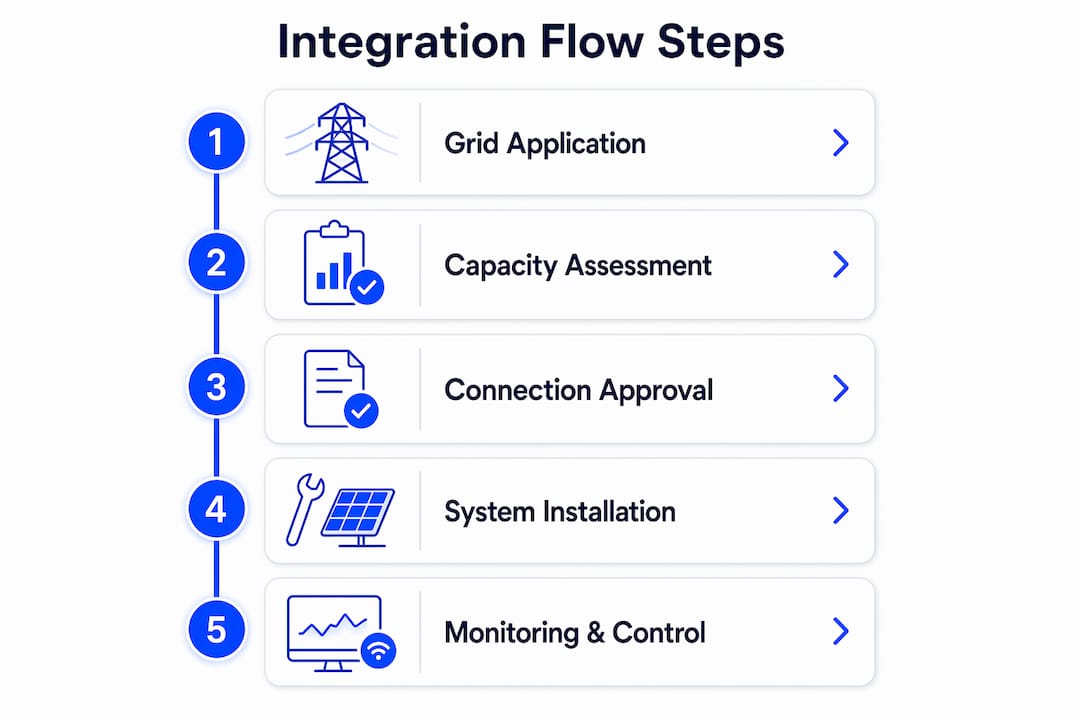
The single biggest cause of project delay is treating the grid connection application as an afterthought. Submit your grid connection application on the same day you sign the installation contract. Grid connection is typically the longest phase of any renewable project, and it runs independently of building permits, so starting it early is the highest-leverage action available.
Regional timelines you need to know
Connection timelines vary dramatically by country and project type. In the Netherlands, residential notification processes take roughly 30 minutes for straightforward cases. In France, industrial feasibility studies typically run 4–6 months and can stretch to 8–12 months in congested zones. Understanding your regional baseline sets realistic expectations and lets you build contingency into project schedules.
Step-by-step process for residential and industrial projects
Conduct a site energy audit. Measure current consumption patterns, peak demand, and available roof or land area before specifying any equipment.
Apply for grid connection. Submit the application to your distribution system operator (DSO) on contract signing day, not after installation.
Obtain building and electrical permits. Run this process in parallel with the grid application, not sequentially.
Specify and procure equipment. Select inverters, storage, and metering hardware based on confirmed grid connection parameters.
Install and commission. Complete physical installation, then conduct protection relay testing and grid compliance verification.
Activate monitoring and EMS. Connect the Energy Management System and confirm real-time data flow before declaring the system operational.
Step | Residential | Industrial |
Grid application | Day 1, simple notification | Day 1, formal feasibility study |
Permit timeline | 2–8 weeks | 3–12 months |
Equipment lead time | 2–6 weeks | 8–20 weeks |
Commissioning | 1–2 days | 1–4 weeks |
EMS activation | Same day | Phased over 1–2 weeks |
Pro Tip: In congested grid zones, ask your DSO about Flexible Connection Agreements before assuming a standard connection is unavailable. FCAs allow earlier grid access by accepting curtailment during peak network strain periods, bypassing infrastructure upgrade queues that can run years long.
Regulatory bodies are also tightening rules around speculative grid reservations. Use-it-or-lose-it provisions and financial guarantees now require earlier proof of project maturity. This reduces capacity hoarding by speculative developers and improves queue fairness for projects that are genuinely ready to build.
What technical challenges affect renewable energy integration flow and how to mitigate them?
Power quality problems are the hidden cost of high renewable penetration. Dense PV installations cause voltage spikes and harmonic distortion even when the grid has sufficient capacity on paper. Research from Poland in 2026 confirms that advanced inverter technology paired with local storage is the primary technical solution for these issues. The problem is not just about having enough megawatts. It is about delivering clean, stable power at the right voltage and frequency at every moment of the day.
Advanced inverter functions including reactive power control, voltage regulation, anti-islanding protection, and virtual inertia emulation are not optional features in high-density renewable grids. They are the minimum technical requirement for maintaining power quality and grid compliance. Pairing these inverter capabilities with local battery storage creates a buffer that absorbs generation spikes and fills demand troughs, reducing the stress placed on the wider network.
Technical mitigation strategies
Reactive power control. Inverters inject or absorb reactive power to hold voltage within statutory limits, preventing equipment damage and nuisance tripping.
Voltage regulation. Dynamic voltage support from inverters compensates for the rapid ramp rates of solar generation during cloud transients.
Anti-islanding protection. Inverters detect grid loss and disconnect within milliseconds, protecting line workers and preventing unsafe voltage islands.
Virtual inertia. Grid-forming inverters emulate the rotational inertia of synchronous generators, supporting frequency stability as conventional plant exits the system.
Local battery storage. A grid-connected battery absorbs excess generation during midday peaks and discharges during evening demand ramps, reducing the curtailment risk that comes with Flexible Connection Agreements.
Harmonic filtering. Active filters built into advanced inverters suppress harmonic distortion caused by high switching frequencies in dense PV arrays.
Pro Tip: When specifying storage for power quality purposes, prioritize round-trip efficiency and response time over raw capacity. The Belinus Energy Wall G1, with its 16 kWh graphene supercapacitor architecture, delivers sub-second response times that LFP-only systems cannot match for transient voltage events.
How can grid flexibility and consumer participation improve renewable integration flow?
Consumer participation is the underused lever in energy flow optimization. Demand-side flexibility in Central and Eastern Europe is held back by delayed legislation, limited smart meter rollout, and regulated pricing that prevents real-time response. The technical infrastructure to enable flexibility often exists. The regulatory and commercial frameworks to activate it frequently do not. That gap represents both a risk and an opportunity for energy professionals who can navigate it.
Smart meters are the foundation of consumer-driven flexibility. Without real-time consumption data, neither dynamic pricing nor automated demand response is possible. Where smart meters are deployed, active grid management through VPPs and DSF programs has demonstrated measurable reductions in peak demand and curtailment events.
Practical flexibility mechanisms that work today include:
Dynamic tariffs. Time-of-use and real-time pricing signals shift flexible loads (EV charging, heat pumps, industrial processes) away from peak periods.
Automated demand response. EMS platforms like the Belinus centralized EMS use 15-minute tariff optimization to dispatch storage and shift loads without manual intervention.
Virtual Power Plant aggregation. Distributed assets are pooled and offered to grid operators as a dispatchable resource, generating revenue while supporting grid stability.
Peer-to-peer energy trading. Where regulations permit, prosumers trade surplus generation directly with neighbors, reducing transmission losses and improving local energy flow.
For a deeper look at how grid flexibility programs translate into measurable cost savings, the Belinus resource library covers both residential and commercial applications with worked examples. Energy professionals working across European markets will also find the regulatory requirements guide for 2026 from Nefino useful for tracking country-specific flexibility legislation.
Key Takeaways
Effective renewable energy integration flow requires coordinating grid capacity, advanced inverter functions, local storage, and demand-side flexibility from the earliest stage of project planning.
Point | Details |
Apply for grid connection early | Submit your DSO application on contract signing day to avoid months of avoidable delay. |
Use FCAs in congested zones | Flexible Connection Agreements provide grid access faster than waiting for infrastructure upgrades. |
Pair inverters with storage | Advanced inverter functions combined with local batteries resolve power quality issues in high-density PV grids. |
Activate demand-side flexibility | Dynamic tariffs and EMS automation shift loads and reduce curtailment without manual intervention. |
Know your regional timeline | Connection timelines range from 30 minutes in the Netherlands to 12 months in congested French industrial zones. |
What I’ve learned about integration flow that most guides skip
Most articles on renewable integration focus on technology specs. The real bottleneck is almost always process, not hardware. I’ve seen projects with perfectly specified inverters and storage systems sit idle for 14 months because the grid connection application went in three weeks after the installation contract instead of on the same day. That is a recoverable mistake, but it is an expensive one.
The second thing most guides miss is the regulatory layer. The shift toward use-it-or-lose-it provisions and financial guarantees is not bureaucratic friction. It is a signal that grid operators are getting serious about queue management. Projects that demonstrate maturity early, with site control, permits in progress, and financial backing confirmed, will move to the front of connection queues as these rules tighten. Projects that treat the grid application as a formality will find themselves behind speculative reservations that regulators are now actively clearing.
The third insight is about systems thinking. Voltage regulation, demand flexibility, and storage dispatch are not separate engineering problems. They are one problem viewed from three angles. The energy professionals who get integration right are the ones who design the EMS, the inverter settings, and the flexibility contracts as a single system from day one, not as sequential afterthoughts. Digitalization makes this possible in ways that were not practical five years ago. The tools exist. The question is whether your project plan reflects that.
— Marc
Belinus supports your renewable energy integration goals
Managing renewable energy integration across residential and industrial projects requires tools that work in real time, not just at commissioning. Belinus builds solar PV, battery storage, and EV charging solutions around a centralized Energy Management System that handles 15-minute dynamic tariff optimization, battery arbitrage, and grid services dispatch from a single platform.

The Belinus EMS connects via RESTful API to third-party systems, supports LFP, pre-lithiated LFP, graphene supercapacitor, and HUC battery technologies, and gives energy professionals a native mobile app and web dashboard for real-time visibility. For projects from small commercial installations to utility-scale deployments, Belinus energy solutions provide the technical architecture to turn integration flow from a planning challenge into a managed, revenue-generating asset.
FAQ
What is renewable energy integration flow?
Renewable energy integration flow is the process of incorporating variable generation sources like solar and wind into a power grid while maintaining stable voltage, frequency, and power quality. It covers the technical, regulatory, and operational steps from grid connection application through live system dispatch.
How long does a grid connection take in Europe?
Connection timelines vary by country and project type. Residential connections in the Netherlands can take as little as 30 minutes, while industrial feasibility studies in France typically run 4–6 months and up to 12 months in congested zones.
What is a Flexible Connection Agreement?
A Flexible Connection Agreement allows a project to connect to a congested grid faster by accepting potential power curtailment during periods of network strain, bypassing the queue for full infrastructure upgrades.
Why do high-density PV installations cause power quality problems?
Dense PV arrays generate voltage spikes and harmonic distortion during rapid output changes, even when the grid has adequate capacity. Advanced inverters with reactive power control and local battery storage are the standard technical solution for these issues.
How does demand-side flexibility improve integration flow?
Demand-side flexibility shifts controllable loads away from peak generation periods, reducing curtailment and grid stress. Smart meters and dynamic pricing are the enabling infrastructure, though uptake in Central and Eastern Europe remains limited by regulatory gaps and slow smart meter deployment.
Recommended
Comments