Renewable Energy Investment Process: 2026 Guide for Investors
- a few seconds ago
- 8 min read

TL;DR:
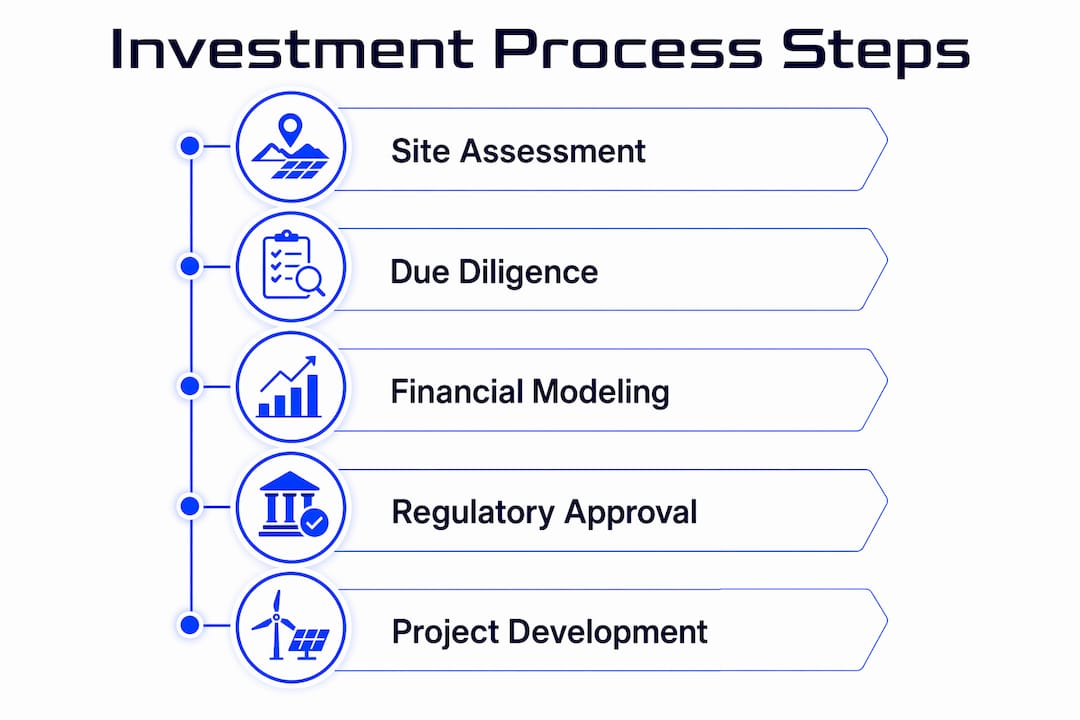
The renewable energy investment process in Europe involves thorough site assessment, legal due diligence, and financial modeling to secure funding.
Discipline and project readiness, including high project maturity levels, are crucial for faster development and better financing terms.
The renewable energy investment process is a structured approach that integrates technical site assessment, regulatory compliance, and financial modeling to secure successful project funding in Europe. European climate investments reached €534 billion in 2025, growing 2.4% from 2024. Yet renewable energy investments specifically declined 9% due to permitting delays and infrastructure constraints. That gap between total climate capital and actual renewable deployment tells investors exactly where the friction points are. Closing that gap requires a disciplined, step-by-step approach to project evaluation, legal compliance, and financial structuring under the EU’s evolving regulatory framework, including the Net-Zero Industry Act and updated auction criteria taking effect in 2026.
What does the renewable energy investment process require upfront?
The first step in any green energy investment is a thorough prerequisites assessment before a single euro of capital is committed. Skipping this phase is the single most common reason projects stall at permitting or fail to attract institutional financing. Investors who complete a structured pre-assessment reduce costly redesigns later and enter financial modeling with reliable inputs.
The core prerequisites fall into three categories:
Regulatory mapping: Identify applicable EU directives, national grid codes, and local zoning rules. Each member state interprets EU frameworks differently, so national-level legal counsel is not optional.
Site analysis: Use GIS and AI-powered platforms to evaluate wind or solar irradiance data, proximity to grid connection points, and land use restrictions. GIS and AI-powered tools reduce site analysis time by up to 40%, enabling parallel evaluation of multiple candidate sites.
Legal due diligence: Confirm land ownership, secure lease agreements covering at least 20 years, and verify environmental impact assessment requirements. Project maturity criteria now require proof of legal land rights and technical readiness as conditions for financing and grid capacity allocation.
A practical site assessment for the Benelux market, for example, must account for both national grid operator requirements and cross-border interconnection rules. Belinus offers site assessment guidance tailored to these regional specifics.
Pro Tip: Run your GIS site screening and legal due diligence in parallel, not sequentially. Discovering a land rights conflict after completing technical analysis costs weeks and significant fees.

How to conduct financial and risk analysis for renewable energy projects
Sound financial analysis is the backbone of any bankable renewable investment. The industry standard for lifecycle valuation is VALERI, defined under DIN EN 17463. VALERI provides a standardized lifecycle financial assessment covering CAPEX, OPEX, revenue streams, and residual asset values. Lenders and institutional investors treat VALERI-compliant models as a baseline requirement, not a differentiator.
Core financial metrics every investor must model
CAPEX and OPEX: Total capital expenditure and annual operating costs, including grid connection fees and insurance.
WACC: Weighted average cost of capital, which sets the discount rate for net present value calculations.
LCOE: Levelized cost of energy, expressed in €/MWh, used to compare project economics across technologies.
ROI and payback period: Gross and risk-adjusted returns over the project’s operational life, typically 20–25 years.
Revenue modeling requires scenario analysis across three market structures. Feed-in tariffs under national EEG-equivalent schemes provide fixed revenue but are being phased down. Contracts for Difference and corporate PPAs provide revenue certainty needed by institutional investors to de-risk renewable projects. Spot market exposure offers upside but demands active energy management and hedging strategies.
Market volatility, regulatory risks, and technical uncertainties must be modeled with scenario analyses and risk premiums to produce decisions that hold under stress. A base case, a downside case with 15% lower energy yield, and an upside case with higher spot prices give lenders the confidence range they need. Sensitivity analysis on WACC and LCOE is equally critical, since a 1-percentage-point shift in the discount rate can change a project’s net present value by millions of euros.
Pro Tip: Build your financial model so that the downside scenario still clears your lender’s debt service coverage ratio. If it doesn’t, restructure the capital stack before approaching banks, not after.
What are the current regulatory and auction frameworks in Europe?
Europe’s auction framework for renewable energy changed materially in 2026. The Net-Zero Industry Act now requires that qualitative, non-price criteria account for a minimum of 30% of auction scoring, or apply when a member state reaches 6 GW of installed capacity in a technology category. Auction criteria now include sustainability, resilience, and cybersecurity as scored dimensions alongside price.
The sustainability criterion alone contains multiple subcriteria: CO2 footprint of equipment, circular economy practices, biodiversity impact, energy efficiency, and pollutant reduction. These detailed sustainability criteria reflect the EU’s intent to diversify supply chains and reduce dependence on single-source manufacturing. Investors who source equipment without checking these criteria risk losing auction points to competitors with better-documented supply chains.
The regulatory transition also affects revenue structures. The shift from fixed feed-in tariffs to Contracts for Difference marks a fundamental change in how projects generate returns:
Fixed feed-in tariffs: Guaranteed price per MWh, set by government, declining in availability across most EU member states.
Contracts for Difference: Two-way price stabilization mechanism where the project receives a strike price and returns excess revenue above it to the government. CfDs provide bankable revenue certainty without the full market exposure of spot trading.
Corporate PPAs: Long-term bilateral contracts with industrial or commercial buyers, increasingly preferred by institutional investors for their credit quality and tenor.
Spot market participation: Direct exposure to wholesale electricity prices, viable only for projects with active energy management systems and battery storage integration.
The maturity assessment framework, known in German regulatory practice as the Reifegradverfahren, grades projects on legal, technical, and financial readiness. Higher maturity scores translate directly into priority grid access and stronger financing terms. Investors who treat maturity assessment as a compliance checkbox rather than a financing tool leave real capital on the table.
What are best practices to accelerate renewable project development?
Execution speed matters in a market where grid connection queues stretch years and auction windows close on fixed dates. The most effective way to accelerate project development is to front-load risk identification rather than discover problems during permitting.
Integrate GIS and AI platforms from day one. Automated screening of wind, solar, grid, and legal data in a single platform eliminates the handoff delays between technical and legal teams.
Prioritize projects with higher maturity scores. Securing project maturity is the primary factor in financing success and is increasingly enforced through national and EU-level frameworks. A project at maturity level 4 or above attracts better debt terms and faster lender approval.
Monitor subsidy and regulatory changes continuously. Auction rules, grid tariffs, and national incentive programs change annually. Investors who track these changes in real time avoid being caught with financial models built on outdated assumptions. The solar incentives landscape in Central Europe shifts frequently enough to warrant quarterly model updates.
Coordinate stakeholder engagement early. Local authority approvals, community consultations, and environmental agency reviews run in parallel with technical design. Starting these processes late is the primary driver of the permitting delays that cause up to 40% of project timeline setbacks.
Secure grid connection applications before finalizing site selection. Grid operators in most EU member states operate on a first-come, first-served basis for connection capacity. Filing a grid application early, even provisionally, protects your position in the queue.
Pro Tip: Request a pre-application meeting with the relevant grid operator before submitting your formal connection request. Grid operators often flag technical conflicts at this stage that would otherwise delay your application by six months or more.
For investors assessing energy return on investment across multiple European markets, integrating these practices into a repeatable project development protocol is what separates developers who close deals from those who accumulate stranded development costs.
Key Takeaways
The renewable energy investment process in Europe requires disciplined sequencing of site assessment, financial modeling, regulatory compliance, and maturity development to produce bankable, auction-ready projects.
Point | Details |
Front-load due diligence | Complete GIS site screening and legal due diligence in parallel before financial modeling begins. |
Use VALERI for financial models | DIN EN 17463 lifecycle valuation is the baseline standard lenders and institutional investors require. |
Understand 2026 auction rules | Qualitative criteria now account for at least 30% of EU auction scoring under the Net-Zero Industry Act. |
Prioritize project maturity | Higher maturity scores unlock priority grid access and better debt financing terms. |
Model revenue across three scenarios | CfDs, corporate PPAs, and spot market exposure each carry different risk and return profiles. |
Why discipline beats speed in European renewable investing
The market narrative for the past decade told developers to move fast, acquire sites aggressively, and figure out the economics later. That approach worked when capital was cheap and auction prices were rising. Investors now face tightening conditions with declining auction prices and rising equity return expectations, which demands a fundamentally different posture.
What I’ve seen consistently is that the developers who close the most deals are not the ones with the largest site portfolios. They are the ones with the fewest projects at low maturity. A pipeline of 50 sites at maturity level 2 is worth less than 10 sites at maturity level 4, because lenders and auction committees both reward readiness over volume.
The tightening of financing conditions is not a temporary cycle. Rising cost of capital and more complex regulatory requirements reflect a structural shift. The market requires a transition from aggressive growth to disciplined, strategy-led development. Investors who internalize that shift early will capture the best projects. Those who don’t will spend their development budgets on sites that never reach financial close.
The practical implication is straightforward: adopt a maturity-gated development process where no project advances to the next stage without meeting defined legal, technical, and financial thresholds. It feels slower at first. It is faster in practice, because you stop spending money on projects that were never going to close.
— Marc
How Belinus supports your renewable investment decisions
Investors who want to move from site identification to financial close faster need tools that integrate technical, legal, and financial data in one place.
Belinus brings together solar PV, battery storage, and energy management capabilities that align directly with the investment criteria covered in this guide. The Belinus Energy Management System operates on 15-minute dynamic tariff optimization, which is the kind of real-time performance data that supports both CfD compliance and spot market participation. For commercial and utility-scale projects, Belinus utility storage modules scale from 400+ kWh to MW capacity, fitting the technical specifications that institutional lenders require in bankable project documentation. Explore the full range of renewable energy options for business or visit Belinus directly to discuss your project requirements.
FAQ
What is the renewable energy investment process?
The renewable energy investment process is a structured sequence of site assessment, legal due diligence, financial modeling, regulatory compliance, and project maturity development that leads to funded and operational energy projects.
What financial metrics matter most for renewable project financing?
Lenders and institutional investors focus on LCOE, WACC, CAPEX, OPEX, and debt service coverage ratios modeled under VALERI (DIN EN 17463) lifecycle valuation standards.
How do EU auction rules affect renewable investment in 2026?
Starting in 2026, the Net-Zero Industry Act requires qualitative criteria including sustainability, resilience, and cybersecurity to account for at least 30% of auction scoring, changing how projects compete for contracts.
What is a Contract for Difference in renewable energy?
A Contract for Difference is a two-way price stabilization mechanism where a project receives a guaranteed strike price per MWh and returns revenue above that price to the government, providing bankable revenue certainty for lenders.
Why do permitting delays affect so many renewable projects?
Permitting delays cause up to 40% of project timeline setbacks because legal, environmental, and grid connection approvals run on separate tracks that are rarely coordinated from the project’s earliest stages.
Recommended