Solar Energy Management – Why It Matters for Central Europe
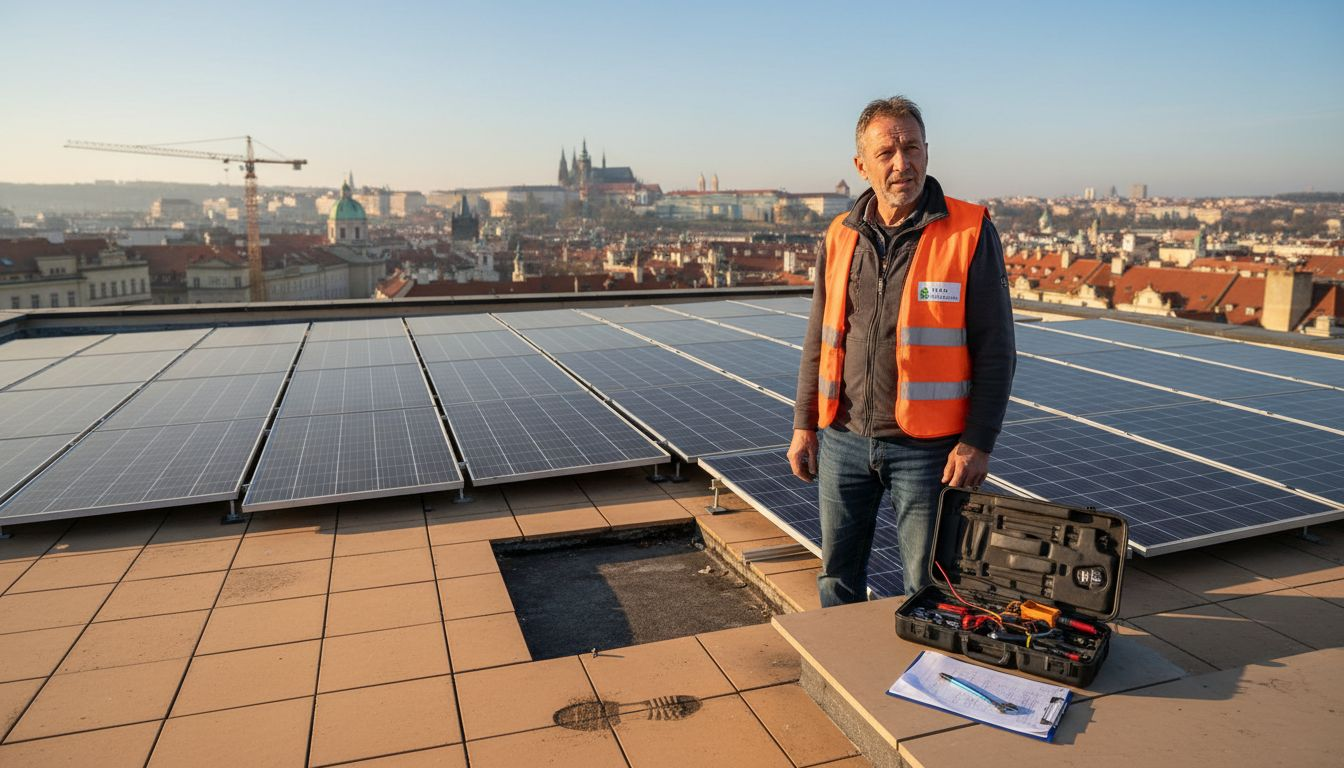
Solar panels on residential and commercial buildings across Central Europe are now delivering savings that rival american solar investments. With rapid advances in solar energy management systems, owners can achieve intelligent control over power generation, storage, and even EV charging. Smart solar monitoring increases energy efficiency by up to 30 percent, transforming how properties handle rising costs. Discover the essential components of modern solutions and see how integrated technology leads to practical benefits for homes and businesses alike.
Table of Contents
Key Takeaways
Point | Details |
Solar Energy Management Systems Optimize Performance | SEMS enables real-time monitoring and efficient energy utilization across residential and commercial settings. |
Important Differences Between Residential and Commercial Systems | Residential systems focus on maximizing self-consumption, while commercial systems cater to larger energy demands and infrastructure. |
Comprehensive Regulations Coming in 2026 | New EU regulations mandate solar installations in public and commercial buildings, impacting future energy infrastructure. |
Financial Benefits of Solar Investments | Maximizing self-consumption and utilizing dynamic pricing can significantly reduce energy costs and enhance overall savings. |
Defining Solar Energy Management Systems
A Solar Energy Management System (SEMS) represents a sophisticated technological framework designed to optimize solar power generation, storage, and distribution across residential and commercial settings. These intelligent systems enable real-time monitoring, control, and efficient energy utilization through advanced digital technologies. Comprehensive IoT-enabled solar monitoring technologies now allow property owners to track performance metrics like current, voltage, power output, and panel temperature with unprecedented precision.
At its core, a solar energy management system integrates multiple components including photovoltaic panels, inverters, battery storage units, and smart control software. These interconnected technologies work seamlessly to maximize energy efficiency, reduce grid dependency, and provide granular control over electricity generation and consumption. Solar technologies in EU research demonstrate how these systems can support both on-grid and off-grid applications, making them versatile solutions for diverse energy needs.
Key features of modern solar energy management systems typically include:
Real-time performance monitoring
Automated load balancing
Grid interaction and power trading capabilities
Predictive maintenance algorithms
Mobile and web-based control interfaces
Advanced energy storage optimization
Pro tip: Invest in a solar management system with comprehensive mobile app integration to track your energy production and consumption in real-time, maximizing your system’s efficiency and potential cost savings.
Residential And Commercial Variations Explained
Solar energy management systems exhibit critical differences between residential and commercial applications, reflecting distinct energy consumption patterns and operational requirements. Rooftop solar PV system comparisons reveal nuanced variations in deployment strategies that fundamentally shape how these technologies are implemented across different sectors.
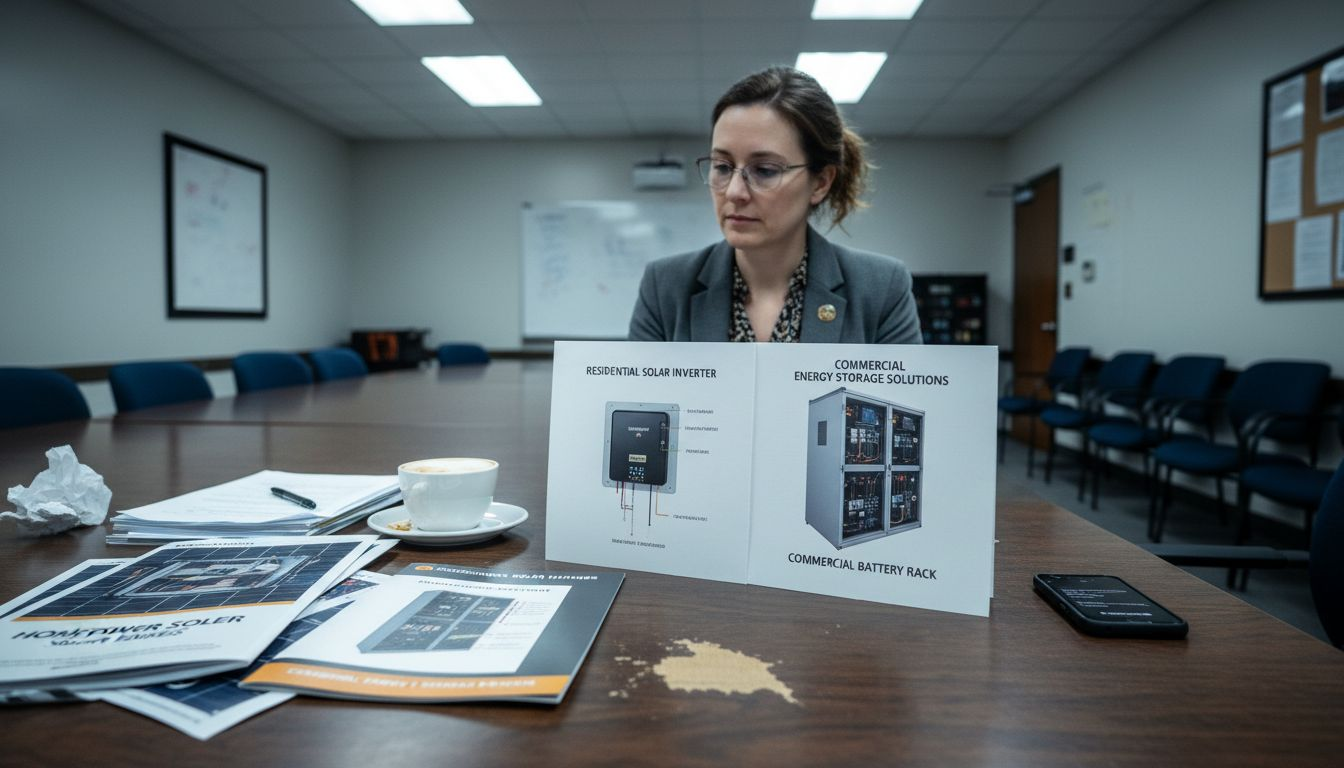
In residential settings, solar energy management typically focuses on household energy optimization, with systems designed to maximize self-consumption and reduce individual electricity costs. These systems are usually smaller in scale, ranging from 3-10 kilowatts, and prioritize direct energy usage and potential grid feed-in. Commercial installations, by contrast, represent more complex ecosystems with larger energy infrastructure requirements. EU solar market dynamics demonstrate that commercial solar setups often exceed 50 kilowatts and integrate advanced energy management strategies.
Key distinctions between residential and commercial solar energy management systems include:
Scale of installation
Energy consumption patterns
Financial investment requirements
Regulatory compliance frameworks
Grid interaction complexity
Technological integration levels
Pro tip: Consult with a professional energy systems integrator to design a solar management solution tailored to your specific residential or commercial energy consumption profile and infrastructure requirements.
Here’s a side-by-side comparison highlighting the differences between residential and commercial solar energy management systems:
Aspect | Residential Systems | Commercial Systems |
Typical System Size | 3-10 kW | Over 50 kW |
Energy Usage Goals | Maximize self-consumption | Support larger infrastructure |
Financial Focus | Reduce household costs | Decrease overhead expenses |
Regulatory Requirements | Fewer permits, simpler codes | Complex, stricter compliance |
Technology Integration Level | Basic smart features | Advanced automation |
Grid Interaction | Simple feed-in arrangements | Power trading capabilities |
Core Technologies And How They Work
Solar energy management systems integrate multiple sophisticated technologies to transform sunlight into usable electricity and optimize energy distribution. Advanced renewable energy control systems involve intricate interactions between photovoltaic panels, inverters, battery storage units, and intelligent software platforms that coordinate energy generation, storage, and consumption in real-time.
The core technological components include photovoltaic (PV) panels that convert solar radiation into electrical current, inverters that transform direct current into alternating current compatible with household and grid requirements, and battery storage systems that enable energy preservation for periods of low sunlight. Concentrated Solar Power technologies demonstrate additional innovative approaches, using sophisticated mirror configurations to focus solar radiation and generate thermal energy for electricity production.
Key technological elements in solar energy management systems comprise:
Photovoltaic panel arrays
Smart inverter technologies
Battery storage systems
Energy management software
Grid connection interfaces
Monitoring and control platforms
Predictive maintenance algorithms
Pro tip: Prioritize systems with modular design and open API capabilities to ensure future technological upgrades and seamless integration with emerging renewable energy innovations.
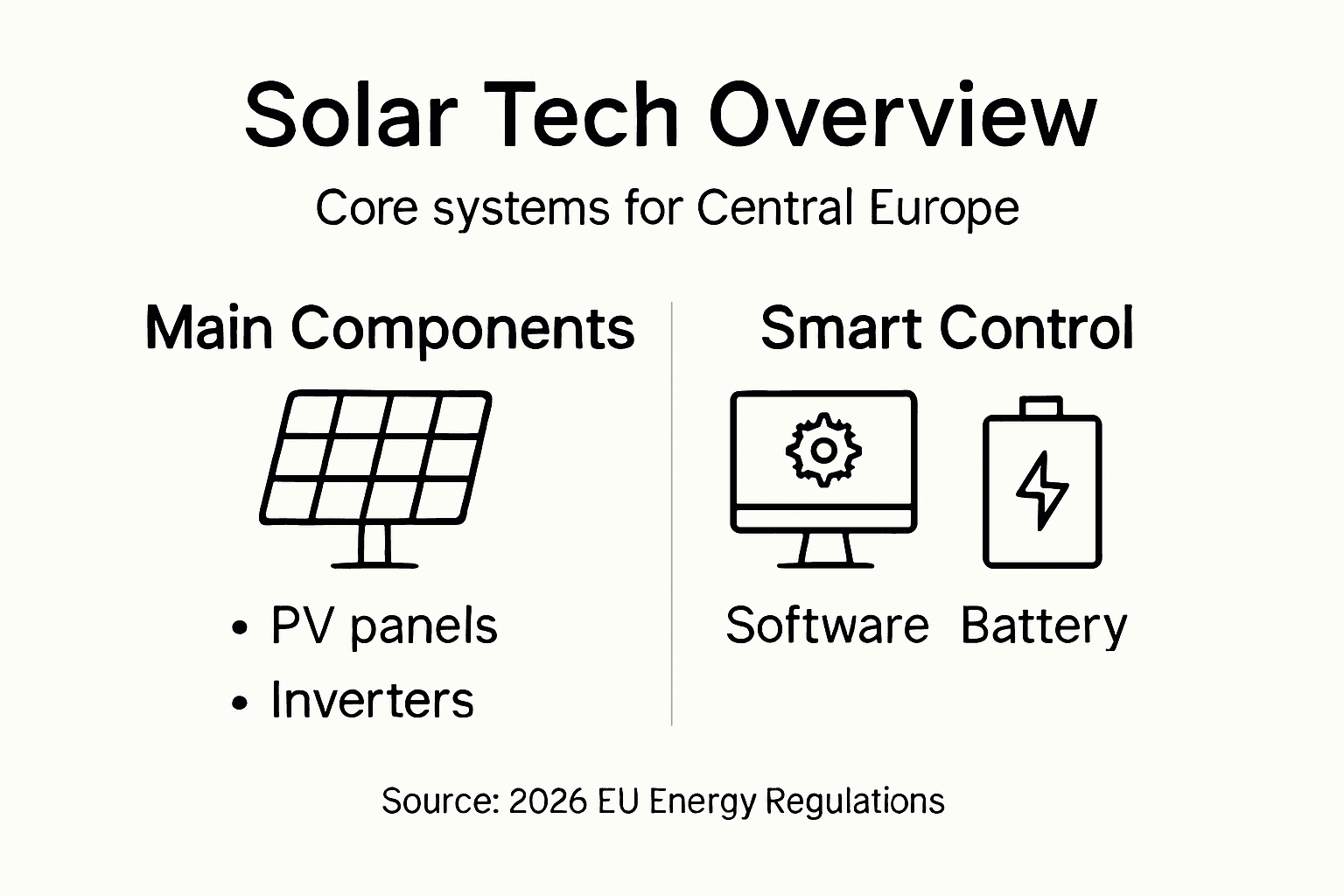
The following table outlines major business impacts of implementing core technologies in solar energy management systems:
Technology Component | Primary Function | Business Impact |
PV Panels | Convert sunlight to electricity | Enable renewable energy supply |
Smart Inverters | Manage energy conversion | Improve power quality and safety |
Battery Storage | Preserve surplus energy | Reduce energy costs, backup power |
Energy Management SW | Optimize usage and monitoring | Enhance efficiency, spot issues |
Grid Connection | Link to external network | Access to dynamic pricing, trading |
2026 EU Regulations And Local Compliance
The European Union is implementing comprehensive solar energy regulations that will dramatically reshape building infrastructure and renewable energy deployment across member states. Energy Performance of Buildings Directive mandates significant changes for new and existing buildings, requiring strategic solar integration starting in 2026.
Specifically, the new regulations target different building categories with phased implementation strategies. Public and commercial buildings must install solar systems first, with residential structures following in subsequent years. EU Solar Standard requirements establish clear guidelines for solar panel installations, considering technical feasibility, economic constraints, and regional variations across European member states.
Key regulatory compliance considerations include:
Solar installation requirements for new buildings
Retrofit mandates for existing structures
Technical feasibility assessments
Economic impact evaluations
Regional implementation variations
Potential financial incentives
Exemption criteria for specific building types
Pro tip: Consult with local energy regulators and professional solar integrators to understand specific compliance requirements for your specific building type and geographic location.
Financial Benefits And Cost Optimization
Solar energy investments in Central Europe represent a strategic financial opportunity, offering substantial economic advantages beyond traditional electricity generation. EU solar market insights demonstrate compelling cost reduction strategies that enable businesses and homeowners to dramatically lower energy expenses while protecting against future price volatility.
The financial optimization of solar energy systems involves multiple revenue streams and cost-saving mechanisms. Property owners can benefit from direct electricity bill reductions, potential feed-in tariff income, and increased property values. Advanced energy management technologies enable sophisticated consumption monitoring, allowing users to maximize self-consumption, sell excess energy back to the grid, and implement dynamic pricing strategies that minimize overall energy expenditures.
Key financial optimization strategies include:
Maximizing energy self-consumption
Implementing smart grid integration
Utilizing dynamic electricity pricing models
Leveraging government incentive programs
Reducing peak demand charges
Implementing predictive energy consumption analytics
Exploring energy trading opportunities
Commercial solar benefits become increasingly attractive as technology costs decline and regulatory support expands across Central European markets.
Pro tip: Conduct a comprehensive energy audit and financial modeling to identify the most cost-effective solar energy management approach tailored to your specific residential or commercial energy consumption profile.
Common Pitfalls And How To Avoid Them
Solar energy management systems present numerous potential challenges that can significantly impact their performance and long-term financial viability. Homeowners and businesses in Central Europe must carefully navigate technical, financial, and operational complexities to ensure optimal system effectiveness and return on investment.
Common pitfalls in solar energy management include inadequate system sizing, poor component selection, and insufficient maintenance planning. Investors frequently underestimate the importance of comprehensive site assessments, which can lead to suboptimal panel placement, reduced energy generation, and diminished system efficiency. Technical miscalculations such as incorrect inverter specifications or battery storage capacity can dramatically reduce the overall system performance and potential energy savings.
Critical pitfalls to avoid include:
Underestimating energy consumption patterns
Neglecting regular system maintenance
Choosing incompatible system components
Failing to account for seasonal performance variations
Overlooking grid connection requirements
Ignoring potential shading and installation constraints
Miscalculating long-term financial projections
Pro tip: Engage a professional solar energy consultant to perform a comprehensive site assessment and system design review before making any significant investment decisions.
Unlock the Full Potential of Solar Energy Management for Central Europe
The challenges described in the article make it clear that optimizing solar energy generation and storage while ensuring regulatory compliance and financial efficiency is critical for both residential and commercial users in Central Europe. From real-time monitoring to sophisticated energy management software, your goal is to maximize self-consumption, reduce costs, and navigate upcoming 2026 EU solar regulations effectively. Belinus offers a comprehensive solution that integrates cutting-edge photovoltaic technology, advanced battery storage, and intelligent Energy Management Systems designed to meet these exact needs.
Explore how our residential solutions featuring the Energy Wall G1 graphene supercapacitor and Solis inverters can help you precisely manage your home’s energy. For businesses, our scalable utility storage and grid-integrated services enable seamless energy trading and cost optimization. Act now to safeguard your investment and stay ahead of evolving regulations with Belinus’ real-time management platform. Visit Belinus Energy Solutions today to design your tailored solar energy management system and turn challenges into business advantages.
Frequently Asked Questions
What is a Solar Energy Management System (SEMS)?
A Solar Energy Management System (SEMS) is a technological framework designed to optimize solar power generation, storage, and distribution, allowing real-time monitoring and control for efficient energy usage in residential and commercial settings.
How do residential and commercial solar energy management systems differ?
Residential systems typically focus on maximizing self-consumption and reducing household electricity costs, while commercial systems are larger and more complex, designed to support larger energy infrastructure and improve operational efficiency.
What core technologies are involved in solar energy management systems?
Core technologies include photovoltaic (PV) panels, inverters, battery storage systems, energy management software, and monitoring platforms that work together to optimize energy generation, storage, and distribution.
What financial benefits can I expect from investing in a solar energy management system?
Financial benefits can include significant reductions in electricity bills, potential income from feed-in tariffs, increased property values, and cost savings through optimized energy management and possible government incentive programs.
Recommended
Comments