Master the Solar Financing Process for Homeowners

Managing rising electricity bills while planning for future energy needs is a common challenge facing households in Central Europe today. With strong growth in the European solar rooftop segment and increasing support from the European Union for renewable energy investments, homeowners have more choices than ever to tailor their solar systems with battery storage and EV charging. This guide walks through practical steps to evaluate your energy requirements, understand current financing options, and select the best solutions for a resilient and efficient home energy setup.
Table of Contents
Quick Summary
Key Point | Explanation |
1. Conduct a Detailed Energy Audit | Analyze your electricity usage patterns to accurately size your solar system for optimal performance. |
2. Explore Diverse Financing Options | Review various financing mechanisms, including loans and grants, to determine the best fit for your budget. |
3. Compare Solar Products Thoroughly | Evaluate solar panels and batteries based on efficiency, cost, and warranty to ensure long-term value. |
4. Prepare Comprehensive Documentation | Gather all required materials and proposals to streamline the financing application process. |
5. Verify System Compliance and Functionality | Ensure your solar system meets regulatory requirements and performs optimally through thorough testing. |
Step 1: Evaluate Your Energy and Financing Needs
Successfully navigating solar financing starts with a comprehensive evaluation of your home’s energy requirements and financial landscape. Understanding your specific energy consumption patterns and potential investment strategies is crucial for making informed decisions about solar installations.
Begin by conducting a detailed energy audit to assess your current electricity usage. Review your past 12 months of utility bills to determine your average monthly consumption. Pay special attention to seasonal variations and peak usage periods. This analysis helps you accurately size a solar system that matches your household’s specific needs.
Next, explore the financing mechanisms available for solar investments. The European Union offers several renewable energy financing mechanisms that can support homeowners transitioning to solar power. These include:
Public-private investment programs
Recovery and Resilience Facility grants
Energy efficiency financing initiatives
Regional sustainable energy project funds
Carefully compare different financing options, including solar loans, home equity lines of credit, leasing arrangements, and potential government incentives. Consider factors like interest rates, loan terms, upfront costs, and long-term savings potential.
Understand that your ideal solar financing strategy depends on your unique financial situation, energy consumption, and local regulatory environment.
Research local and national solar incentives specific to your region. Many European countries offer tax credits, grants, and rebates that can significantly reduce your initial investment. The solar market in Central Europe is experiencing robust growth, with increasing support for residential solar installations.
Here is a comparison of popular solar financing options and their key characteristics:
Financing Option | Typical Upfront Cost | Ownership Structure | Main Long-Term Advantage |
Solar Loan | Moderate | Homeowner | Maximizes return on investment |
Solar Lease | Low to None | Third-party | Fixed monthly payments |
Home Equity Line of Credit | Varies | Homeowner | Potential tax-deductible interest |
Government Grant | Low to None | Homeowner | Reduces initial project expense |
Public-Private Partnership | Moderate | Shared or homeowner | Access to additional funding streams |
Pro tip: Request multiple solar quotes from certified installers and compare their financial modeling to ensure you receive the most comprehensive and cost-effective solution for your home energy needs.
Step 2: Research Solar Financing Solutions
Building upon your energy assessment, the next critical phase involves thoroughly investigating solar financing solutions that align with your specific financial situation and energy goals. A comprehensive research approach will help you navigate the complex landscape of solar investment options.
Begin by exploring the renewable energy financing mechanisms available through European Union programs. These initiatives provide structured pathways for homeowners to access funding for solar installations. Key financing models to investigate include:
Feed-in tariffs
Investment grants
Contracts for difference
Competitive tender programs
Public-private partnership options
Carefully analyze the support schemes specific to your region. Different European countries offer varying levels of financial incentives, tax credits, and regulatory support for residential solar projects. The Status Review of Renewable Support Schemes reveals a diverse range of mechanisms designed to encourage solar adoption.
Understanding local financing options is crucial for maximizing your solar investment and minimizing upfront costs.
Contact local solar installers, financial advisors, and regional energy offices to gather detailed information about available financing programs. Pay close attention to:
Interest rates for solar loans
Duration of financing terms
Potential government rebates
Tax incentive structures
Performance-based incentive programs
Compare multiple quotes and financing models to identify the most cost-effective solution for your specific energy needs. Consider both short-term expenses and long-term savings potential when evaluating different financing approaches.

Pro tip: Request comprehensive financial modeling from at least three different solar installers to ensure you receive a comprehensive understanding of potential investment returns and financing options.
Step 3: Select Preferred Solar and Battery Products
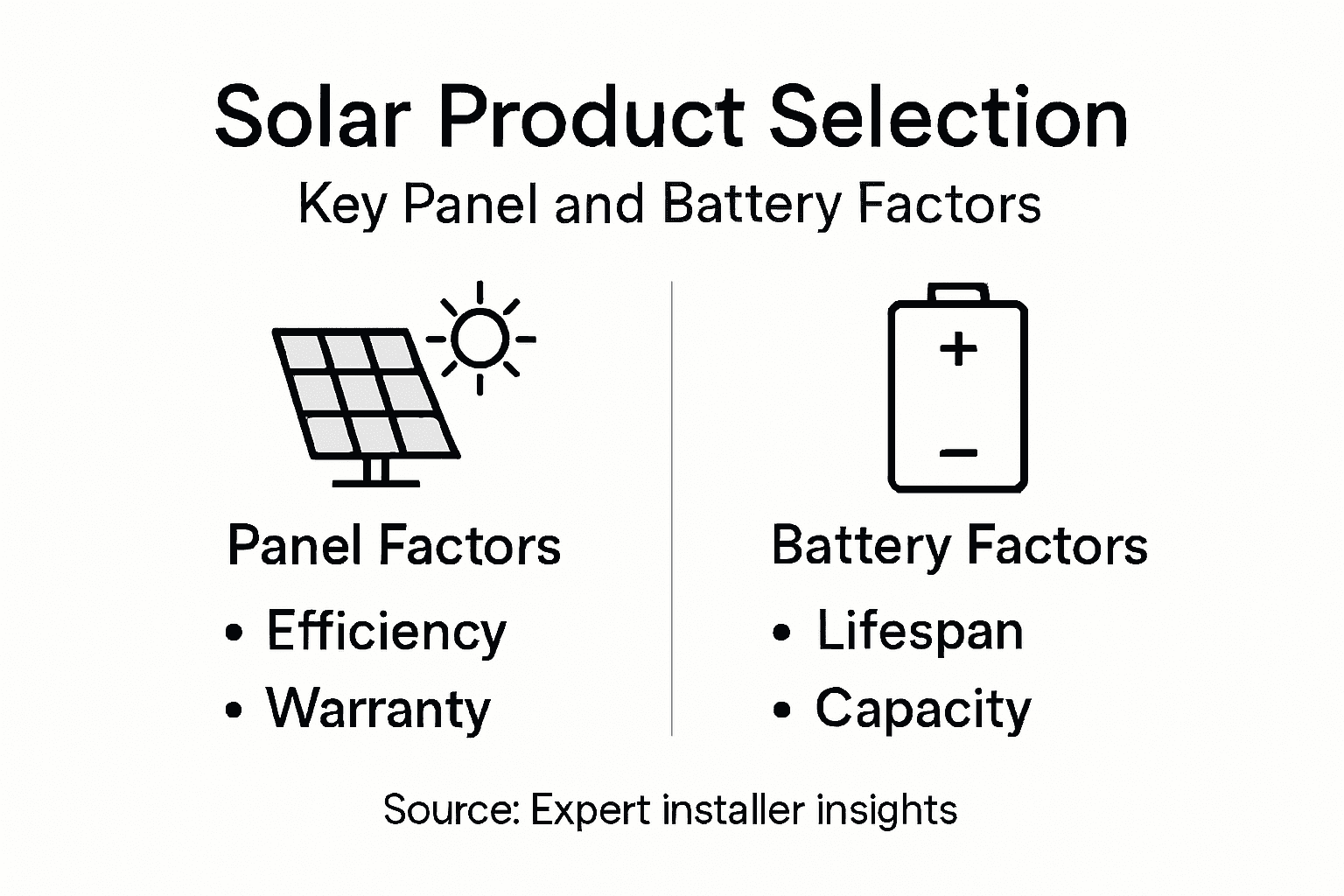
Selecting the right solar panels and battery storage system is a critical decision that will impact your home energy performance for decades. Your goal is to choose products that maximize efficiency, reliability, and long-term value while meeting your specific energy consumption needs.
Start by evaluating solar panel options based on critical performance metrics. EU solar market trends highlight the importance of choosing panels with competitive pricing and high efficiency ratings. Key considerations include:
Solar panel efficiency percentage
Temperature coefficient performance
Manufacturer warranty terms
Material durability ratings
Certification and compliance standards
When selecting battery storage, prioritize systems that align with emerging European regulatory requirements. The EU Batteries Regulation establishes strict guidelines for residential energy storage solutions, emphasizing sustainability and performance standards.
Choosing solar and battery products is about balancing technical specifications, financial considerations, and long-term energy goals.
Consider these essential battery selection criteria:
Depth of discharge capabilities
Round-trip energy efficiency
Expected operational lifespan
Compatibility with existing solar infrastructure
Compliance with European safety regulations
Request detailed technical specifications and performance data from multiple manufacturers. Compare products across different dimensions, including:
Initial purchase cost
Estimated energy production
Maintenance requirements
Integration potential with smart home systems
Potential return on investment
Pro tip: Request independent performance certifications and conduct side-by-side comparisons of at least three different solar panel and battery storage configurations to ensure you select the most appropriate system for your specific energy needs.
This table summarizes essential technical factors to compare when selecting solar panels and batteries:
Selection Factor | Panels Matter Because | Batteries Matter Because |
Efficiency | Affects energy output | Influences usable stored energy |
Lifespan | Determines panel replacement need | Impacts replacement frequency |
Warranty Coverage | Provides manufacturer assurance | Reduces maintenance cost risk |
Regulatory Compliance | Ensures market eligibility | Meets safety and subsidy rules |
Step 4: Apply for Solar Financing and Approval
With your solar and battery products selected, the next critical phase involves navigating the solar financing application process. Understanding the intricacies of EU financing application procedures will help you successfully secure the necessary funding for your solar project.
Begin by gathering all required documentation. Essential paperwork typically includes:
Detailed project proposal
Technical specifications of solar equipment
Energy consumption historical data
Financial statements
Property ownership documents
Solar system design plans
Economic feasibility report
Carefully review the specific requirements of potential financing sources. Different lenders and government programs have unique application criteria and submission guidelines.
Your financing application’s success depends on presenting a clear, comprehensive, and professionally structured proposal.
Prepare for the application process by:
Checking your credit score
Calculating precise project costs
Estimating potential energy savings
Identifying multiple financing channels
Understanding tax incentive eligibility
Submit applications to multiple financing sources to increase your approval probability. Consider options such as:
Bank solar loans
Government green energy grants
Energy efficiency financing programs
Private solar investment funds
Regional sustainable energy initiatives
Pro tip: Create a comprehensive digital portfolio with all required documents scanned and organized, enabling quick and efficient submission across multiple financing platforms.
Step 5: Review and Confirm Financing Terms
With your solar financing application submitted, the critical next phase involves meticulously reviewing and confirming the proposed financing terms. Understanding the nuanced details of renewable energy support schemes will protect your financial interests and ensure a favorable solar investment.
Carefully examine the financing contract, paying close attention to these critical elements:
Interest rates and annual percentage rate (APR)
Loan term duration
Monthly payment structures
Prepayment penalty clauses
Early termination conditions
Performance-linked incentive provisions
Collateral or security requirements
Analyze the total cost of financing beyond the initial interest rate. This includes understanding potential fees, adjustment mechanisms, and long-term financial implications.
Your goal is to secure financing terms that balance affordable payments with maximum solar investment potential.
Key aspects to verify include:
Fixed versus variable interest rates
Potential tax credit implications
Renewable energy subsidy eligibility
Performance guarantee terms
Insurance and warranty coverage
Compare multiple financing proposals to identify the most advantageous terms. Consider not just the immediate financial impact, but also the long-term energy savings and investment returns.
Pro tip: Engage an independent financial advisor specialized in renewable energy investments to review your financing contract and provide an unbiased assessment of the proposed terms.
Step 6: Verify System Integration and Activation
After completing your solar financing, the final critical phase involves carefully verifying your solar system’s integration and activation. Grid-connected solar system procedures require meticulous attention to ensure seamless performance and regulatory compliance.
Begin the system activation process by coordinating with your certified solar installer to conduct comprehensive performance tests. Essential verification steps include:
Checking inverter connections
Validating electrical system compatibility
Confirming meter installation
Testing solar panel output
Verifying grid interconnection settings
Calibrating monitoring systems
Reviewing safety protection mechanisms
Ensure your solar system meets all local regulatory requirements by requesting official documentation of system compliance and grid connection approval.
Successful system activation depends on precise technical coordination and thorough performance verification.
Key aspects to verify during activation include:
Real-time energy production monitoring
Smart meter functionality
Grid synchronization capabilities
Emergency shutdown procedures
Data logging and reporting systems
Schedule a comprehensive system walkthrough with your installer, ensuring you understand all operational parameters and monitoring tools. Request detailed documentation about system performance expectations, maintenance requirements, and warranty coverage.
Pro tip: Photograph and document every stage of the system installation and activation process to maintain a comprehensive record for future reference and potential warranty claims.
Simplify Your Solar Financing Journey with Belinus
Navigating the complexities of solar financing can feel overwhelming. From evaluating your specific energy needs to selecting the right solar panels and battery storage, every step demands careful attention to detail and financial planning. Common challenges include understanding financing terms, managing application documents, and choosing products that deliver lasting value. Belinus understands these hurdles and offers integrated solutions designed to make your transition to solar energy seamless and financially smart.

Take control of your home energy future today by partnering with Belinus. Our advanced Energy Management System connects efficient solar PV, cutting-edge battery storage like the upcoming Energy Wall G1, and smart inverters, all tailored to optimize your savings and energy autonomy. Explore all our residential solutions and discover how our expertise can simplify financing approval and system activation. Don’t wait to turn your solar investment into measurable benefits. Visit Belinus to learn more and get started on your personalized solar path now.
Frequently Asked Questions
What are the first steps in evaluating my energy needs for solar financing?
Start by conducting a detailed energy audit of your household. Review your last 12 months of utility bills to determine your average monthly usage and identify any seasonal variations.
How can I compare different solar financing options effectively?
To effectively compare financing options, list each type (e.g., solar loans, leases, grants) with their key characteristics like upfront costs and potential savings. Analyze their interest rates and payback terms to make an informed choice that fits your financial situation.
What documentation do I need to apply for solar financing?
Gather essential documents such as your project proposal, technical specifications of the solar equipment, financial statements, and proof of property ownership. Ensure all paperwork is organized to streamline the application process.
How do I ensure that my solar system meets regulatory compliance?
Coordinate with your solar installer to verify that your system complies with local regulations during activation. Request written documentation confirming compliance to protect your investment and facilitate smooth installation.
What key factors should I consider when choosing solar panels and battery storage?
Evaluate solar panels based on efficiency, warranty coverage, and material durability. For batteries, focus on lifespan, depth of discharge capabilities, and compliance with safety regulations to ensure a reliable energy system.
How can I increase the chances of getting approved for solar financing?
Submit applications to multiple financing sources to increase your approval chances. Ensure your proposal is clear, comprehensive, and includes all required documents to provide lenders with confidence in your project.
Recommended
Comments