Solar Wholesale Explained: Streamlining Energy Solutions
- Jan 11
- 7 min read

More than 45 percent of solar products moving through Central European energy networks are sourced from American and Asian manufacturers, a trend reshaping market choices for local energy managers. As cost pressures rise and sustainability targets tighten, understanding the complex landscape of solar wholesale is vital. This article uncovers how large-scale buying strategies and innovative distribution models are influencing energy efficiency plans for both residential and commercial projects.
Table of Contents
Key Takeaways
Point | Details |
Understanding Solar Wholesale | Solar wholesale involves bulk purchasing and trading of solar energy products, facilitating more reliable energy distribution across networks. |
Innovative Distribution Models | Effective distribution strategies are essential, incorporating diverse products and collaborative efforts to reduce dependency on external manufacturers. |
Pricing and Risk Management | Advanced pricing models are crucial for navigating financial risks associated with market volatility and regulatory changes. |
Regulatory Compliance | Navigating the complex regulatory framework in Central Europe is vital for successful market entry and operational strategy in solar wholesale. |
Defining Solar Wholesale and Its Key Concepts
Solar wholesale represents a sophisticated mechanism for large-scale solar energy distribution and trading within energy markets. At its core, this concept involves bulk purchasing, selling, and transferring solar energy products and services across regional and national electricity networks. Solar power generation trends in Central Europe demonstrate a critical transformation in how renewable energy is structured and managed.
The primary components of solar wholesale include comprehensive product procurement, grid integration strategies, and complex energy trading mechanisms. Energy managers must understand that solar wholesale goes beyond simple transactions - it represents a dynamic ecosystem where solar modules, inverters, battery storage systems, and grid infrastructure interact seamlessly. This intricate network enables efficient energy distribution, allowing solar power to become a more reliable and scalable resource for residential and commercial applications.
Central European markets are experiencing significant shifts in solar wholesale frameworks, characterized by innovative cross-border cooperation and progressive policy environments. The transition involves multiple stakeholders: solar manufacturers, grid operators, energy traders, and regulatory bodies working collaboratively to create more flexible and sustainable energy systems. Key strategic elements include battery storage integration, smart grid technologies, and developing robust mechanisms for managing intermittent renewable energy generation.
Pro tip: When exploring solar wholesale opportunities, conduct comprehensive financial modeling that includes 15-20 year projections to accurately assess long-term energy infrastructure investments.
Types of Solar Products and Distribution Models
Solar wholesale encompasses a diverse range of products and sophisticated distribution strategies that are transforming energy markets. European solar product manufacturing currently faces significant challenges, with production primarily concentrated outside the region. The primary product categories include photovoltaic (PV) modules, inverters, battery storage systems, and comprehensive energy management technologies that enable advanced solar infrastructure.

Distribution models in the solar wholesale market have evolved to address complex market dynamics. These models range from direct import strategies to integrated value chains that involve manufacturing, assembly, and installation processes. Key players include wholesale suppliers, installers, engineering procurement and construction (EPC) contractors, and utility companies. Each distribution channel requires unique inventory management approaches, pricing strategies, and technical expertise to navigate the increasingly competitive renewable energy landscape.
The Central European solar wholesale market is characterized by strategic collaborations aimed at reducing dependency on external manufacturers. This involves developing robust supply chains, diversifying trading partnerships, and investing in local manufacturing capabilities. Emerging trends indicate a shift towards more integrated solutions that combine hardware products with advanced energy management software, creating more flexible and intelligent solar energy systems that can adapt to changing market conditions and grid requirements.
Pro tip: When evaluating solar wholesale products, prioritize systems with modular design and comprehensive compatibility to ensure future scalability and technological adaptability.
The following table summarizes key solar wholesale product categories and their main functions in the energy market:
Product Category | Primary Function | Business Impact |
Photovoltaic (PV) Modules | Convert sunlight to electricity | Enable renewable power generation |
Inverters | Change DC to AC power | Support grid compatibility |
Battery Storage Systems | Store excess solar energy | Enhance grid stability and reliability |
Energy Management Tech | Monitor and optimize system output | Improve efficiency and scalability |
How Solar Wholesale Streamlines Energy Solutions
Solar market integration strategies represent a critical mechanism for accelerating renewable energy deployment across Central Europe. Solar wholesale fundamentally transforms energy infrastructure by creating efficient pathways for solar product distribution, enabling faster and more strategic capacity expansion. This approach allows energy managers to overcome traditional barriers of solar implementation by providing comprehensive, scalable solutions that connect manufacturers, distributors, and end-users in a seamless ecosystem.
The wholesale model dramatically enhances energy solution efficiency through multiple strategic mechanisms. By aggregating demand and optimizing supply chain logistics, wholesale channels dramatically reduce per-unit costs and increase accessibility of solar technologies. These channels enable bulk purchasing, streamlined technical support, and integrated system design that addresses complex regional energy requirements. The approach supports grid resilience by facilitating advanced storage solutions and intelligent energy management technologies that can adapt to fluctuating market conditions.
Central European markets are experiencing significant transformations driven by sophisticated wholesale approaches. These strategies involve creating collaborative networks that transcend traditional market boundaries, fostering innovation and knowledge exchange among manufacturers, developers, and regulatory bodies. By developing integrated solutions that combine hardware, software, and technical expertise, solar wholesale is breaking down historical barriers to renewable energy adoption and creating more flexible, responsive energy infrastructure.
Pro tip: Prioritize wholesale partners with proven track records of technological integration and comprehensive system design to maximize long-term energy infrastructure investments.
Pricing Models, Financial Risks, and Cost Structure
Solar wholesale pricing strategies represent a complex ecosystem of financial mechanisms designed to manage risk and optimize market performance. These sophisticated pricing models incorporate multiple approaches including spot market transactions, long-term contractual agreements, and volume-based discounting structures that provide flexibility for energy managers and solar technology distributors. The intricate pricing landscape requires deep understanding of market dynamics, technological evolution, and regional economic conditions.
Financial risk management in solar wholesale involves comprehensive strategies to mitigate potential market volatilities. Critical risk factors include component price fluctuations, inventory management challenges, and rapidly changing regulatory incentive landscapes. Successful wholesale operations implement advanced forecasting techniques, diversified product portfolios, and adaptive pricing mechanisms that can quickly respond to market shifts. These approaches help stabilize revenue streams and protect against potential financial uncertainties inherent in the renewable energy sector.
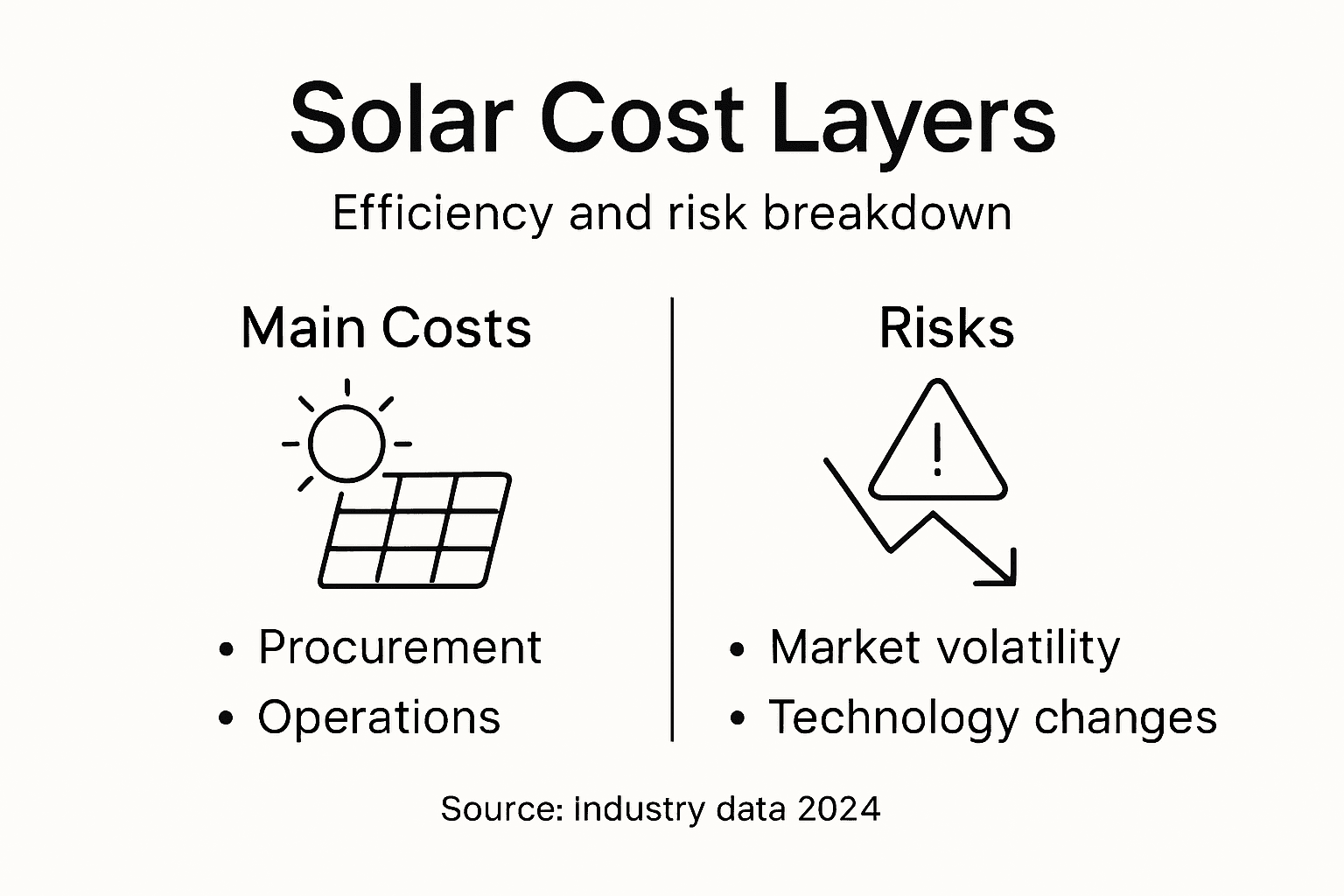
The cost structure of solar wholesale encompasses multiple complex layers beyond simple product acquisition. Operational expenses include warehousing, logistics, technical support infrastructure, inventory management systems, and comprehensive distribution network maintenance. Energy managers must develop nuanced financial models that account for technological depreciation, market volatility, and potential regulatory changes. Strategic wholesale operations increasingly focus on creating value-added services that extend beyond traditional product distribution, including system design consultation, technical integration support, and long-term performance optimization.
Pro tip: Develop multi-year financial models that include scenario planning for potential technological and regulatory changes to effectively manage solar wholesale investment risks.
Here is a comparison of common solar wholesale pricing models and the key risks associated with each approach:
Pricing Model | Description | Main Financial Risk |
Spot Market Transactions | Real-time market-based pricing | Volatile price fluctuations |
Long-Term Agreements | Fixed rates over several years | Risk of outdated pricing |
Volume-Based Discounts | Reduced rates for bulk purchases | Over-commitment of inventory |
Hybrid Approaches | Combines fixed and variable contracts | Complexity in risk management |
Critical Compliance and Market Challenges in Central Europe
Solar wholesale regulatory landscape in Central Europe presents a complex framework of interconnected challenges that demand sophisticated strategic approaches. The region confronts significant regulatory variations across national boundaries, creating intricate compliance requirements for solar wholesale operators. These challenges encompass divergent renewable energy policies, inconsistent permitting procedures, and complex grid access regulations that significantly impact market entry and operational strategies for solar technology providers.
The market dynamics reveal multiple critical obstacles that solar wholesale stakeholders must navigate. Supply chain dependencies remain a substantial constraint, with limited domestic manufacturing capacities forcing heavy reliance on international imports. Regulatory uncertainty compounds these challenges, requiring continuous adaptation to evolving EU renewable directives and national legislative frameworks. Energy managers must develop flexible strategies that can quickly respond to changing policy landscapes while maintaining technological and financial resilience.
Technological infrastructure and cross-border collaboration emerge as key mechanisms for addressing these systemic challenges. Central European markets are increasingly focusing on developing smart grid technologies, harmonizing regional policies, and creating more integrated electricity trading platforms. These efforts aim to reduce bureaucratic friction, streamline renewable energy deployment, and create more stable investment environments. Strategic stakeholder cooperation among manufacturers, regulators, and energy providers becomes crucial in developing adaptive frameworks that can support rapid solar wholesale market evolution.
Pro tip: Develop comprehensive compliance mapping that tracks regulatory changes across multiple national jurisdictions to anticipate and mitigate potential market entry barriers.
Transform Your Solar Wholesale Strategy with Belinus Integrated Energy Solutions
The challenges of managing solar wholesale operations such as complex pricing models, regulatory compliance across Central Europe, and integrating diverse solar products demand a partner who understands the entire ecosystem. Belinus offers cutting-edge solutions that align perfectly with these needs including advanced Energy Management Systems and scalable battery storage designed for commercial and residential applications. Whether you require dynamic tariff optimization or seamless integration of photovoltaic modules, inverters, and storage, our solutions empower you to overcome market volatility and regulatory uncertainty with confidence.

Unlock the full potential of your solar wholesale initiatives today. Visit Belinus to explore how our intelligent EMS, modular Energy Walls, and powerful EV charging options create an adaptable and cost-efficient solar energy infrastructure. Act now to future-proof your investment and streamline energy distribution in a rapidly evolving market. Learn more about our commercial solutions and integrated technologies designed for scalability and performance.
Frequently Asked Questions
What is solar wholesale?
Solar wholesale refers to the bulk purchasing, selling, and distribution of solar energy products and services across electricity networks. It creates a dynamic ecosystem where various solar components, including modules and inverters, integrate for efficient energy distribution.
How does solar wholesale streamline energy solutions?
Solar wholesale streamlines energy solutions by aggregating demand, optimizing supply chain logistics, and enabling bulk purchasing. This approach reduces per-unit costs and increases accessibility, integrating advanced storage solutions and energy management technologies to enhance grid resilience.
What are the primary product categories in solar wholesale?
The primary product categories in solar wholesale include photovoltaic (PV) modules, inverters, battery storage systems, and energy management technologies. Each plays a distinct role in facilitating renewable power generation and optimizing energy distribution.
What are the key risks associated with solar wholesale pricing models?
Key financial risks associated with solar wholesale pricing models include price fluctuations in the spot market, the potential for outdated pricing in long-term agreements, over-commitment of inventory in volume-based discounts, and complexities in risk management with hybrid approaches.
Recommended
Comments