Supercapacitor Technology Explained: 2026 Research Guide
- 2 hours ago
- 8 min read
TL;DR:
Supercapacitors store energy through electrostatic and surface redox mechanisms, providing rapid power delivery. They have high cycle life and tolerate many charge cycles but offer lower energy density than batteries. These devices are ideal for high-power, short-duration applications like regenerative braking and grid support.
Supercapacitor technology is an energy storage method that uses electrostatic and electrochemical mechanisms to deliver power far faster than batteries while lasting orders of magnitude longer. Known formally as electrochemical capacitors or ultracapacitors, these devices store 10–100 times more energy per unit mass than electrolytic capacitors and tolerate many more charge-discharge cycles than lithium-ion batteries. Graphene-based supercapacitors, hybrid ultracapacitors, and electric double-layer capacitors (EDLCs) represent the leading research frontiers in 2026. If you study energy storage or work in applied electrochemistry, understanding what is supercapacitor technology means understanding the physics, materials, and tradeoffs that define the next generation of power systems.
What is supercapacitor technology and how does it store energy?
Supercapacitor technology stores energy through two distinct mechanisms: electric double-layer capacitance (EDLC) and pseudocapacitance. Understanding both is the foundation of supercapacitor working principles.
In an EDLC, ions from the electrolyte accumulate at the electrode surface when voltage is applied. No chemical reaction occurs. The charge sits at the interface between the electrode and the electrolyte, forming two layers of opposite charge. This is purely electrostatic storage, which is why EDLCs charge and discharge in milliseconds and survive hundreds of thousands of cycles without significant degradation.
Pseudocapacitance works differently. It involves fast, reversible faradaic redox reactions at or near the electrode surface. These reactions look chemically similar to what happens in a battery, but they are surface-confined and highly reversible. That reversibility is what separates pseudocapacitance from battery-style storage and preserves cycle life.
Hybrid supercapacitors combine both mechanisms to push energy density higher while keeping the power delivery and cycle life advantages of EDLCs. One electrode acts as an EDLC-type carbon electrode; the other uses a faradaic material. The result is a device that sits closer to a battery in energy density but still charges far faster.
EDLC: Electrostatic, no chemical reaction, extremely fast, very long cycle life
Pseudocapacitor: Surface redox reactions, higher energy density, slightly shorter cycle life
Hybrid: Asymmetric electrodes combining both, best balance of energy and power
Pro Tip: When comparing supercapacitors for a research application, always check whether the device is a true EDLC, a pseudocapacitor, or a hybrid. Each has a different failure mode and a different sweet spot for power versus energy tradeoffs.
What types of supercapacitors exist and what materials drive performance?
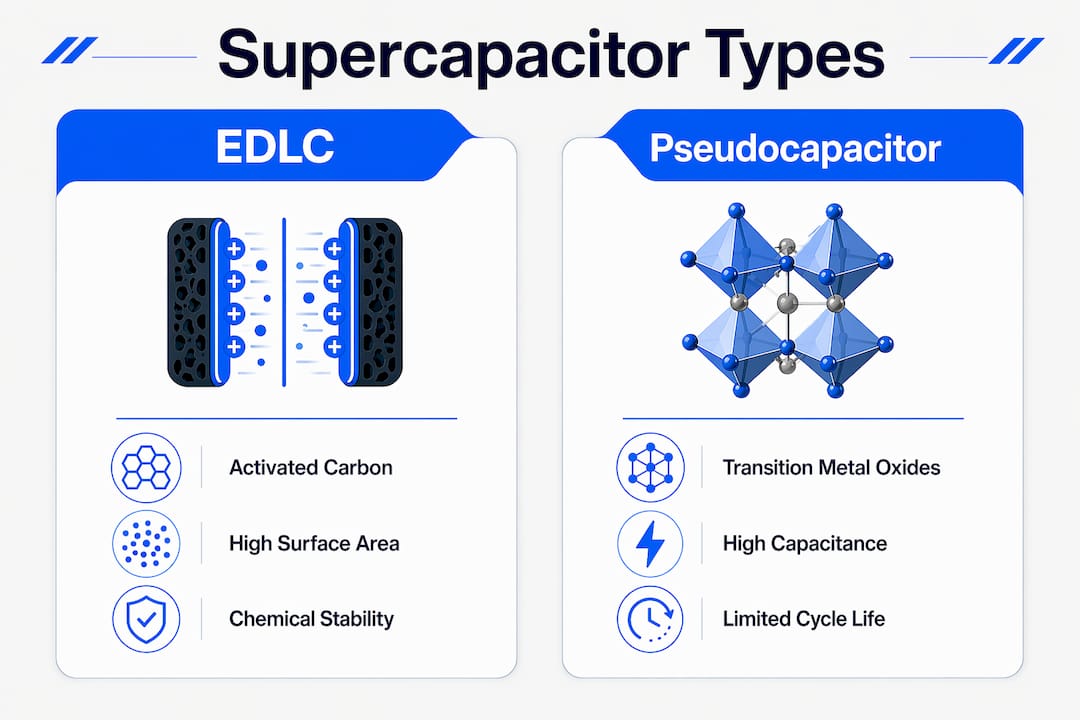
Supercapacitors are classified into EDLCs, pseudocapacitors, and hybrids based on their charge storage mechanism. Electrode material is the single biggest variable controlling capacitance, power density, and cycle stability.
EDLC electrode materials
Activated carbon dominates commercial EDLCs because it is cheap, has a high surface area, and is chemically stable. Graphene and carbon nanotubes offer superior conductivity and theoretical surface area, making them targets for next-generation devices. Carbon aerogels provide a three-dimensional porous network that improves ion transport. Each material trades off surface area, conductivity, and cost differently.
Pseudocapacitor and hybrid materials
Transition metal oxides such as ruthenium oxide and manganese dioxide are the workhorses of pseudocapacitor electrodes. Conducting polymers like polyaniline and polypyrrole add flexibility and lower cost. Hybrid devices use asymmetric electrode pairs, pairing a carbon-based EDLC electrode with a faradaic electrode to extract benefits from both mechanisms. Asymmetric electrode design offsets the limitations of pure EDLC or pseudocapacitor architectures.
Material Type | Example Materials | Key Advantage | Key Limitation |
Carbon (EDLC) | Activated carbon, graphene, CNTs | Long cycle life, fast charge | Lower energy density |
Metal oxide (pseudo) | RuO₂, MnO₂ | Higher capacitance | Shorter cycle life, cost |
Conducting polymer | Polyaniline, polypyrrole | Flexible, low cost | Swelling, degradation |
Hybrid composite | Carbon + metal oxide | Balanced energy and power | Complex fabrication |
Electrode material properties including surface area, pore structure, conductivity, and chemical stability fundamentally govern every performance metric. A high surface area means more sites for ion adsorption, but pores must be the right size for the electrolyte ions to access them. Conductivity controls how fast charge moves through the electrode. Both must be optimized together.
Recent advances in 2D materials, particularly graphene derivatives and MXenes, are pushing capacitance and cycle life beyond what conventional carbons can achieve. Belinus has built its Energy Wall G1 around a 16 kWh graphene supercapacitor architecture, reflecting how far commercial graphene supercap technology has advanced by 2026.
Pro Tip: Surface area alone does not predict capacitance. A material with 2,000 m²/g but poorly matched pore size for the electrolyte will underperform a material with 1,200 m²/g and optimized pore distribution.
How do performance metrics define real-world supercapacitor capability?
Commercial supercapacitors typically reach energy densities of 5–8 Wh/L and specific energy in the range of 0.5–15 Wh/kg. Those numbers are well below lithium-ion batteries, which is why supercapacitors serve high-power, short-duration roles rather than long-duration storage.
Equivalent series resistance (ESR) is the metric that most directly limits power output. High ESR means more energy is lost as heat during fast discharge, reducing both efficiency and peak power. Reducing ESR requires low-resistance electrode materials, good electrode-electrolyte contact, and high-conductivity current collectors. A 2026 study published in Nature Partner Journals demonstrated that electrode resting and rehydration reduced ESR by approximately 70% and increased power density by 40%, while the device retained 95% of its capacitance after 550,000 cycles. That result shows physical optimization methods can rival complex chemical modifications in impact.
Voltage window is the other critical lever. Energy density depends on capacitance and voltage window, and the electrolyte sets the upper limit on voltage. Aqueous electrolytes cap out around 1.0–1.2 V. Organic electrolytes push that to 2.5–2.7 V. Ionic liquids can reach 3.5 V or higher, which dramatically increases energy density since energy scales with the square of voltage.
Metric | Typical EDLC | Hybrid Supercapacitor | Li-ion Battery |
Energy density | 5–8 Wh/L | 10–30 Wh/L | 200–400 Wh/L |
Power density | Very high (kW/kg) | High | Moderate |
Cycle life | 500,000+ cycles | 100,000+ cycles | 500–2,000 cycles |
Charge time | Seconds | Seconds to minutes | Minutes to hours |
Standardized testing for supercapacitors remains fragmented across the field. Reported metrics vary widely depending on test conditions, electrolyte, and measurement protocol. Researchers should treat published figures as context-dependent rather than absolute benchmarks.
Pro Tip: When evaluating a supercapacitor for deployment, request ESR data at the operating temperature range, not just room temperature. ESR rises sharply in cold conditions and can cut peak power by more than half.
Where are supercapacitors used today?
Supercapacitors are deployed wherever high power delivery, rapid cycling, and long service life matter more than energy capacity. Regenerative braking in buses, trains, and trams is the most established application. The supercapacitor captures kinetic energy during braking and releases it during acceleration, cutting fuel consumption without the cycle degradation that would destroy a battery in the same role.
Key application areas include:
Transportation: Regenerative braking in electric buses, light rail, and hybrid vehicles
Renewable energy buffering: Smoothing output fluctuations from wind and solar installations
Grid services: Frequency regulation and short-term power balancing
Industrial UPS: Bridging power during generator startup or grid interruptions
Consumer electronics: Camera flash systems, wireless sensors, and wearables requiring burst power
Supercapacitors work best as a complement to batteries, not a replacement. In a hybrid energy storage system, the supercapacitor handles peak power demands while the battery manages sustained energy delivery. This arrangement extends battery life significantly by shielding it from high-current stress. Belinus supports this architecture through its Energy Management System, which coordinates graphene supercap and LFP storage in real-time across residential and commercial installations.
The limitation is clear: a supercapacitor cannot power a home overnight. Its role is precision power delivery over seconds to minutes, not hours. That constraint is not a flaw. It is a design feature that makes supercapacitors exceptionally durable and reliable in their intended role.
Key Takeaways
Supercapacitor technology fills a specific and irreplaceable role in energy storage: delivering high power instantly, cycling hundreds of thousands of times, and complementing batteries in systems that demand both speed and endurance.
Point | Details |
Two core mechanisms | EDLCs use electrostatic storage; pseudocapacitors use surface redox reactions; hybrids combine both. |
Electrode material determines performance | Surface area, pore structure, and conductivity must all be optimized together, not independently. |
ESR is the key power limiter | Reducing ESR through electrode design or physical treatment directly increases peak power output. |
Supercapacitors complement batteries | They handle peak power and rapid cycling; batteries handle sustained energy delivery. |
Testing context matters | Reported metrics vary widely due to fragmented protocols; always evaluate figures in their test context. |
Why I think supercapacitors are more misunderstood than any other storage technology
The most common mistake I see in energy storage discussions is treating supercapacitors as failed batteries. Researchers compare energy density numbers, see that supercapacitors lose badly, and conclude the technology is niche or immature. That framing misses the point entirely.
Supercapacitors are not trying to be batteries. They are trying to do something batteries physically cannot: deliver massive bursts of power, absorb regenerative energy in milliseconds, and do it a million times without meaningful degradation. The 550,000-cycle result from the 2026 electrode rehydration study is not a footnote. It is a fundamental statement about what this technology is built for.
What excites me most in 2026 is the convergence of materials science and device engineering. Graphene-based electrodes are no longer a laboratory curiosity. Belinus has commercialized a 16 kWh graphene supercapacitor product in the Energy Wall G1, which tells you something real about where manufacturing readiness stands. The gap between research papers and deployable hardware is closing faster than most analysts expected.
The field still has genuine problems. Standardized testing is a mess. Two papers can report wildly different capacitance values for chemically similar electrodes because the test conditions differ. That fragmentation slows deployment decisions and makes it hard to compare commercial products honestly. Fixing that requires coordination between standards bodies, researchers, and manufacturers. It is not glamorous work, but it is the bottleneck.
My honest view: the researchers who will move this field forward fastest are the ones who treat ESR, cycle life, and energy density as a system to optimize together, not as separate targets. The synergy between electrode architecture and electrolyte design is where the real breakthroughs are hiding.
— Marc
Belinus and advanced supercapacitor energy storage
Belinus develops energy storage systems built around graphene supercapacitor technology, LFP batteries, and intelligent energy management for residential and commercial applications.

The Energy Wall G1 is a 16 kWh graphene supercapacitor unit designed for residential use, with a Q1 2026 launch at €7,000 per unit. For commercial and utility-scale needs, Belinus offers modular storage starting at 400+ kWh, scalable to MW capacity. The Belinus EMS runs 15-minute dynamic tariff optimization and coordinates multiple storage technologies in real time. Researchers and practitioners looking to see how supercapacitor principles translate into deployable energy systems can explore the full product range and technical architecture at Belinus.com.
FAQ
What is a supercapacitor in simple terms?
A supercapacitor is an energy storage device that sits between a conventional capacitor and a battery. It stores more energy than a capacitor and delivers power far faster than a battery, making it ideal for high-power, short-duration applications.
What are the main advantages of supercapacitors over batteries?
Supercapacitors charge in seconds, deliver very high peak power, and last hundreds of thousands of cycles without significant degradation. Batteries store more total energy but degrade faster under high-current cycling.
How do supercapacitors work at the electrode level?
EDLCs store charge by accumulating ions at the electrode-electrolyte interface without any chemical reaction. Pseudocapacitors use fast, reversible surface redox reactions. Both mechanisms are highly reversible, which is why cycle life far exceeds that of batteries.
What limits supercapacitor energy density?
Energy density is constrained by capacitance and the voltage window set by the electrolyte. Aqueous electrolytes limit voltage to around 1.0–1.2 V, while ionic liquids can reach 3.5 V, significantly increasing stored energy for the same electrode design.
Are supercapacitors a replacement for batteries?
Supercapacitors are not a replacement for batteries. They work best as a complement, handling peak power demands and rapid cycling while batteries manage sustained energy delivery over longer periods.
Recommended
Comments