What Is Energy Independence? A 2026 Policy Guide
- 3 days ago
- 9 min read

TL;DR:
Energy independence refers to a nation’s ability to meet all energy needs solely from domestic resources, reducing reliance on imports. Achieving true self-sufficiency requires integrating generation, storage, demand management, and resilient supply chains, with critical minerals being a significant underlying dependency. Policies must address technological, logistical, and equity challenges to build sustainable, real-time energy autonomy.
Energy independence is defined as a nation’s capacity to meet all of its energy needs from domestic resources, without relying on external imports. Measured primarily by domestic energy flows rather than total consumption, it shields economies from global market disruptions and geopolitical pressure. In 2026, the concept has expanded well beyond oil reserves. Renewable energy, battery storage, electrification, and critical mineral supply chains now define what genuine energy self-sufficiency looks like. The U.S. Bureau of Labor Statistics reports 11% annual growth in renewable sector jobs, signaling that energy independence is also an economic strategy, not just a security doctrine.
What is energy independence, and how is it measured?
Energy independence is not a single number. Nations and energy communities measure it using two distinct frameworks, and confusing them leads to serious policy errors.
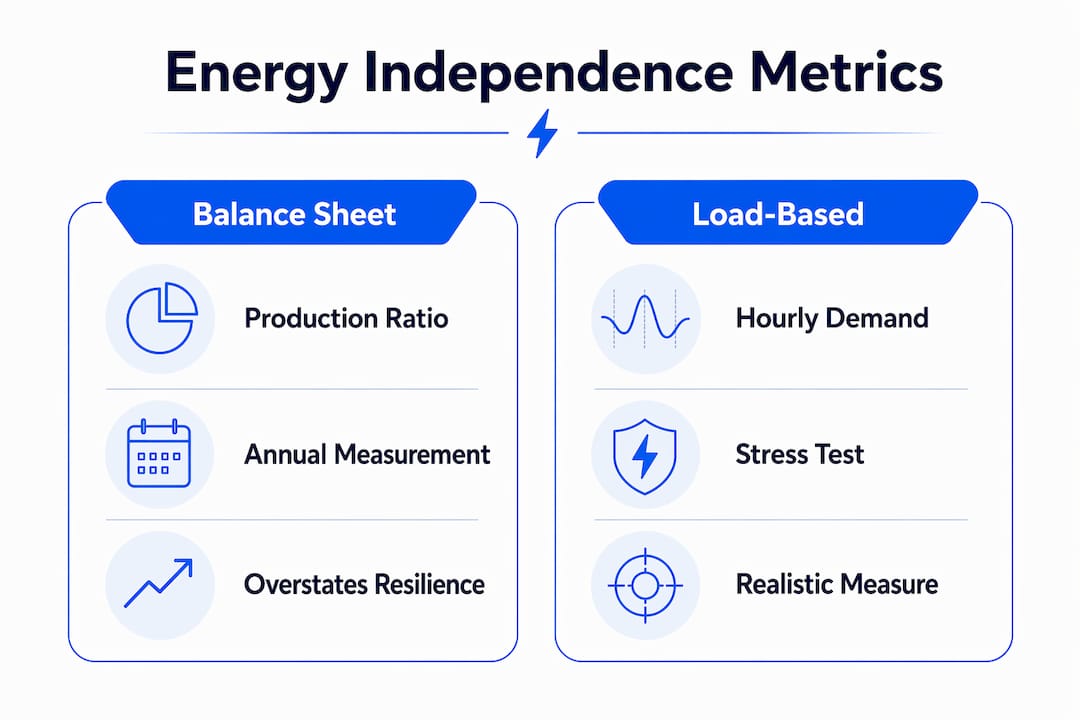
The first is balance-sheet self-sufficiency: total annual domestic energy production divided by total annual consumption. A country can score well here while still depending on the grid during winter evenings or industrial peak hours. The second is load-based self-sufficiency: real-time coverage of demand from local generation at every moment of the day and year. A European study found that electrical-only self-sufficiency reached 26% on an annual basis, but when heating and transport were included, the figure collapsed to 4.2%. That gap reveals exactly why solar panels alone cannot deliver true energy autonomy.
Seasonal mismatches drive most of this gap. Solar generation peaks in summer; heating demand peaks in winter. Without storage or flexible demand management, high annual production figures mask real-time vulnerability. This is why integrated energy systems combining generation, battery storage, and smart demand response are the only credible path to genuine self-sufficiency.
Electrification further complicates measurement. As households switch from gas boilers to heat pumps and from gasoline cars to EVs, total electricity demand rises sharply. A self-sufficiency score calculated before electrification understates the generation capacity actually needed. Policymakers who ignore this shift will consistently underinvest in grid capacity.
Balance-sheet self-sufficiency measures annual production vs. consumption. High scores are achievable but can mask real-time grid dependence.
Load-based self-sufficiency measures real-time coverage. Far harder to achieve and the more meaningful metric for resilience.
Seasonal storage gaps are the primary barrier. Winter solar output in northern Europe can drop by 70% compared to summer peaks.
Electrification shifts the baseline. Every heat pump and EV added to the grid raises the generation target for true self-sufficiency.
Pro Tip: When evaluating any energy independence claim from a government or utility, ask which metric they are using. Balance-sheet figures routinely overstate actual resilience by a factor of five or more.
What are the economic and strategic benefits of energy independence?
Energy self-sufficiency delivers three categories of benefit: economic growth, supply chain resilience, and national security. Each is real, but each comes with trade-offs that honest policy analysis cannot ignore.
On the economic side, the renewable sector’s 11% annual job growth in the U.S. demonstrates that domestic energy production creates durable local employment. Unlike fossil fuel extraction, which concentrates wealth in resource-rich regions, solar and wind installations distribute jobs across manufacturing, installation, and maintenance. Industrial development follows: battery gigafactories, inverter plants, and grid equipment manufacturers all cluster around energy-independent policy frameworks.
Resilience to price shocks is the most immediate strategic benefit. Nations that import energy are exposed to commodity price swings, currency risk, and supplier leverage. The 2021 to 2022 European gas crisis demonstrated how a single supply disruption can translate into household energy bills doubling within months. Domestic generation insulates consumers from that transmission mechanism.
“Pursuing energy sovereignty by boosting domestic fossil fuels without renewables risks an isolated, expensive, and environmentally harmful future.” — Grattan Institute
The national security argument is straightforward: energy-importing nations transfer strategic leverage to exporters. Reducing that leverage through domestic production limits the ability of foreign governments to use energy as a political instrument. However, a 2025 Nature Communications study found that countries previously dependent on imports may face cost increases of up to 150% to achieve full domestic demand coverage, with average system cost increases around 2%. That asymmetry matters. Full self-sufficiency is not always the optimal target. Partial independence, combined with diversified import sources, often delivers better outcomes per dollar spent.
Electrification technologies like EVs and heat pumps are 2 to 4 times more energy-efficient than their fossil-fuel equivalents. Higher efficiency means less total energy needed to deliver the same services, which directly reduces the generation capacity required for self-sufficiency. This is one of the most underappreciated levers in the entire energy independence debate.
Which technologies actually enable energy self-sufficiency?
The technology stack for energy independence has four layers: generation, storage, demand management, and grid infrastructure. No single layer is sufficient on its own.
Generation is led by solar photovoltaics, wind power, and hydropower. Solar PV costs have fallen over 90% since 2010, making it the default first choice for most regions. Advanced configurations matter significantly. Research published in Nature Communications shows that horizontal single-axis tracking and deliberate inverter undersizing improve both cost-effectiveness and the seasonal generation profile, spreading output more evenly across the year.
Technology | Primary role | Key limitation |
Solar PV | Daytime generation | Seasonal and weather variability |
Wind power | Continuous generation | Site-specific, grid integration cost |
Battery storage | Time-shifting generation | Upfront capital cost, mineral supply |
Heat pumps | Demand reduction | Cold-climate performance at extremes |
EVs with V2G | Mobile storage and demand flexibility | Grid infrastructure readiness |
Storage is the critical bridge between generation and consumption. Battery systems, including lithium iron phosphate (LFP) and emerging graphene supercapacitor technologies, allow surplus daytime solar to cover evening and overnight demand. Without storage, even a well-resourced solar installation remains grid-dependent for roughly half of its operating hours.
Demand management through electrification is the most underutilized tool. Transitioning to an all-electric system shifts supply chain risk from continuous fuel imports to a one-time hardware dependency. Once a heat pump or EV charger is installed, it operates independently of trade disruptions. This is a structural change in risk profile, not just an efficiency gain. Household electrification guides, like those covering EVs and heat pumps, show how individuals can participate directly in this transition.
Critical minerals represent the most significant vulnerability in the current technology stack. Lithium, cobalt, nickel, and rare earth elements are concentrated in a small number of countries. Bridgewater’s analysis of major economies notes that China controls critical mineral supply chains in ways that create secondary dependencies for nations pursuing renewable-based independence. Solving the generation problem while ignoring mineral supply chains simply relocates the dependency rather than eliminating it.
Pro Tip: When designing a solar-plus-storage system for self-sufficiency, prioritize battery capacity sized for your worst seasonal month, not your average month. Average sizing leaves you grid-dependent precisely when energy prices are highest.
What policy and practical strategies drive energy independence?
Achieving energy independence requires coordinated action across government, industry, and households. No single actor can deliver it alone.
Domestic manufacturing incentives. The U.S. Inflation Reduction Act and the EU’s Net-Zero Industry Act both use tax credits and procurement rules to build domestic supply chains for solar panels, batteries, and wind components. Manufacturing locally reduces the hardware import dependency that replaces fuel import dependency in an electrified system.
Critical mineral policy. Governments in Australia, Canada, and the EU are funding domestic mining and processing of lithium, cobalt, and nickel. This is not optional. Without domestic or allied mineral supply, renewable energy independence remains structurally dependent on geopolitical rivals.
Grid modernization. A generation-heavy strategy without grid investment fails. Smart grids with real-time pricing, demand response programs, and cross-border interconnection allow renewable energy to be dispatched efficiently. The U.S., China, and EU all differ sharply in approach here: the U.S. relies on market mechanisms, China on state-directed investment, and the EU on regulatory coordination across member states.
Energy communities. Local energy sharing models, where households and businesses pool generation and storage, dramatically improve load-based self-sufficiency. Salzburg Research confirms that energy communities require integrated strategies combining technology, economic viability, and social acceptance. Technology alone does not create a functioning energy community.
Equity frameworks. Energy transition benefits concentrate among higher-income households that can afford solar and EVs. Policy frameworks that ignore this dynamic entrench inequality. Feed-in tariffs, community solar programs, and subsidized electrification for low-income households are not peripheral concerns. They determine whether energy independence becomes a broadly shared national asset or a premium product for the affluent.
Individual electrification. At the household level, the sequence matters: insulate first, then electrify heating, then add solar, then add storage. Each step reduces import dependence and improves the economics of the next. Renewable energy options for businesses follow the same logic at larger scale.
Key takeaways
True energy independence requires integrating generation, storage, demand management, and supply chain resilience into a single coordinated system, not just adding solar panels to an existing grid.
Point | Details |
Two metrics, one concept | Balance-sheet self-sufficiency overstates resilience; load-based self-sufficiency is the measure that actually matters for security. |
Electrification multiplies impact | EVs and heat pumps are 2 to 4 times more efficient than fossil alternatives, reducing the total generation needed for self-sufficiency. |
Critical minerals are the hidden dependency | Renewable independence built on imported lithium and cobalt relocates rather than eliminates strategic vulnerability. |
Full self-sufficiency has a price | Net-importing regions can face cost increases up to 150% for complete domestic coverage; partial independence often delivers better value. |
Policy must address equity | Without deliberate inclusion frameworks, energy transition benefits concentrate among higher-income groups, undermining broad national resilience. |
Why the critical minerals conversation is the one most people are missing
Most public discourse on energy independence focuses on generation capacity: how many gigawatts of solar, how many wind turbines. That framing is incomplete, and after working in this sector, I find it increasingly frustrating.
The real constraint in 2026 is not generation technology. Solar PV and wind are mature, cost-competitive, and deployable at scale. The constraint is the supply chain underneath them. A nation that installs gigawatts of solar panels manufactured with Chinese-processed lithium and rare earth elements has not achieved independence. It has traded one dependency for another, and arguably a more fragile one, because fuel imports can be diversified quickly while mineral processing capacity takes a decade to build.
The second thing I think is consistently underestimated is the role of storage in real-time self-sufficiency. I have seen too many feasibility studies that model annual generation matching annual consumption and declare success. That is the balance-sheet illusion. Real independence means covering demand at 7 p.m. on a cold January evening when solar output is near zero and heating demand is at its peak. That requires storage, demand flexibility, and grid intelligence working together. Systems like the Belinus Energy Management System, which optimizes across generation, storage, and dynamic tariffs in 15-minute intervals, represent the architecture that genuine self-sufficiency actually requires.
The optimism I hold is grounded in the pace of technology cost reduction and the growing sophistication of integrated energy systems. The path is clear. The challenge is political will and supply chain investment, not physics.
— Marc
Start building your energy independence with Belinus

Belinus designs integrated energy systems that address every layer of the self-sufficiency challenge: solar generation, battery storage, EV charging, and intelligent energy management in a single coordinated platform. The Belinus EMS optimizes across all connected assets in real time, using 15-minute dynamic tariff data to maximize self-consumption and minimize grid dependence. Whether you are a homeowner planning your first solar-plus-storage installation or a policymaker evaluating community energy infrastructure, Belinus has the technical depth and product range to support your goals. Explore the full Belinus energy solutions portfolio and take the first concrete step toward genuine energy autonomy.
FAQ
What is the simplest definition of energy independence?
Energy independence is a nation’s or household’s ability to meet all of its energy needs from domestic sources without relying on imports. It is measured by domestic energy flows rather than total consumption.
How does renewable energy contribute to energy self-sufficiency?
Solar PV, wind, and hydropower generate electricity domestically, eliminating the need for continuous fuel imports. When combined with battery storage and smart demand management, they can cover demand across all hours and seasons.
What are the biggest challenges of energy independence?
Seasonal generation gaps, critical mineral supply chains, and the upfront cost of full self-sufficiency are the primary barriers. Net-importing regions can face cost increases up to 150% for complete domestic energy coverage.
How do EVs and heat pumps support energy independence?
Electrification technologies are 2 to 4 times more efficient than fossil-fuel alternatives, reducing total energy demand. Lower demand means less generation capacity is needed to achieve self-sufficiency, improving both economics and resilience.
What is the difference between energy independence and energy sovereignty?
Energy independence focuses on meeting domestic demand without imports. Energy sovereignty is a broader concept that includes the right to set national energy policy free from external pressure. A country can be energy-independent while still being politically constrained by trade relationships or critical mineral dependencies.
Recommended
Comments