Wholesale PV explained: smart solar buying and selling 2026
- 5 hours ago
- 9 min read

Many European property owners believe solar PV is just about installing panels and receiving fixed feed-in tariffs. This misconception leaves significant revenue on the table. Wholesale PV opens a different path: bulk purchasing of solar equipment combined with direct marketing of your electricity into wholesale markets at real-time prices. Instead of locking into static tariffs, you can capitalize on price fluctuations, optimize with battery storage, and participate in energy arbitrage. This guide explains how wholesale PV works, the role of energy management systems, integration strategies with storage, and practical steps to maximize your solar investment in 2026.
Table of Contents
Key takeaways
Point | Details |
Wholesale PV combines bulk buying and direct electricity marketing | Property owners purchase solar equipment at wholesale prices and sell excess power into wholesale markets instead of fixed tariffs. |
Energy management systems enable market participation | Real-time EMS platforms manage 15-minute trading blocks, forecasting, and remote control required for wholesale market access. |
Battery storage amplifies financial returns through arbitrage | Charging during low-price periods and discharging at peaks doubles revenue potential compared to simple feed-in arrangements. |
Market volatility brings risks but premiums offset downsides | Price fluctuations expose sellers to uncertainty, yet aggregator premiums and subsidies stabilize returns for most users. |
Practical setup requires partnerships and cost planning | Success depends on selecting experienced aggregators, installing suitable EMS, and understanding setup and operational costs. |
What is wholesale PV and how does it work?
Wholesale PV refers to two interconnected practices: purchasing solar panels and components in bulk at wholesale prices, and selling your generated electricity directly into wholesale energy markets rather than through fixed feed-in tariffs. This dual approach reduces upfront costs and maximizes revenue flexibility. Wholesale PV enables residential and commercial owners to sell excess power beyond fixed feed-in tariffs by bulk purchasing and direct marketing.
Direct marketing means you bypass traditional utility buyback programs and instead sell electricity at real-time market prices. This requires collaboration with direct marketers or aggregators who handle forecasting, bidding, and compliance. These intermediaries submit your generation forecasts into day-ahead and intraday markets, then adjust in real time as your actual production varies. You earn the market price for each kilowatt-hour sold, minus marketing fees.
European wholesale markets operate with 15-minute trading blocks, demanding precise forecasting and rapid response capabilities. Systems larger than 100 kW in Germany, for example, face mandatory market participation rules requiring remote control and real-time data transmission. Smaller systems can participate voluntarily but benefit from aggregator pooling to meet minimum bid sizes.
Key components for wholesale PV participation include:
Advanced energy management system (EMS) with real-time monitoring and remote control
Partnership with licensed direct marketer or aggregator experienced in EU markets
Compliance with grid codes and market rules for your system size and location
Optional battery storage to optimize arbitrage opportunities and increase revenue
Costs involve EMS installation (around €5,000), monthly aggregator fees (€50 to €150), and marketing fees (0.2 to 0.6 cents per kWh). Despite these expenses, wholesale participation often delivers higher returns than fixed tariffs, especially during peak demand periods when market prices spike. The key is understanding market timing and leveraging technology to respond dynamically.
“Wholesale PV transforms solar owners from passive generators into active market participants, unlocking revenue streams that fixed tariffs cannot match.”
For property owners considering this path, evaluating your system size, energy consumption patterns, and willingness to engage with market complexity is essential. Solar wholesale energy solutions provide frameworks for understanding how bulk purchasing and direct marketing intersect to optimize both capital and operational expenses.
Integrating energy storage with wholesale PV for maximum benefit
Battery storage transforms wholesale PV from a generation-only proposition into a flexible energy asset. When solar production floods the grid during midday, wholesale prices often drop to zero or turn negative. Storage systems charge during these periods, capturing cheap or free electricity. Later, during evening peaks when solar output fades and demand surges, stored energy discharges at premium prices. This arbitrage strategy can double revenue potential compared to simple feed-in arrangements.
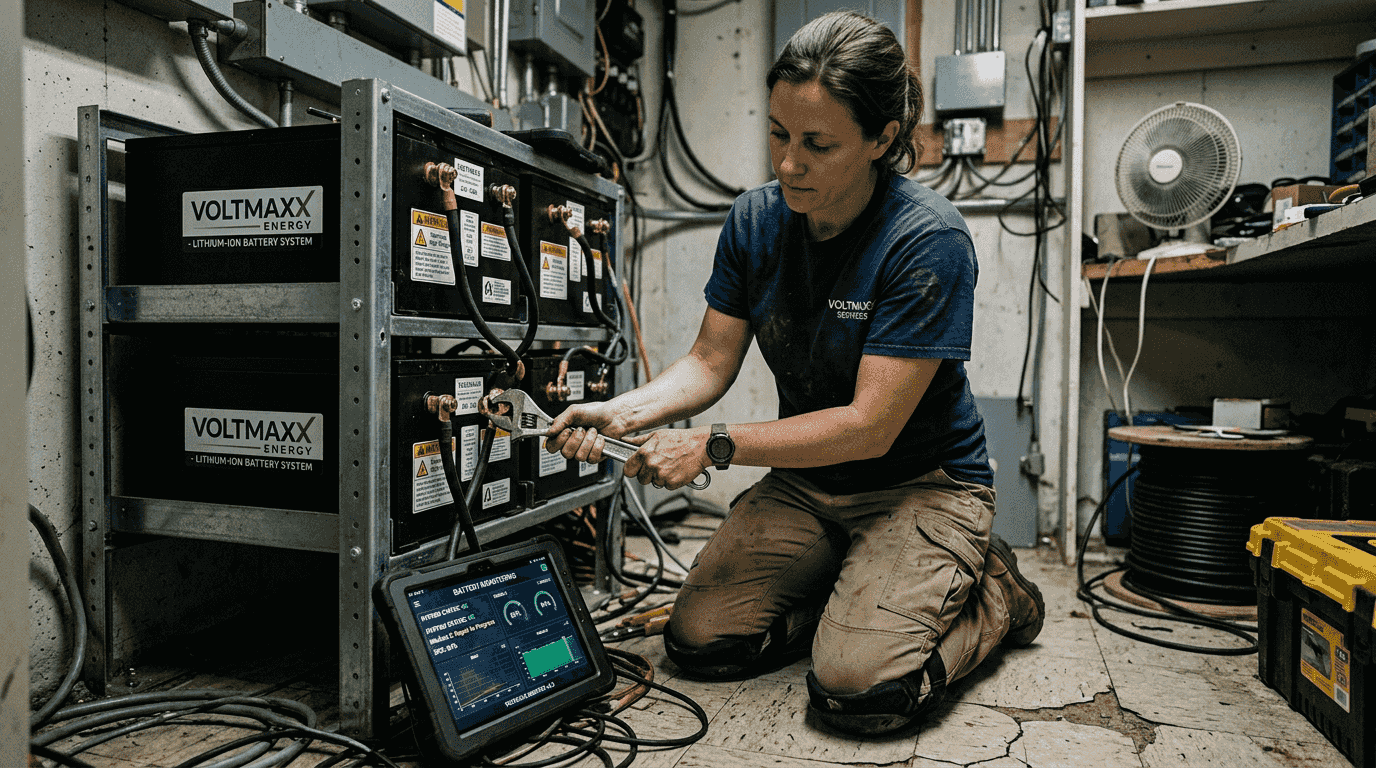
Beyond arbitrage, storage enables multi-market participation. Day-ahead markets allow you to commit generation and discharge schedules 24 hours in advance. Intraday markets let you adjust as forecasts change. Balancing markets pay for rapid response to grid frequency deviations. Each market offers distinct revenue opportunities, and storage provides the flexibility to capture value across all three simultaneously.
Benefits of integrating storage with wholesale PV include:
Improved self-consumption by storing excess solar for evening use, reducing grid dependence
Cost savings through time-shifting electricity purchases away from peak tariff periods
Revenue generation by selling stored energy during high-price windows
Grid service payments for providing frequency regulation and demand response
Storage degradation and upfront costs require careful consideration. Lithium iron phosphate (LFP) batteries typically last 6,000 to 10,000 cycles, while graphene supercapacitors like Belinus Energy Wall G1 offer extended lifespans with faster charge/discharge rates. Calculating payback periods must account for cycling frequency, depth of discharge, and market price volatility.
Pro Tip: Start with conservative cycling strategies (one full cycle per day) to extend battery life, then increase frequency as you gain confidence in market patterns and forecasting accuracy.
Optimization strategies depend on your consumption profile and market access. Commercial properties with predictable demand can schedule storage discharge to offset peak utility charges. Residential users benefit more from self-consumption optimization, storing midday solar for evening use. Both scenarios improve economics compared to exporting all excess generation at low midday prices.
Integrating solar with storage home energy systems requires matching storage capacity to your solar output and consumption patterns. Oversized storage sits idle, while undersized systems miss arbitrage opportunities. A typical residential setup pairs 5 to 10 kWh storage with 5 to 8 kW solar capacity. Commercial installations scale proportionally, often reaching 50 to 200 kWh storage for 50 to 100 kW solar arrays.
Why integrate PV storage becomes clear when comparing annual returns: PV-only systems earn market prices during generation hours, while PV plus storage captures both generation revenue and arbitrage premiums, often increasing total earnings by 30 to 50 percent.
Key market trends, challenges, and opportunities for EU property owners
Rooftop PV installations dominate European solar capacity, covering approximately 8% of total electricity supply as of 2025. This rapid growth creates both opportunities and challenges for wholesale market participants. European PV markets see record production but increased price volatility and grid congestion challenges, making storage and real-time management crucial.
Negative price events occur frequently, especially in Germany where grid constraints and solar surpluses push midday prices below zero. During these periods, generators without storage actually pay to export electricity. Systems equipped with storage simply stop exporting and charge batteries instead, avoiding losses and positioning for evening profits.
The EU introduced 15-minute trading blocks across member states in 2025, replacing older hourly blocks. This change improves renewable integration by allowing faster market adjustments but increases forecasting complexity. Accurate 15-minute solar production forecasts require sophisticated weather models and real-time cloud tracking, typically provided by aggregators as part of their service packages.
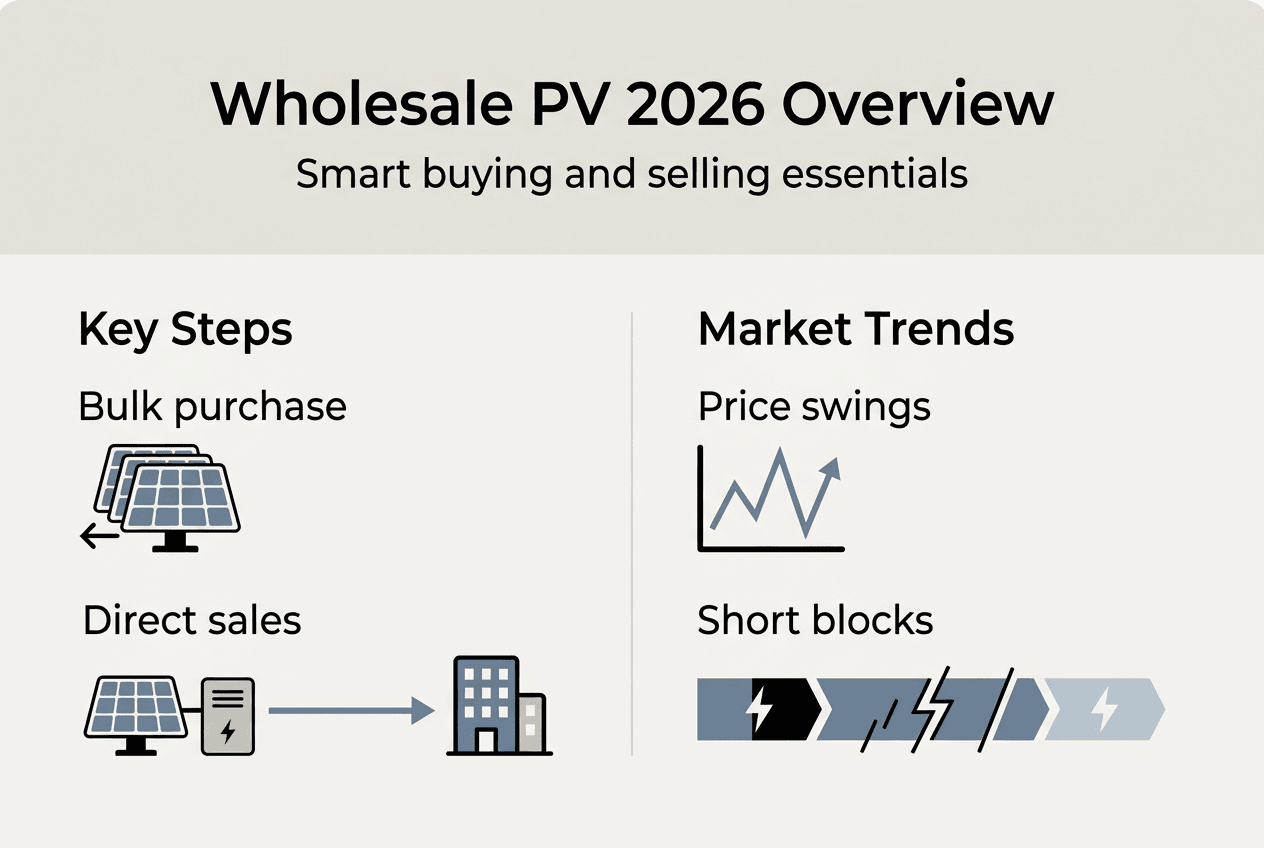
Commercial and industrial (C&I) systems show 8 to 10 year payback periods with current subsidies and wholesale market participation. Older systems installed under generous feed-in tariff programs may still favor fixed rates over market exposure. Evaluating your existing contract terms and remaining subsidy duration helps determine optimal timing for transitioning to wholesale participation.
Market Factor | Impact on Wholesale PV | Mitigation Strategy |
Price volatility | Revenue uncertainty from hourly price swings | Use aggregator premiums and storage arbitrage |
Grid congestion | Curtailment during high solar production | Install storage to capture curtailed energy |
Forecasting requirements | Penalties for inaccurate generation predictions | Partner with experienced aggregators |
Regulatory changes | Shifting subsidy and market rules | Monitor policy updates and maintain flexibility |
Real-time EMS and remote control systems are mandatory for systems above 100 kW in most EU markets. These platforms communicate with grid operators, execute curtailment commands, and transmit generation data every 15 minutes. Smaller systems benefit from voluntary EMS installation to access wholesale markets through aggregator pooling.
Key opportunities for 2026 include:
Expanding balancing market access for residential aggregators, opening new revenue streams
Declining storage costs making arbitrage strategies economically viable for smaller systems
Improved forecasting tools reducing penalties and increasing net market revenues
Policy support for distributed energy resources strengthening long-term market stability
Pro Tip: Monitor your local transmission system operator announcements for grid expansion projects, as improved infrastructure reduces congestion and negative price events in your area.
Solar payback calculation benelux roi guide 2026 provides detailed frameworks for evaluating wholesale participation against fixed tariff alternatives. Solar energy management central europe explores regional market differences affecting strategy selection.
Practical steps for residential and commercial owners to leverage wholesale PV
Transitioning to wholesale PV participation requires systematic planning and technology deployment. Follow these steps to implement an effective strategy:
Install or upgrade to a suitable EMS for real-time data and remote control capabilities. Your EMS must communicate with aggregators and grid operators, log generation data at 15-minute intervals, and support remote curtailment commands. Belinus EMS platforms integrate with Solis inverters and Energy Wall storage systems, providing centralized management for residential and commercial installations.
Partner with direct marketers or aggregators experienced in EU wholesale electricity markets. Evaluate aggregators based on premium offerings (typically 0.3 to 0.8 cents per kWh above market price), contract flexibility, forecasting accuracy, and customer support quality. Established aggregators handle regulatory compliance, reducing your administrative burden.
Evaluate system size for mandatory market participation rules. Germany requires systems above 100 kW to participate in direct marketing, while smaller systems can join voluntarily through aggregator pooling. Understanding your local thresholds helps determine whether independent participation or pooled arrangements make sense.
Consider integration of energy storage to maximize financial returns through arbitrage. Match storage capacity to your solar output and consumption patterns. Residential systems typically pair 1 to 2 kWh storage per kW of solar capacity, while commercial installations optimize based on demand profiles and available capital.
Assess costs including setup (around €5,000 for EMS installation), monthly fees (€50 to €150 for aggregator services), and marketing fees (0.2 to 0.6 cents per kWh). Compare total costs against expected revenue increases from wholesale participation. Most systems achieve positive returns within the first year of market participation.
Monitor policy changes and market signals to adjust strategies and optimize revenue. Subscribe to aggregator market reports, track wholesale price trends, and review contract terms annually. Market conditions evolve rapidly, and flexibility allows you to capitalize on emerging opportunities.
Pro Tip: Start with monitored pilot setups before scaling to full wholesale market participation. Run your existing system through an aggregator for three to six months while maintaining your fixed tariff as backup, then transition fully once you understand revenue patterns and operational requirements.
Commercial PV installation process guides larger property owners through system sizing, permitting, and grid interconnection procedures. Integrated PV systems energy management explores how centralized platforms coordinate solar, storage, and consumption for optimal market participation.
Starting with an EMS for monitoring and working with aggregators helps mitigate risks and secure premiums in direct marketing. Technology selection matters: platforms supporting API integrations enable future expansion into EV charging coordination and smart appliance control, multiplying optimization opportunities beyond simple solar arbitrage.
Explore smart solar solutions with Belinus
Belinus offers tailored solar PV and energy storage systems designed for European residential and commercial properties seeking wholesale market participation. Our solutions include advanced energy management systems managing 15-minute trading blocks, real-time battery arbitrage, and multi-market revenue optimization. The Energy Wall G1 graphene supercapacitor delivers 16 kWh capacity with rapid charge/discharge rates ideal for frequent arbitrage cycling, launching Q1 2026 at €7,000 per unit.

Benefit from expert consultations optimizing your solar investments for 2026 market conditions and beyond. Our centralized EMS integrates Solis inverters, Energy Wall storage, and ETAP Pro EV chargers into unified platforms accessible through native mobile apps and web dashboards. Whether you operate a residential rooftop system or manage commercial installations, Belinus solar solutions provide the technology and support needed to maximize wholesale PV returns.
Frequently asked questions
What is wholesale PV and why should I consider it?
Wholesale PV combines bulk purchasing of solar equipment with direct marketing of generated electricity into wholesale markets at real-time prices. This approach reduces upfront costs through bulk buying and increases revenue potential by capturing price spikes instead of fixed tariffs. Property owners gain flexibility to optimize earnings through storage arbitrage and multi-market participation. Consider wholesale PV if your system exceeds 25 kW or you have appetite for active energy management.
How does integrating battery storage improve solar PV returns?
Storage allows charging batteries during low-price periods (often midday when solar floods the grid) and discharging during high-price evening peaks. This arbitrage strategy can double revenue compared to simple feed-in arrangements. Storage also enables self-consumption optimization, reducing grid purchases during expensive peak hours. Systems combining PV and storage typically see 30 to 50 percent higher annual returns than PV-only installations.
What are the costs involved in direct marketing of solar electricity?
Typical costs include EMS installation (around €5,000), marketing fees (0.2 to 0.6 cents per kWh sold), and monthly aggregator fees (€50 to €150). Larger commercial systems may face higher setup costs but benefit from economies of scale on per-kWh fees. Understanding these costs helps estimate realistic payback periods, which typically range from 8 to 10 years for C&I systems with current subsidies and market conditions.
Are there risks to selling PV electricity on wholesale markets?
Price volatility exposes sellers to revenue uncertainty, as wholesale prices fluctuate hourly based on supply and demand. Negative price events can force generators to pay for exporting electricity. However, aggregator premiums (0.3 to 0.8 cents per kWh above market price) and government subsidies offset most downside risk. Using advanced EMS platforms and partnering with reputable aggregators further reduces operational risks through accurate forecasting and automated curtailment responses.
Recommended
Comments