Why Upgrade Business Energy: the CFO's Case
- 7 days ago
- 8 min read

TL;DR:
Energy upgrades encompass on-site generation, storage, smart controls, and integrated management, reducing costs and boosting resilience. These strategies improve operating margins, enhance brand perception, and attract high-quality tenants, customers, and employees. Implementing comprehensive, holistic solutions with incentives and data-driven management maximizes financial and environmental benefits.
Most business owners treat energy as a fixed cost. You pay the bill, move on, and assume there’s not much you can do beyond shopping for a cheaper supplier. That thinking is costing you money. Understanding why upgrade business energy decisions matter in 2026 goes well beyond finding a lower per-kWh rate. It touches your operating margins, your brand perception, your exposure to market volatility, and your ability to attract tenants, customers, and employees who care about what your building signals about your values.
Table of Contents
Key takeaways
Point | Details |
Upgrades go beyond switching suppliers | True energy upgrades combine on-site generation, storage, efficiency, and smart controls for compounding savings. |
Market volatility is a real financial risk | Diversifying energy sources and aligning procurement with infrastructure reduces cost exposure significantly. |
Incentives lower upfront barriers | Government and utility rebate programs can reduce capital requirements to near zero when bundled correctly. |
Data is the upgrade multiplier | Granular energy monitoring unlocks Scope 2 reporting compliance and ongoing optimization opportunities. |
Integrated strategy outperforms piecemeal fixes | Businesses combining procurement, generation, and management consistently outperform peers on cost control. |
Why upgrade business energy: the real case for change
Energy efficiency is not a sustainability checkbox. Energy upgrades affect profitability, brand image, property value, and the comfort of the people inside your building. The National Labs identify operating cost reduction and competitiveness as primary outcomes, not secondary ones.
So what does an energy upgrade actually include? It is not just switching suppliers. A real upgrade involves at least some combination of:
On-site generation such as solar PV or wind, reducing dependence on grid pricing
Battery storage to capture cheap or self-generated power and discharge during expensive periods
Efficiency improvements to lighting, HVAC, insulation, and industrial processes
Smart controls and monitoring to stop wasting energy that no one is tracking
EV charging infrastructure integrated into your load management to avoid demand spikes
Each of these layers adds to a compounding effect. A solar array saves money in daylight hours. A battery stores that savings for evening use. A smart energy management system prevents the battery from depleting when grid prices drop, so you are always optimizing. That is a fundamentally different outcome than simply negotiating a better tariff.
The benefits of upgrading energy also extend to your commercial real estate value. Buildings with certified energy performance attract higher-quality tenants and command stronger lease rates. If you own the property your business occupies, an upgrade is both an operational and an asset investment.
Pro Tip: Before comparing upgrade options, audit your current energy use by category. HVAC, lighting, and process loads often tell completely different stories, and the highest-spend category is rarely the easiest to optimize.
Incentive programs reduce the financial barrier further than most owners realize. Austin Energy, for example, offers over 20 rebate programs for commercial customers, including $1 per square foot for insulation and $50 to $80 per average kilowatt saved during peak demand events. These are real dollars that reduce your effective capital requirement from day one.
Managing energy market volatility
Energy prices are not stable, and pretending they are is a financial planning error. The question is not whether prices will swing. It is whether your business is positioned to absorb that swing or hedge against it.
Businesses that combine procurement with on-site generation and flexible purchasing consistently outperform peers when spot prices spike. Here is how that strategy works in practice:
Diversify your energy sources. On-site solar or wind generation creates a buffer against grid price volatility. You generate at a known cost regardless of what the market does.
Use battery storage as a financial instrument. Charge during off-peak or self-generation periods. Discharge during peak pricing windows. The Belinus Energy Management System runs 15-minute dynamic tariff optimization to do this automatically.
Align your procurement cycle with your infrastructure roadmap. If you are renewing a fixed-rate contract, know when your solar or storage upgrade will come online. Locking a long contract before installing generation means you miss the arbitrage window.
Consider a power purchase agreement. A PPA lets you buy renewable energy at a contracted price for 10 to 20 years, removing spot market exposure entirely for that portion of your load.
Integrate flexible purchasing. Buying a portion of energy on flexible or time-of-use contracts gives you options to shift consumption to cheaper periods, particularly when combined with storage.
“Successful businesses don’t manage procurement and infrastructure separately. They run them as a single risk management function. When those two cycles are misaligned, companies leave significant savings on the table.” Source: BusinessGreen Feature on Energy Market Volatility
Integrated energy strategies that combine procurement, on-site generation, and energy management consistently outperform businesses that treat these as separate decisions. The ones who get it right are not energy experts. They are businesses that hired the right partners and stopped treating energy as a passive cost.
Evaluating the real cost savings
The financial case for upgrading business energy is strong, but you need to look at it correctly. Most businesses focus entirely on commodity rates, and that is only part of the picture.
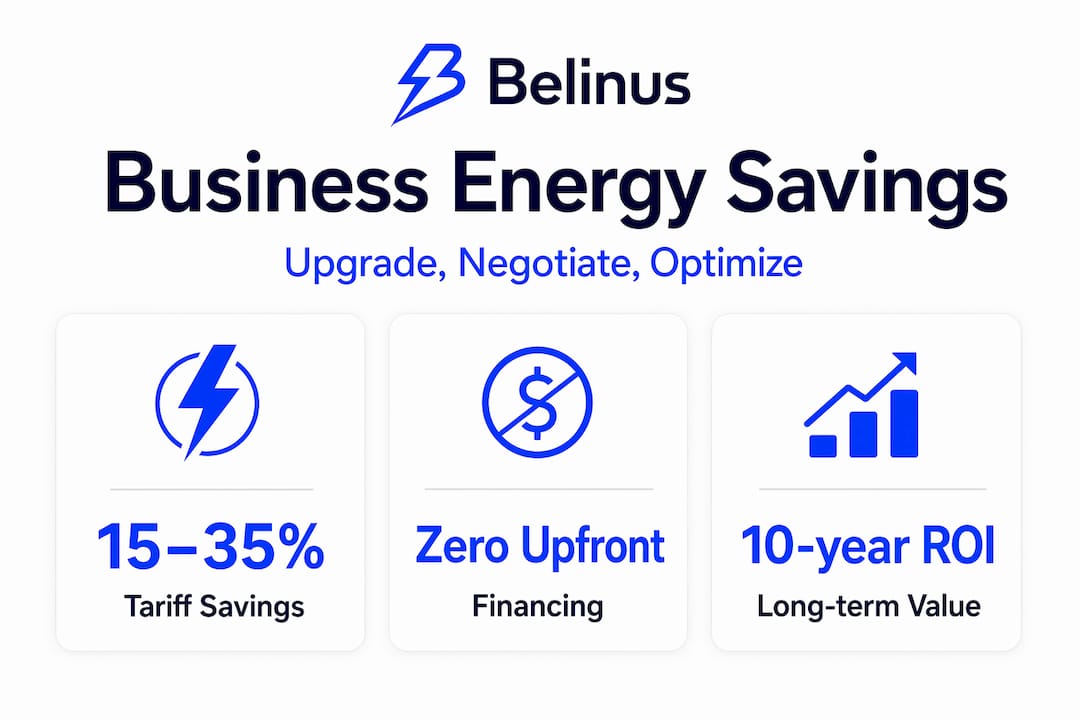
UK businesses switching from deemed or out-of-contract tariffs to properly negotiated fixed deals can save 15 to 35% on their bills immediately, before any physical upgrade. That gap exists because suppliers charge a significant premium when you let a contract expire or never properly negotiate one. Closing that gap is the first, easiest win.
Cost category | Controllable? | Typical intervention |
Commodity rate | Partially | Fixed contracts, PPAs, on-site generation |
Supplier margins | Yes | Competitive tendering, broker management |
Non-commodity charges | Partially | Demand management, time-of-use shifts |
Network charges | Partially | Demand reduction, local generation offset |
Wastage and inefficiency | Fully | Monitoring, controls, upgrades |
Most businesses underestimate controllable costs by focusing only on commodity prices. Your supplier margin, standing charges, and non-commodity levies are all areas where informed action produces measurable savings. Pairing that knowledge with physical upgrades creates a multiplier effect.
Government funding programs back this approach. In England and Wales, the Heat Network Efficiency Scheme funds diagnostic studies and hardware replacement for heat networks, separating revenue grants for initial studies from capital grants for actual hardware. That staged approach lets you validate savings potential before committing full capital, which is exactly how you should be thinking about any major upgrade project.
Financing makes the math even cleaner. Bundling rebates with financing can reduce upfront costs to near zero for small businesses, with repayments structured against the savings the upgrade generates. That is not a loan. That is a self-funding improvement.
Pro Tip: Model your energy upgrade as a 10-year financial position, not a one-year capital expense. Include avoided costs, incentive recovery, and asset value changes. The payback period almost always looks shorter than the initial quote suggests.
Holistic energy management: treating it as a system
The single biggest mistake businesses make with energy upgrades is treating them as individual projects. One year you add solar. Next year you look at lighting. The year after, someone proposes a battery. Each decision is evaluated in isolation, and none of them delivers the full return they should.
Managing energy as a connected system changes the outcome entirely. Here is what that looks like in practice:
Centralized monitoring that captures granular hourly data across all loads. Granular energy data is becoming a compliance requirement for Scope 2 emissions reporting, not just a nice-to-have operational tool.
Solar and storage coordination so generation, storage, and consumption interact intelligently. Without this, you can have solar on the roof and still pay peak rates because your battery discharged at the wrong time.
EV charging integration into your load management profile. A fleet of unmanaged EV chargers can double your peak demand charge. Managed correctly through a system like Belinus’s ETAP Pro EV Charger with fleet integration, that same fleet becomes a dispatchable load you control.
Emissions reporting automation using real consumption data rather than averages or estimates. For businesses with sustainability commitments or reporting obligations, this is a compliance upgrade as much as an energy one.
Phased capital planning aligned to governance cycles. Phased energy upgrades that start with diagnostic studies before hardware commitments consistently deliver better ROI than all-at-once capital deployments.
Platforms like the Belinus EMS bring all of these streams together, running real-time optimization across solar, storage, and EV loads through a single interface. The result is a system that gets smarter over time, not one that delivers a single payback event and flatlines.
My honest take on where most businesses get this wrong

I have watched business owners spend months debating whether to install solar while sitting on contracts that are costing them 25% more than the market rate. That is the wrong starting point. Every energy upgrade decision should begin with a full picture of what you currently control and what you are currently leaving on the table.
The businesses I have seen do this well share one habit: they treat energy as a portfolio. Not a single line item. They segment their spend into what is fixed, what is variable, and what is wastage. Then they target interventions in order of impact per dollar committed.
What surprises most decision-makers is that the highest-return interventions are rarely the most expensive ones. Renegotiating a contract or fixing a metering setup can outperform a $100,000 equipment upgrade in year one. The problem is those wins are invisible. Nobody gets a photo of a renegotiated contract.
I also think the sustainability angle is undersold in purely financial conversations. The importance of energy efficiency for brand positioning is real and accelerating. Your employees, your customers, and increasingly your financiers look at your energy footprint. That is a competitive variable, not a marketing footnote.
The businesses that treat energy upgrades as a long-term portfolio rather than a procurement decision are consistently better positioned. They spend less, report better, and attract stronger partners. That is not a coincidence.
— Marc
See how Belinus can help you take the next step
If you are ready to move from identifying why upgrade business energy matters to actually acting on it, Belinus provides the tools and technology to make that transition concrete.
Belinus brings together solar PV, battery storage, and EV charging into a single integrated energy platform with a centralized EMS that handles dynamic tariff optimization, real-time arbitrage, and emissions tracking. Whether you are a mid-size business looking to reduce grid dependence or a larger operation managing multiple sites, the Belinus system scales to your needs. Explore how industrial energy monitoring can cut your costs and improve your reporting today.
FAQ
What does “upgrading business energy” actually mean?
Upgrading business energy means moving beyond supplier switching to include on-site generation, storage, smart controls, and integrated energy management. It targets both cost reduction and energy security at the same time.
How much can a business realistically save by upgrading energy?
Savings vary, but businesses switching from out-of-contract tariffs alone can save 15 to 35% before any physical upgrade. Physical upgrades combined with rebates and financing often deliver full payback within 5 to 8 years.
What financial incentives exist for business energy upgrades?
Programs like Austin Energy’s rebate schemes offer per-square-foot and per-kilowatt payments, while UK government grants fund diagnostic studies and hardware for heat network improvements. Many utilities offer similar programs worth researching locally.
Why is an energy management system worth the investment?
An energy management system coordinates solar, storage, and load shifting in real time, preventing the kind of misaligned discharge or unmanaged demand spikes that erode savings from individual upgrades. Without it, your separate systems work against each other.
How does upgrading energy improve business competitiveness?
Beyond direct cost savings, energy efficiency upgrades increase property value, improve employee and customer comfort, and strengthen brand positioning with stakeholders who increasingly evaluate environmental performance as a business quality signal.
Recommended
Comments