Battery technology types for sustainable energy 2026
- 1 day ago
- 10 min read
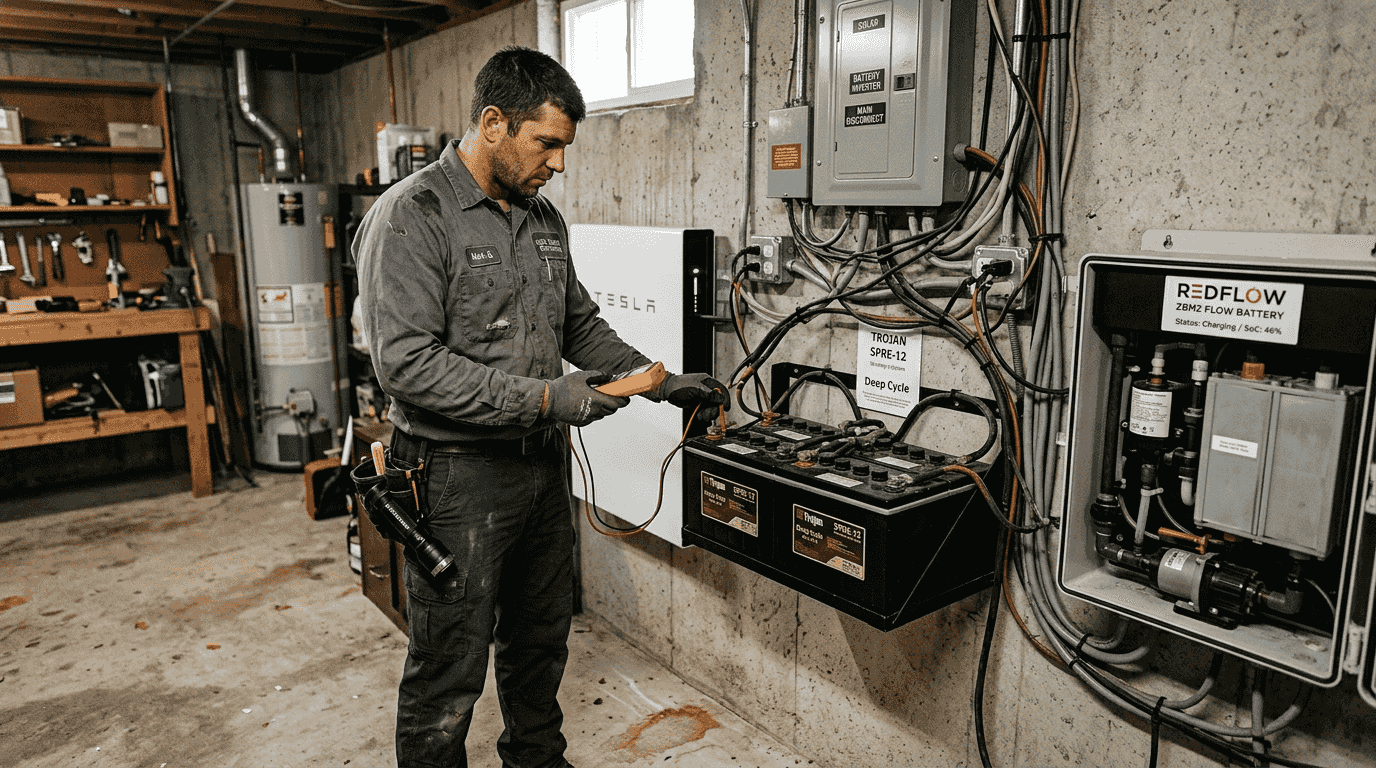
Choosing the right battery technology can feel overwhelming when you’re trying to optimize energy use at home or in your small business. With multiple advanced options available in 2026, each offering different benefits for sustainable energy management, you need a clear framework to evaluate what works best for your situation. This guide walks you through essential criteria for assessing battery technologies and compares lithium-ion, lead-acid, and flow batteries so you can make an informed decision that aligns with your energy needs and sustainability goals.
Table of Contents
Key takeaways
Point | Details |
Evaluation criteria matter | Efficiency, lifetime, energy density, cost, and environmental impact determine which battery fits your needs. |
Three main technology types | Lithium-ion, lead-acid, and flow batteries each serve different applications and budgets. |
Match technology to use case | High-power needs favor lithium-ion, while long-duration storage suits flow batteries. |
Consider total cost of ownership | Upfront price differs from lifetime value when factoring in cycle life and maintenance. |
Sustainability drives innovation | Advanced battery options in 2026 support renewable integration and reduce carbon footprints. |
How to evaluate battery technology types: essential criteria
Before diving into specific battery technologies, you need a solid framework for comparison. The right metrics help you cut through marketing claims and focus on what actually matters for your energy storage needs. Important metrics for long-duration energy storage include efficiency, lifetime, and energy density, which are especially critical when you’re planning sustainable energy systems.
Start with round-trip efficiency, which measures how much energy you get back compared to what you put in. A battery with 90% efficiency returns 90 kWh for every 100 kWh stored. This directly impacts your electricity bills and system payback period. Next, consider cycle life, the number of charge-discharge cycles a battery can handle before capacity drops significantly. A system lasting 5,000 cycles at one discharge per day gives you nearly 14 years of service, while 10,000 cycles doubles that lifespan.
Energy density tells you how much power fits in a given space. For residential installations with limited room, high energy density batteries pack more storage into smaller footprints. Cost per kilowatt-hour stored varies widely across technologies, and you need to account for both upfront investment and replacement expenses over the system’s lifetime. Environmental impact matters too, from manufacturing processes to end-of-life recycling options.
Pro Tip: Calculate total cost of ownership over 20 years rather than comparing sticker prices. A cheaper battery with half the cycle life often costs more in the long run.
When evaluating options, create a weighted scorecard based on your priorities:
Energy needs and usage patterns
Available installation space
Budget for initial investment and maintenance
Sustainability and recycling requirements
Integration with existing solar or grid systems
Understanding the role battery technologies play in industry helps you see how residential applications benefit from commercial innovations. The same principles apply whether you’re powering a home or managing energy for a small business facility.
Lithium-ion, lead-acid, and flow batteries: overview and features
Three battery technologies dominate the residential and small commercial energy storage market in 2026. Each brings distinct advantages and tradeoffs that make sense for different applications. Understanding how these technologies work helps you match capabilities to your specific requirements.
Lithium-ion batteries have become the default choice for many installations due to their high energy density and efficiency. These systems use lithium compounds in the cathode and typically achieve 90-95% round-trip efficiency. You’ll find them in compact wall-mounted units that fit easily in garages or utility rooms. Modern lithium-ion systems handle 3,000-10,000 cycles depending on depth of discharge and chemistry variations like lithium iron phosphate or nickel manganese cobalt. The technology integrates seamlessly with solar inverters and smart energy management systems. However, upfront costs remain higher than alternatives, and thermal management requirements add complexity to installation.
Lead-acid batteries represent the most established and budget-friendly technology. These systems have powered off-grid applications for decades and still make sense when initial cost is the primary constraint. You can expect 500-1,500 cycles from flooded lead-acid batteries and up to 3,000 from sealed variants. Round-trip efficiency typically ranges from 70-85%, meaning more energy loss compared to newer technologies. Lead-acid batteries require more physical space due to lower energy density and need regular maintenance for flooded types. Environmental concerns around lead extraction and recycling exist, though established recycling infrastructure handles end-of-life disposal better than some newer chemistries.
Flow batteries use liquid electrolytes stored in external tanks, with performance characteristics that differ significantly from solid-state lithium-ion and lead-acid systems. Vanadium redox flow batteries are the most common variant, though zinc-bromine and other chemistries exist. These systems excel at long-duration storage because you can scale energy capacity independently from power output by simply adding larger electrolyte tanks. Cycle life often exceeds 10,000-20,000 cycles with minimal degradation. Flow batteries handle deep discharge without damage and maintain consistent performance across their lifetime. The tradeoff comes in lower energy density and higher complexity, making them more suitable for larger installations where space is available.
Exploring hybrid battery systems in Central Europe shows how different technologies can work together to optimize performance and cost.
Comparing battery technologies: performance and practical considerations
Seeing these technologies side by side reveals where each shines and where compromises exist. The following comparison helps you weigh options based on real-world performance metrics that affect your daily energy management.
| Metric | Lithium-Ion | Lead-Acid | Flow Batteries | | — | — | — | | Energy Density | 150-250 Wh/kg | 30-50 Wh/kg | 20-70 Wh/kg | | Round-Trip Efficiency | 90-95% | 70-85% | 65-85% | | Cycle Life | 3,000-10,000 | 500-3,000 | 10,000-20,000+ | | Upfront Cost | €€€ | € | €€€€ | | Maintenance Needs | Minimal | Moderate to High | Moderate | | Scalability | Limited | Limited | Excellent | | Environmental Impact | Moderate | Higher (lead) | Lower (recyclable electrolytes) |
Beyond these specifications, practical deployment factors shape which technology works best for your situation. Climate plays a bigger role than many homeowners realize. Lithium-ion batteries perform optimally between 15-25°C and require thermal management in extreme temperatures. Lead-acid batteries tolerate wider temperature ranges but lose capacity in cold conditions. Flow batteries handle temperature variations better due to their liquid electrolyte design, though practical deployment challenges like climate and logistics affect installation in some regions.
Installation space constraints often eliminate certain options immediately. A typical 10 kWh lithium-ion system fits in a space roughly the size of a water heater, while an equivalent lead-acid bank might require three times that footprint. Flow batteries need room for electrolyte tanks in addition to the power stack, making them more suitable for commercial installations or properties with dedicated equipment areas.

Pro Tip: Factor in future expansion when choosing battery technology. Systems that allow modular additions save money compared to replacing entire units when energy needs grow.
Real-world deployments demonstrate these tradeoffs in action. Flow batteries deployed in South Australia like the Invinity VS3 system show how long-duration storage supports renewable integration at scale. For residential applications, lithium-ion dominates due to space efficiency and decreasing costs. Small businesses with higher energy demands increasingly consider flow batteries when they have adequate installation space and need storage lasting 4-8 hours or more.
Maintenance requirements differ substantially across technologies:
Lithium-ion systems need minimal intervention beyond monitoring software updates
Flooded lead-acid batteries require regular water level checks and terminal cleaning
Flow batteries need periodic electrolyte testing and pump maintenance
Looking at utility scale storage examples provides insight into how these technologies perform in demanding applications, which translates to reliability expectations for smaller systems.
The best battery technology isn’t the one with the highest specifications. It’s the one that matches your energy patterns, budget, and physical constraints while meeting sustainability goals.
Which battery technology fits your home or business? Situational recommendations
Applying all this technical knowledge to your specific situation requires matching technology capabilities to your actual energy needs and constraints. Follow these steps to narrow down the right choice for your home or small business.
First, analyze your energy consumption patterns. Pull up your electricity bills from the past year and identify your daily usage curve. Do you consume most energy during daylight hours when solar panels produce, or do you need significant storage for evening and overnight use? Homes with high daytime consumption benefit most from smaller batteries that handle peak shaving. Properties with evening-heavy usage need larger capacity for time-shifting solar generation. Small businesses often show different patterns on weekdays versus weekends, requiring flexible systems that adapt to varying demands.
Second, determine your storage duration needs. Calculate how many hours of backup power you want during grid outages or how long you need to store solar energy for later use. Lithium-ion batteries excel at 2-4 hour storage windows, perfect for daily solar shifting and short outages. If you need 6-8 hours or more of continuous power, flow batteries become more cost-effective despite higher upfront investment. Lead-acid makes sense primarily when budget constraints are severe and you can tolerate more frequent replacement cycles.
Third, assess your available space and installation environment. Measure the area where you plan to install the battery system and note temperature ranges throughout the year. Compact lithium-ion units fit almost anywhere, while flow batteries need dedicated space with proper ventilation. Consider whether you have indoor climate-controlled space or if the system will face outdoor temperature extremes.
Fourth, calculate your total budget including installation, maintenance, and eventual replacement costs. Expert battery recommendations from research institutions emphasize total cost of ownership over purchase price. A lithium-ion system costing €8,000 with 10,000 cycles delivers better value than a €4,000 lead-acid system needing replacement after 1,500 cycles.
Fifth, prioritize your sustainability goals. If minimizing environmental impact ranks high, investigate recycling programs and manufacturing processes for each technology. Flow batteries with recyclable electrolytes and lithium-ion systems with established recycling infrastructure both support circular economy principles better than traditional lead-acid.
Pro Tip: Start with a smaller system that allows expansion rather than oversizing initially. Battery prices continue falling, so adding capacity in 2-3 years often costs less than buying excess capacity today.
For typical scenarios:
Urban homeowner with limited space: Choose compact lithium-ion for high energy density and minimal maintenance
Rural property with backup power needs: Consider lead-acid if budget is tight, lithium-ion if you can afford better performance
Small business with high daytime energy use: Lithium-ion systems with 4-6 hour storage optimize solar self-consumption
Commercial facility needing long-duration storage: Flow batteries provide the best economics for 6+ hour discharge cycles
Sustainability-focused installation: Lithium iron phosphate or flow batteries offer the best environmental profiles
Understanding the role batteries play in renewables across Central Europe shows how regional energy markets influence technology choices. Your local electricity pricing structure, available incentives, and grid reliability all factor into which battery technology delivers the best return on investment.
Discover advanced energy solutions tailored for you
Now that you understand how to evaluate and compare battery technologies, you’re ready to explore solutions designed specifically for European homeowners and small businesses pursuing sustainable energy management. Belinus develops integrated energy systems that combine solar PV, advanced battery storage, and intelligent management software to optimize your energy use and reduce costs.
Our Energy Wall G1 launching in Q1 2026 brings graphene supercapacitor technology to residential applications, offering 16 kWh storage with exceptional cycle life and efficiency. For larger installations, we provide scalable utility storage modules starting at 400+ kWh that grow with your business needs. Every system integrates with our centralized Energy Management System, which optimizes battery charging and discharging based on 15-minute dynamic tariffs and your consumption patterns. Whether you need a compact residential solution or a commercial-scale installation, our team designs custom systems that match the evaluation criteria and technology types covered in this guide to your specific requirements.
FAQ
What are the main types of battery technologies for home energy?
Lithium-ion, lead-acid, and flow batteries represent the three primary technologies for residential and small business energy storage in 2026. Lithium-ion offers the best combination of efficiency and energy density for most applications. Lead-acid provides a budget-friendly option with proven reliability despite shorter cycle life. Flow batteries excel when you need long-duration storage and can accommodate larger installation footprints.
How do flow batteries compare to lithium-ion batteries?
Flow batteries have longer lifetimes and better scalability but typically lower energy density than lithium-ion systems. Lithium-ion batteries pack more storage into smaller spaces and deliver higher round-trip efficiency, making them ideal for residential installations with limited room. Flow batteries shine in commercial applications where space is available and storage duration exceeds 6-8 hours. The choice depends on your specific energy patterns and physical constraints.
What factors should I consider when choosing a battery system?
Consider efficiency, energy density, cycle lifetime, upfront and maintenance costs, and environmental impact when selecting a battery system. Analyze your daily energy consumption patterns to determine required storage capacity and discharge duration. Evaluate available installation space and temperature conditions that affect battery performance. Calculate total cost of ownership over 20 years rather than focusing solely on purchase price. Align your selection with sustainability goals by researching recycling programs and manufacturing processes for each technology type.
How long do different battery technologies last?
Lithium-ion batteries typically deliver 3,000-10,000 cycles depending on chemistry and depth of discharge, translating to 8-27 years with daily cycling. Lead-acid systems last 500-3,000 cycles or roughly 1.5-8 years under similar conditions. Flow batteries exceed 10,000-20,000 cycles with minimal degradation, potentially providing 27-55 years of service. Actual lifespan depends on operating conditions, maintenance quality, and how deeply you discharge the battery each cycle. Shallower discharge cycles extend life across all technologies.
Are battery storage systems worth the investment in 2026?
Battery storage systems deliver strong returns when you have solar panels, face high electricity rates, or need backup power during outages. Systems pay for themselves through reduced grid purchases, peak demand charge avoidance, and participation in energy arbitrage programs. The economics improve significantly in regions with time-of-use pricing where you can store cheap overnight electricity for use during expensive peak hours. Factor in available incentives and subsidies that reduce upfront costs in many European markets. Calculate your specific payback period based on local electricity rates and your consumption patterns.
Recommended
Comments