Energy System Scalability Explained for Professionals
- Jul 9
- 8 min read

TL;DR:
Energy system scalability depends on modular storage, grid flexibility, and standardized interoperability. Grid access constraints and system-level coordination pose the greatest challenges to expanding capacity effectively. Proper modeling and systemic planning are essential for delivering scalable, reliable, and cost-effective energy infrastructure.
Energy system scalability is defined as the ability of energy infrastructure and technology to expand capacity and performance efficiently as demand grows, without proportional increases in cost or complexity. This concept sits at the intersection of technical design, grid economics, and policy, making it central to every serious renewable deployment decision. Modular battery storage, grid flexibility mechanisms, and standardized interoperability protocols are the three technical pillars that determine whether a system scales or stalls. For energy professionals and policymakers, energy system scalability explained is not an abstract concept. It is the difference between a grid that absorbs 500 MW of new solar capacity and one that queues it for a decade.
How modular battery storage enables scalability in energy systems
Battery storage scales along two independent dimensions: power, measured in megawatts, and capacity, measured in megawatt-hours. These two metrics are not interchangeable. A system with abundant MWh but insufficient MW cannot deliver the instantaneous response that frequency regulation or peak shaving requires.
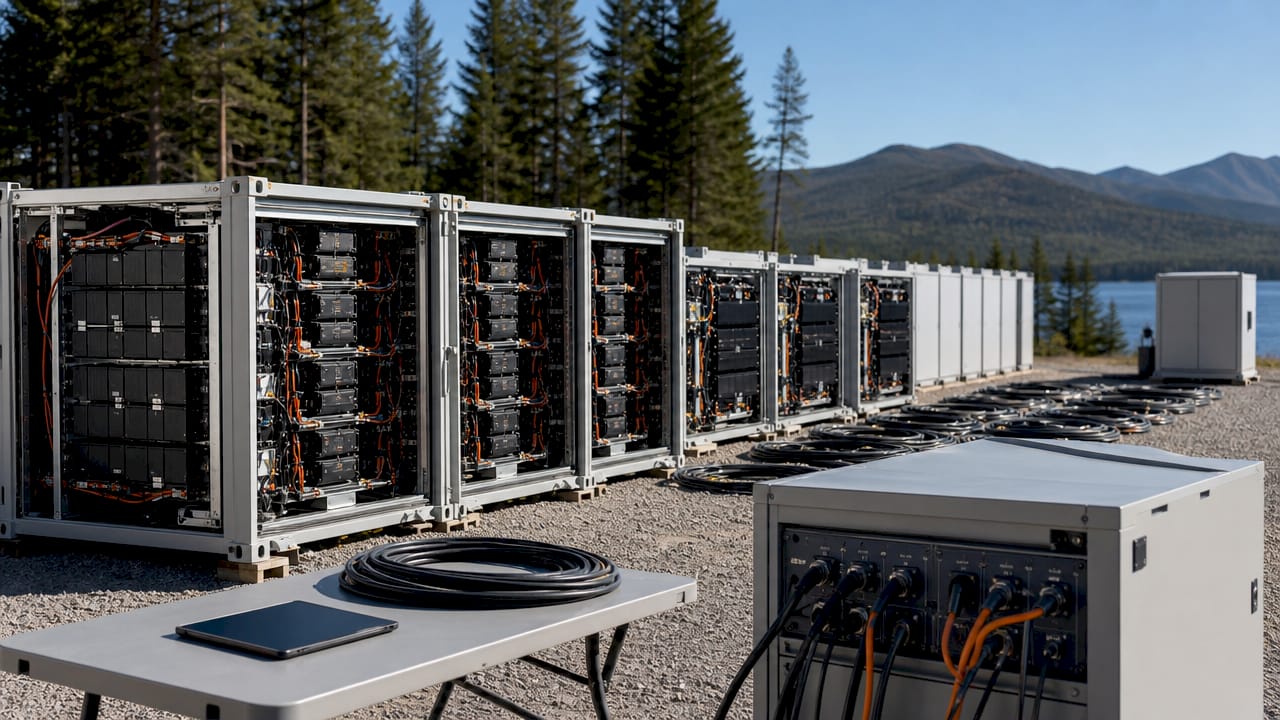
The standard architecture for grid-scale battery deployment uses containerized modules. Each container integrates cells, a battery management system, thermal management, and a power conversion system. This design allows operators to add modules without redesigning the entire installation. A 50 MW/100 MWh battery delivers two hours of full-power output, a configuration common in frequency response and energy arbitrage applications. That two-hour discharge duration is the baseline for most grid service contracts in European markets.
Discharge duration determines which grid services a battery can provide:
1-hour duration: Frequency containment reserve, fast demand response
2-hour duration: Frequency restoration reserve, peak shaving, arbitrage
4-hour duration: Capacity firming, renewable integration buffer, islanding support
8+ hour duration: Seasonal storage, long-duration backup for critical infrastructure
The table below shows how power and capacity scale together in common deployment configurations:
System size | Power (MW) | Capacity (MWh) | Primary application |
Small commercial | 1 | 2 | Demand charge reduction |
Mid-scale grid | 10 | 20 | Frequency response |
Large grid-scale | 50 | 100 | Arbitrage and firming |
Utility-scale | 200 | 400+ | System balancing |
Belinus utility storage modules start at 400+ kWh and scale to MW capacity, using this same containerized architecture. The Belinus Energy Management System coordinates dispatch across modules in 15-minute intervals, aligning storage output with dynamic tariff signals.
Pro Tip: When sizing a battery system for grid services, calculate the required power-to-capacity ratio before specifying module count. A system that adds MWh without upgrading the power conversion system creates a bottleneck that limits grid service delivery regardless of total installed capacity.
What role does grid flexibility play in scalability?
Flexibility is the core capability that separates a truly scalable energy system from one that simply has more installed capacity. Flexibility integrates battery storage, automated regulation, and demand-side management into a coordinated response mechanism. Without that coordination, adding generation or storage capacity does not improve system performance proportionally.
The challenge is that flexibility benefits are unevenly distributed. Industrial consumers with large, controllable loads capture most of the value from demand-side flexibility programs. Residential consumers contribute smaller, less predictable loads that are harder to aggregate and monetize. This asymmetry creates political friction around cost allocation, which slows the policy frameworks that scalable systems depend on.
Flexibility is more than a feature of modern energy systems. It is the systemic capability that makes capacity growth meaningful. Without coordinated flexibility, additional megawatts of generation or storage deliver diminishing returns to grid reliability and cost efficiency.
Smart grid projects demonstrate what coordinated flexibility looks like in practice. The Danube InGrid project, funded with €135 million from the EU, deploys automated on-load tap changer transformers and real-time monitoring across distribution networks in Central and Eastern Europe. These systems regulate voltage automatically as distributed renewable generation fluctuates, enabling the network to absorb higher penetration without manual intervention.
Scalability in energy systems also requires standardized interoperability. Distributed energy resources coordinated through hierarchical control architectures and RESTful APIs can respond to system signals at scale. Without those interfaces, each asset operates in isolation, creating what engineers call “flexibility islands.” These islands have local value but contribute nothing to system-level stability. Belinus addresses this directly through its RESTful API and centralized EMS, which aggregates signals from solar PV, battery storage, and EV charging across a single control layer.
Pro Tip: Assess your flexibility assets against a hierarchical control framework before deployment. Local optimization without system-level coordination produces isolated flexibility islands that reduce overall grid value and limit your ability to participate in ancillary service markets.
Cybersecurity is the risk that scales alongside flexibility. Every connected asset is a potential attack surface. Automated demand response systems, smart inverters, and grid-edge storage all require encrypted communication protocols and access controls. This is not a secondary concern. It is a design requirement for any scalable, flexible energy system.
What are the main challenges limiting energy system scalability?
The most underappreciated constraint on scalability in energy systems is not technology. It is grid access. Grid access in Central Europe is allocated administratively rather than priced as a scarce economic resource. This creates speculative queuing, where developers reserve grid connection capacity without firm project commitments, blocking access for projects that are ready to build.
The consequences are concrete:
Queue congestion: Interconnection queues in several EU member states contain multiples of the actual buildable capacity, with no mechanism to prioritize projects by system value.
Delayed delivery: Grid infrastructure projects take 10+ years to complete, while battery storage and solar PV can be deployed in months.
Misaligned incentives: Administrative allocation rewards early reservation, not project readiness or grid contribution.
Stranded investment risk: Developers who secure connections early may find the grid configuration has changed by the time their project reaches financial close.
The real energy crisis in Central Europe is not a shortage of generation capacity. It is a shortage of grid access, caused by allocation mechanisms that treat a scarce economic resource as a free administrative entitlement.
The temporal mismatch between renewable deployment speed and grid expansion timelines is the defining scalability challenge of this decade. Battery storage partially bridges this gap by providing services that defer the need for new transmission infrastructure. But storage cannot substitute for grid expansion indefinitely. At high penetration levels, the absence of adequate transmission capacity creates congestion that no amount of local storage can resolve.
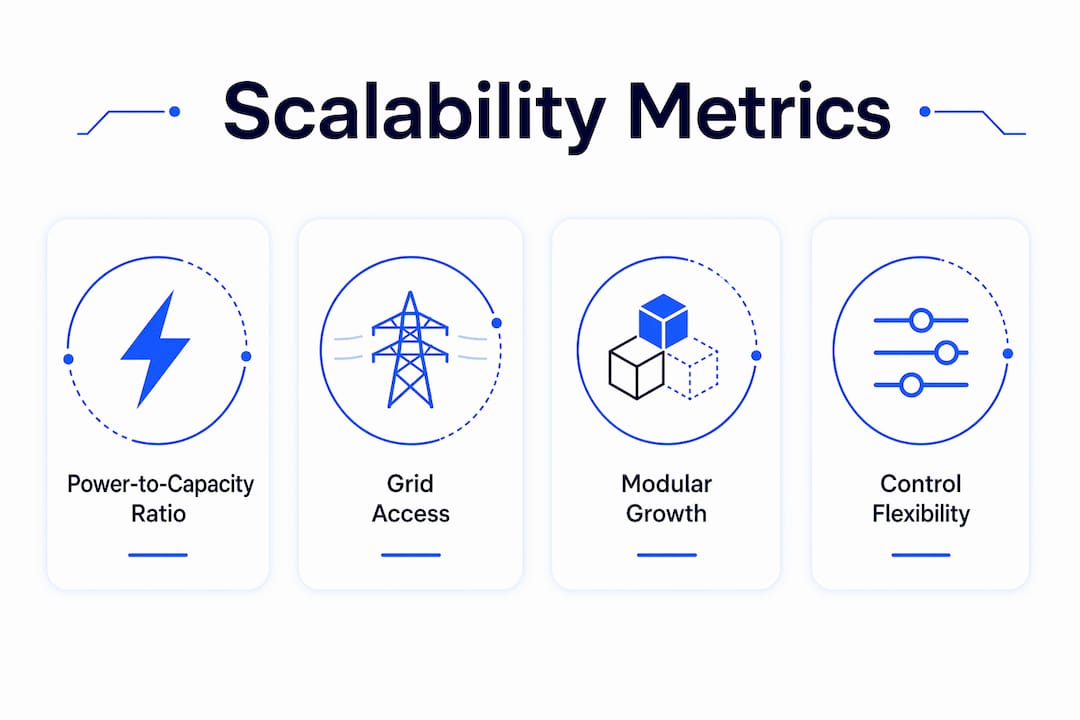
A less-discussed scalability pitfall is the power-to-capacity ratio problem in battery systems. Operators focused on maximizing MWh often undersize the power conversion system and grid interconnection. The result is a battery that cannot discharge at the rate the grid needs during stress events. Capacity on paper does not equal capability in practice.
How do professionals measure and model energy system scalability?
Measuring scalability requires quantitative models that capture both technical performance and economic constraints. Energy system planning models use a convergence tolerance below 10% between generation technology outputs to balance model complexity with accuracy. This 10% margin is the standard threshold for determining whether a scenario has reached a stable, consistent solution across all modeled time periods.
The practical steps for scalability modeling follow a structured sequence:
Define the baseline: Map current generation capacity, load profiles, and grid topology at the relevant geographic scale.
Identify throughput metrics: Select load factors, utilization rates, and congestion indices as the primary scalability indicators.
Run scenario iterations: Apply demand growth projections and technology deployment rates to test how the system responds under different expansion paths.
Apply convergence checks: Verify that model outputs stabilize within the 10% tolerance before drawing policy conclusions.
Calibrate against real deployments: Use data from commissioned battery projects and grid infrastructure upgrades to validate model assumptions.
The table below shows the key metrics used to assess scalability at different system levels:
System level | Primary metric | Scalability indicator |
Asset level | Power-to-capacity ratio | Discharge capability per MWh installed |
Network level | Congestion frequency | Hours per year at transmission limit |
System level | Renewable curtailment rate | MWh curtailed as share of total generation |
Planning level | Convergence tolerance | Model stability across scenario iterations |
Scenario planning that ignores scalability constraints produces infrastructure decisions that look optimal on paper but fail under real operating conditions. The most common error is modeling generation expansion without simultaneously modeling the grid reinforcement required to deliver that generation to load centers.
Key Takeaways
Energy system scalability requires coordinated growth across generation, storage, grid infrastructure, and flexibility mechanisms. No single technology scales a system alone.
Point | Details |
Power and capacity are separate dimensions | Size battery systems by both MW and MWh to avoid power conversion bottlenecks. |
Grid access is the binding constraint | Administrative allocation of grid connections causes speculative queuing and delays that technology cannot solve. |
Flexibility requires system-level coordination | Isolated flexibility assets create islands that reduce grid value; standardized APIs and hierarchical control are required. |
Convergence tolerance guides modeling | Energy planning models use a below-10% convergence margin to produce reliable scenario outputs for policy decisions. |
Temporal mismatch is the decade’s core challenge | Battery storage can defer grid investment, but cannot substitute for transmission expansion at high renewable penetration. |
Why scalability demands systemic thinking, not just bigger hardware
The energy sector has a persistent tendency to treat scalability as a procurement problem. Buy more panels, add more batteries, connect more assets. That framing misses the point entirely. What I have seen repeatedly in large-scale energy projects is that the binding constraint is almost never the technology. It is the system around the technology.
Grid access allocation in Central and Eastern Europe is the clearest example. The technical capacity to connect gigawatts of new renewable generation exists. The administrative framework to allocate that capacity fairly does not. Fixing this requires treating grid access as a priced economic resource, not a first-come, first-served entitlement. That is a policy decision, not an engineering one.
The second lesson I would push hard on is the danger of high-cost, niche technologies that promise scalability but cannot be absorbed by real systems at the required rate. Hydrogen is the current example. The production costs, infrastructure requirements, and conversion losses make it a poor candidate for near-term grid-scale deployment in most markets. Policymakers who bet heavily on it risk supply security while waiting for costs to fall.
The path that actually works is modular, interoperable, and grid-aware. Battery storage with standardized interfaces, coordinated through a capable energy management system, and sized correctly for both power and capacity. That combination delivers scalability that is measurable, deployable, and economically defensible. The complexity will grow as more assets connect. The answer to that complexity is better coordination architecture, not simpler systems.
— Marc
Belinus: modular storage and grid flexibility at scale
Scalable energy systems require hardware that grows with demand and software that coordinates every asset in real time. Belinus designs exactly that combination, from residential battery walls to utility-scale storage modules exceeding 400 kWh, all managed through a centralized EMS that runs 15-minute dynamic tariff optimization.

The Belinus platform supports LFP, pre-lithiated LFP, graphene supercapacitor, and HUC chemistries, giving project developers the flexibility to match technology to application. The RESTful API connects third-party assets into the same control layer, eliminating the flexibility island problem at the system level. For professionals working on commercial battery storage projects or utility-scale deployments, Belinus provides custom system design from small commercial and industrial installations up to grid-scale capacity. Explore the full range of solutions at belinus.com.
FAQ
What is energy system scalability?
Energy system scalability is the ability of energy infrastructure to expand capacity and performance efficiently as demand increases, without proportional rises in cost or complexity. It encompasses generation, storage, grid infrastructure, and flexibility mechanisms working in coordination.
How does modular battery storage support scalability?
Modular containerized battery systems allow operators to add power and capacity incrementally without redesigning the full installation. A standard 50 MW/100 MWh configuration delivers two hours of full-power output and can be expanded by adding modules with integrated power conversion and control.
What is the biggest constraint on energy infrastructure scalability?
Grid access is the primary constraint in most markets. Administrative allocation mechanisms create speculative queuing that delays project delivery by years, while grid expansion timelines of 10 or more years lag far behind the speed of renewable and battery deployment.
Why does the power-to-capacity ratio matter for battery scaling?
A battery system that adds MWh without upgrading its power conversion system cannot discharge at the rate grid services require during stress events. The power-to-capacity ratio determines actual grid service capability, not just installed capacity on paper.
How do energy planning models account for scalability?
Planning models apply a convergence tolerance below 10% between generation technology outputs to confirm that scenario results are stable and consistent. This threshold balances computational complexity with the accuracy needed for infrastructure investment decisions.
Recommended
Comments