What Is Energy Wholesaling? A Guide for Business Professionals
- 5 hours ago
- 8 min read

TL;DR:
Energy wholesaling involves bulk buying and selling electricity between producers, utilities, large consumers, and traders before power reaches end users. High-frequency market clearing, renewable integration, and new prosumer participation are transforming wholesale energy trading, creating opportunities and risks for participants.
Energy wholesaling is defined as the bulk buying and selling of electricity and related energy commodities between producers, utilities, large industrial consumers, and retail energy suppliers before power reaches end users. The industry term is “wholesale electricity trading,” and it sits at the second step of the energy value chain, after generation and before transmission to consumers. Markets like those coordinated by Independent System Operators (ISOs) and Regional Transmission Organizations (RTOs) set prices in real time, creating transparency and enabling risk management across the grid. Deregulation since the 1990s opened these markets to a wider range of participants, including financial traders and renewable energy producers, fundamentally reshaping how electricity is priced and delivered.
What is energy wholesaling and who does it involve?
Wholesale electricity trading is not a single transaction type. It is an ecosystem of buyers, sellers, contracts, and market operators working simultaneously to balance supply and demand across the grid.
The core participants fall into five distinct groups:
Energy producers and generators. Power plants, wind farms, and solar arrays sell electricity into wholesale markets. Renewables bid at near-zero marginal cost, while gas and coal plants bid higher based on fuel costs.
Utilities and retail energy suppliers. These entities purchase wholesale power and deliver it to homes and businesses. They hedge customer consumption by buying energy in advance to manage price exposure.
Large industrial and commercial consumers. Factories, data centers, and hospital networks often buy directly from wholesale markets, bypassing retail suppliers to access lower prices.
Energy traders and financial intermediaries. These participants transfer risk from parties that cannot absorb volatility to those willing to accept it for a price. They include hedgers locking in forward prices and speculators taking directional positions without physical assets.
Market operators and regulators. ISOs and RTOs coordinate grid reliability and wholesale market operations across many regions. They act as neutral administrators, ensuring fair trading and balancing supply with demand in real time.
Pro Tip: If your business consumes large volumes of electricity, check whether your regional ISO or RTO allows direct market participation. Qualifying as a large consumer can cut procurement costs significantly compared to standard retail rates.
How does energy wholesaling work: trading mechanisms and pricing

Wholesale electricity markets use several distinct trading mechanisms. Each serves a different purpose in the energy supply chain.
Spot markets and day-ahead auctions
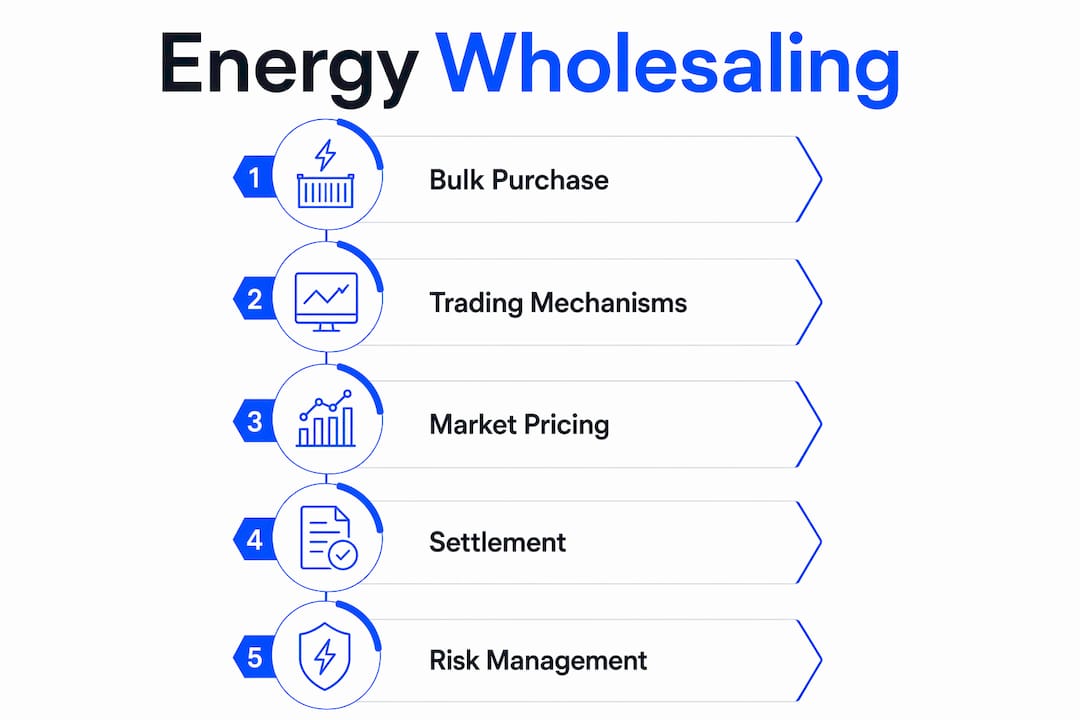
The two most common market types are the spot market and the day-ahead market. The spot market clears in real time, with prices set every 5 minutes based on generation offers and forecast demand. Prices spike when solar generation drops in the evening and demand remains high. The day-ahead market allows buyers and sellers to commit to volumes and prices 24 hours before delivery, reducing exposure to real-time price swings.
Merit order pricing
Wholesale electricity prices are set by merit order dispatch. Generators are ranked from lowest to highest short-run marginal cost, and the grid calls on them in that order until demand is met. The price paid to all generators is set by the most expensive unit needed to satisfy demand at that moment. Renewables, with near-zero marginal costs, sit at the front of the merit order. This mechanism means that high renewable penetration consistently pushes wholesale prices down.
Bilateral trades and Power Purchase Agreements
Not all wholesale energy trades happen on public exchanges. A large volume of wholesale energy is traded bilaterally through private Power Purchase Agreements (PPAs). These contracts lock in a fixed or indexed price between a producer and a buyer for a defined period, often 10–20 years. PPAs give producers revenue certainty and give buyers protection from spot market volatility. Large corporations like Google and Amazon have used PPAs to secure renewable energy at predictable costs.
Trading mechanism | Price certainty | Flexibility | Best suited for |
Real-time spot market | Low | High | Short-term balancing |
Day-ahead auction | Medium | Medium | Daily procurement planning |
Power Purchase Agreement | High | Low | Long-term budget stability |
Pro Tip: Combining a base-load PPA with spot market purchases for variable demand gives you price stability on core consumption while keeping flexibility for peaks. This hybrid approach is standard practice among sophisticated energy buyers.
What are the benefits and risks of energy wholesaling?
Wholesale markets deliver real advantages for businesses and the broader energy sector. They also carry risks that have caused serious financial damage when underestimated.
Key benefits
Price transparency. Public market clearing prices give all participants a real-time benchmark. This transparency makes procurement decisions more defensible and auditable.
Efficient grid dispatch. Merit order pricing ensures the cheapest available generation runs first. The result is lower average costs across the system compared to centrally planned dispatch.
Risk management tools. Hedging strategies and financial instruments let participants lock in prices, cap exposure, and manage cash flow. Futures, options, and swaps are all actively traded in major wholesale markets.
Market access for renewables. Wholesale markets give solar and wind producers a direct route to sell power at competitive prices, accelerating investment in clean generation.
Risks that demand serious attention
Wholesale markets are not passive. Improper market balancing has caused supplier failures during volatile periods, most visibly in the United Kingdom during the 2021 energy price crisis when dozens of retail suppliers collapsed. The California energy crisis of 2000–2001 demonstrated that market manipulation can drive prices to catastrophic levels, costing consumers billions of dollars.
Credit exposure is a structural risk in wholesale trading. Participants must post collateral to guarantee performance, and margin requirements can trigger liquidity crises during extreme price moves. A trader who is technically profitable on paper can face insolvency if a margin call arrives during a price spike and cash is not available.
“Energy trading transfers risk from parties who cannot afford volatility to those willing to accept it for a price.” The implication is direct: if your organization cannot absorb sudden price swings, you need a hedging strategy before entering wholesale markets.
How does renewable energy change the wholesale market?
Renewable energy has fundamentally altered wholesale price dynamics. Solar and wind generation carry near-zero marginal costs, so they always bid low and dispatch first under merit order rules. As their share of the generation mix grows, they push average wholesale prices down across the board.
The effect is not uniformly positive. During periods of very high renewable output, wholesale prices can turn negative. This happens when solar and wind produce more power than the grid can absorb, and generators pay to offload surplus electricity rather than curtail output. Germany, Australia, and California have all recorded significant periods of negative wholesale prices as renewable penetration has increased.
Market condition | Renewable output | Wholesale price impact |
High demand, low wind/solar | Low | Prices spike, gas sets the merit order |
Moderate demand, high solar | High | Prices fall, renewables dominate dispatch |
Low demand, very high wind/solar | Very high | Prices go negative, storage and exports absorb surplus |
This price volatility creates a direct opportunity for battery storage and grid flexibility services. Assets that can charge during negative price periods and discharge during peak demand periods earn revenue from the price spread. Belinus utility-scale storage systems, which scale to megawatt capacity, are designed precisely for this type of grid arbitrage application.
Pro Tip: Track your regional ISO’s price data for periods of negative or near-zero wholesale prices. These windows signal when battery storage or demand response programs deliver the highest financial return.
Small renewable producers, including commercial solar installations, are increasingly able to sell surplus generation back to the grid through feed-in mechanisms and aggregator platforms. This growing participation of prosumers, parties who both produce and consume electricity, is one of the most significant structural shifts in wholesale markets today.
Key Takeaways
Energy wholesaling is the foundation of electricity pricing, and understanding its mechanics gives businesses a direct advantage in procurement, risk management, and sustainable energy investment.
Point | Details |
Core definition | Wholesale electricity trading is bulk buying and selling between producers, utilities, traders, and large consumers before retail delivery. |
Pricing mechanism | Prices clear every 5 minutes in real-time markets using merit order dispatch, with renewables setting the floor. |
Risk management | PPAs and financial hedges protect against spot market volatility; unhedged exposure has caused supplier insolvencies. |
Renewable impact | Solar and wind push wholesale prices down and can cause negative pricing during peak output periods. |
Storage opportunity | Battery assets that charge during low-price periods and discharge at peak demand earn revenue from the price spread. |
The wholesale market is changing faster than most businesses realize
The wholesale energy market I watch most closely is not the one described in textbooks from 2010. The version operating today is faster, more data-driven, and far more influenced by renewable generation than most business professionals appreciate.
The single biggest shift I see is the compression of price signals. When markets clear every 5 minutes, the competitive advantage goes to participants who can respond in near real time, not those who set a procurement strategy once a quarter. Smart grid technology and automated energy management systems are no longer optional tools for sophisticated players. They are the baseline requirement for anyone serious about wholesale market participation.
The second shift is the democratization of market access. Prosumers, aggregators, and virtual power plants are pulling smaller producers and consumers into markets that were once exclusive to utilities and large traders. This is genuinely new territory, and the regulatory frameworks in most regions have not caught up. Businesses that position themselves now, before the rules solidify, will have structural advantages over those who wait.
My honest view is that the biggest risk in wholesale markets is not price volatility. It is ignorance of collateral requirements. I have seen profitable trading strategies collapse because the operator did not model margin calls during a price spike. Before any organization enters wholesale trading, the credit and liquidity mechanics deserve as much attention as the price forecasting.
— Marc
How Belinus supports energy market participants
Belinus builds the hardware and software infrastructure that connects commercial and utility-scale energy assets to wholesale markets. The Belinus Energy Management System runs on 15-minute dynamic tariff cycles, enabling battery arbitrage and grid services that respond directly to wholesale price signals. For businesses exploring solar wholesale strategies or utility-scale storage deployment, Belinus offers custom system design from small commercial installations up to megawatt-scale projects. The affiliated company Solarimex handles PV wholesale supply, while Evonity covers EV charging infrastructure for fleet integration.

If your organization is evaluating wholesale market participation, grid flexibility services, or long-term energy procurement strategy, the Belinus team works directly with commercial and utility clients to design systems that generate measurable returns from market price dynamics. Visit belinus.com to connect with the team.
FAQ
What is the difference between wholesale and retail energy?
Wholesale energy is traded in bulk between producers, utilities, and large consumers at market-clearing prices. Retail energy is the packaged product sold to homes and small businesses at a fixed or variable tariff that includes transmission, distribution, and supplier margin.
How are wholesale electricity prices set?
Wholesale prices clear every 5 minutes in real-time markets based on generation offers and forecast demand. The price is set by the most expensive generator needed to meet demand at that moment, a process called merit order dispatch.
What is a Power Purchase Agreement in wholesale energy?
A PPA is a bilateral contract between an energy producer and a buyer that locks in a price for electricity over a defined term. PPAs provide price certainty outside the spot market and are widely used by corporations securing long-term renewable energy supply.
What risks do businesses face in wholesale energy markets?
The primary risks are price volatility, credit exposure, and collateral requirements. Margin calls during price spikes can create liquidity crises even for organizations with sound trading positions.
How does renewable energy affect wholesale prices?
Renewable generators bid at near-zero marginal cost, pushing wholesale prices down when output is high. During periods of very high solar or wind generation, prices can turn negative, creating revenue opportunities for battery storage and demand response assets.
Recommended
Comments