Home vs industrial storage: choosing the right energy solution
- 5 hours ago
- 8 min read

TL;DR:
Residential and industrial energy storage differ greatly in size, objectives, and technology.
Proper system sizing depends on specific energy goals, load profiles, and local regulations.
Integration with renewables and thorough maintenance are crucial for optimal performance.
Energy storage is not a one-size-fits-all technology, yet many homeowners and facility managers in Benelux treat it that way. A system that works perfectly for a family home in Ghent will fall short in a logistics warehouse in Rotterdam, and vice versa. The gap between residential and industrial storage goes far beyond size. It involves different objectives, different technologies, different regulatory requirements, and very different return-on-investment timelines. This guide breaks down exactly what separates the two, so you can make a confident, well-informed decision for your specific situation.
Table of Contents
Key Takeaways
Point | Details |
Purpose-driven selection | Choose storage based on your unique household or facility needs, not size alone. |
Integration amplifies value | Pairing storage with renewables boosts savings and energy independence. |
Cost and regulation gaps | Industrial systems cost more and face stricter rules than home setups in Benelux. |
Maintenance matters | Regular checks are critical for efficiency in both home and industrial storage. |
Understanding energy storage: Home vs industrial basics
At its core, energy storage means capturing electricity when it is cheap or abundant and using it when it is expensive or scarce. But that simple definition plays out very differently depending on whether you are a homeowner with solar panels or a facility manager running a production line.
For residential users, the primary goals are straightforward. You want to maximize self-consumption from your solar system, reduce your electricity bill, and keep the lights on during a grid outage. Battery storage is used differently in homes versus industrial settings, and understanding that difference is the first step to making the right choice.
For industrial users, the objectives are broader and more complex. Think demand peak shaving, which means cutting the expensive demand charges utilities apply during high-consumption periods. Think grid services, where your storage system participates in frequency regulation and earns revenue. Think sustainability reporting, where measurable carbon reduction supports ESG targets.
Benelux adds its own layer of urgency to both contexts. Belgium, the Netherlands, and Luxembourg consistently rank among the highest electricity price regions in Europe. That price pressure makes storage financially attractive at every scale. At the same time, national and regional sustainability mandates are tightening, pushing both homeowners and facility managers to act sooner rather than later.
Here is a quick overview of typical objectives by context:
Residential: Solar self-consumption, backup power, bill reduction, EV charging support
Industrial/commercial: Demand charge management, grid services, arbitrage, sustainability compliance, operational resilience
Common to both: Reducing dependence on grid power, lowering carbon footprint, improving energy cost predictability
The technologies used also differ. Residential systems typically use lithium iron phosphate (LFP) batteries or newer graphene-based solutions for their safety and compact size. Industrial systems may use large-format LFP, pre-lithiated LFP, or hybrid ultracapacitor (HUC) configurations that prioritize cycle life and power density over physical footprint.
Pro Tip: Before comparing any products, write down your top three energy goals. That single exercise will immediately narrow your options and prevent you from overspending on features you will never use.
Exploring the residential benefits of storage alongside industrial cost control strategies gives you the full picture of what is possible at each scale.
Comparing features: Scale, technology, and costs
With this foundation, let’s break down the specific features and cost implications side by side.
Feature | Residential | Industrial/Commercial |
Typical capacity | 5 to 20 kWh | 100 kWh to multi-MW |
Primary technology | LFP, graphene supercap | LFP, HUC, pre-lithiated LFP |
Installation complexity | Low to moderate | High, requires engineering |
Maintenance | Minimal, app-monitored | Regular professional inspections |
Upfront cost | €5,000 to €20,000 | €50,000 to millions |
ROI timeline | 7 to 12 years | 4 to 8 years (with grid services) |
Regulatory burden | Moderate | High |
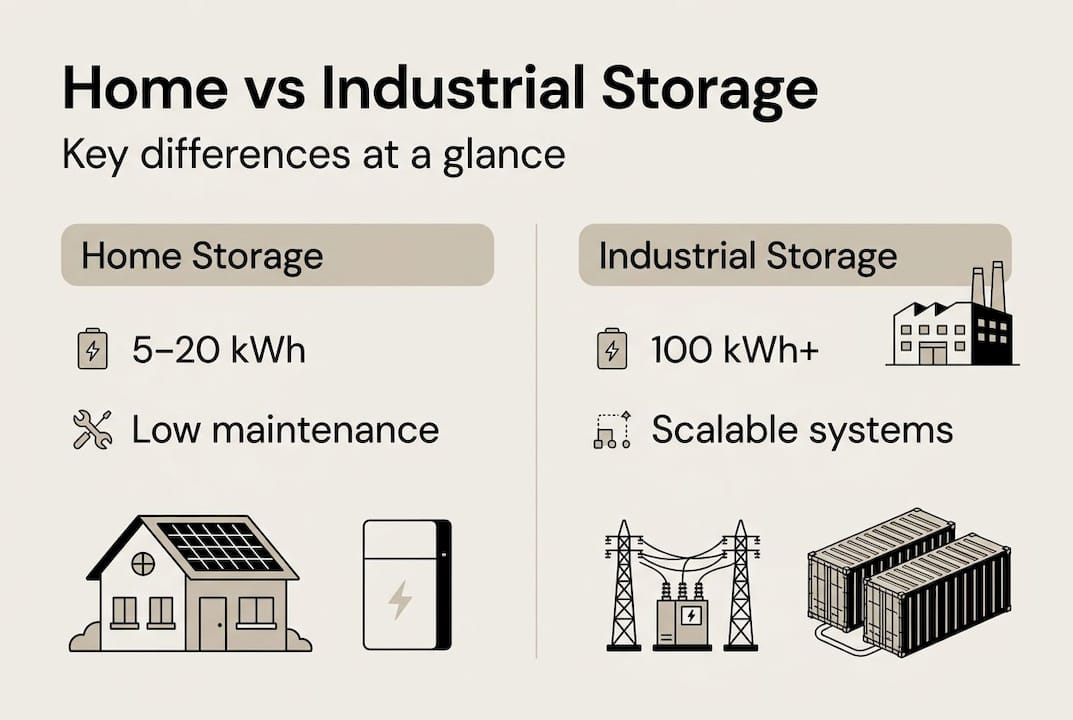
Industrial systems prioritize scalability, while home systems focus on cost and ease of use. That distinction shapes every purchasing decision. A homeowner does not need a power conversion system rated for megawatt output. A factory manager cannot rely on a 10 kWh wall unit to shave demand peaks during a production surge.
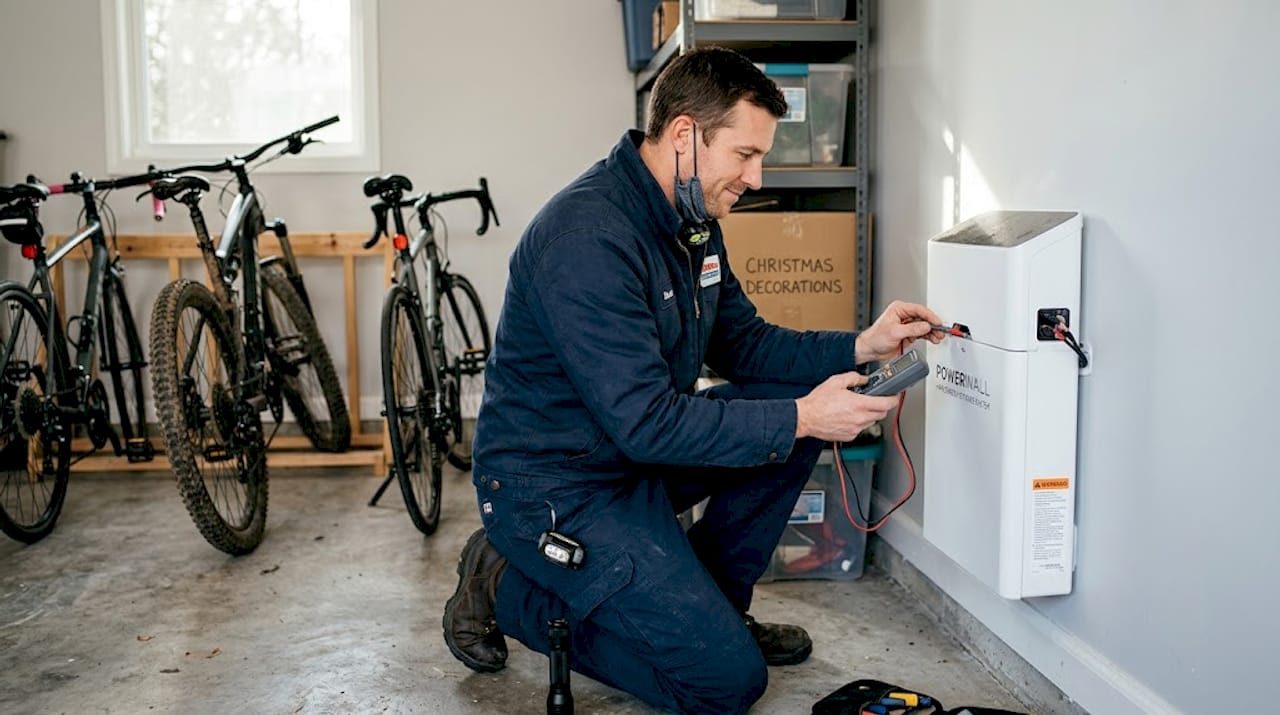
For homes, the best storage options in 2026 cluster around 10 to 20 kWh systems that pair with 5 to 10 kW solar arrays. The Belinus Energy Wall G1, for example, offers 16 kWh of graphene supercapacitor storage at €7,000, launching in Q1 2026. That is a strong value proposition for a mid-sized home with moderate solar output.
For industrial users, the math changes completely. A 400 kWh module may cost ten times more upfront, but it can participate in grid frequency regulation, earning revenue that directly offsets the investment. The payback period shrinks when the system is generating income, not just saving costs.
Key factors to weigh when selecting your system:
Capacity sizing: Oversize slightly for homes (future EV charging), but do not oversize for industry without a load analysis
Cycle life: Industrial systems need 4,000 or more cycles; residential can often work with 2,000 to 3,000
Warranty terms: Look for 10-year minimum on residential, performance guarantees on industrial
Software integration: Both scales benefit from an energy management system (EMS) that optimizes dispatch in real time
Pro Tip: For commercial facilities, always request a demand charge analysis before sizing storage. Cutting even one demand peak per month can justify a significant portion of your annual system cost.
Browsing home storage options and reviewing commercial scalability case studies will give you concrete benchmarks before you request a quote.
Integration with renewables: Benefits in the Benelux context
Feature comparisons are important, but integration with renewables is often the real game changer in Benelux energy planning.
Pairing solar with storage enhances energy savings and flexibility in ways that neither technology achieves alone. Solar panels generate electricity when the sun shines. Storage captures what you do not use immediately and releases it when prices peak or the sun sets. Together, they can cover 60 to 80 percent of a typical home’s annual electricity needs in Belgium or the Netherlands.
At the industrial scale, the pairing becomes even more strategic. A rooftop PV array combined with a 500 kWh battery system can flatten a facility’s load profile, reducing both energy costs and grid connection fees. In some cases, it also qualifies the facility for capacity market payments.
For Benelux homeowners, the most efficient pairing is a south-facing solar array of 6 to 10 kWp combined with a 10 to 16 kWh battery. This configuration captures the midday solar surplus and covers evening demand without oversizing either component.
For industrial users, the optimal setup depends heavily on load profiles. A three-shift operation needs different storage sizing than a business that runs only during daylight hours.
“The real value of storage is not what it holds, it is when it releases. Timing is everything in Benelux energy markets where dynamic tariffs can swing by a factor of five within a single day.”
Steps to add storage alongside your existing or planned solar system:
Audit your current energy consumption by hour of day
Size your solar array to match your daytime base load
Calculate the storage capacity needed to cover your evening and overnight demand
Select an inverter and EMS that support dynamic tariff optimization
Check local grid connection rules and subsidy eligibility before ordering equipment
Belgium’s prosumer tariff structure, the Netherlands’ saldering phase-out, and Luxembourg’s net metering rules all affect how quickly your investment pays back. Staying current on these policies is not optional. It is part of the financial model.
For a deeper look at how solar integration works in practice, or to follow a step-by-step integration process, those resources will walk you through the specifics without overwhelming technical jargon.
Practical considerations: Maintenance, safety, and regulations
Beyond integration, a successful storage system also depends on day-to-day operation and legal compliance.
Maintenance for residential systems is genuinely low. Modern LFP and graphene systems are designed for minimal intervention. You check the app, review performance data monthly, and schedule a professional inspection every two to three years. That is roughly comparable to maintaining a heat pump.
Industrial systems are a different story. Industry storage often faces stricter regulatory frameworks, and maintenance schedules reflect that. Expect quarterly thermal inspections, annual capacity tests, and continuous remote monitoring through a dedicated platform. Skipping these steps does not just void warranties. It can trigger compliance violations.
Regulatory area | Residential | Industrial |
Electrical installation code | Required | Required + certified engineer |
Grid connection approval | Standard notification | Formal application, load study |
Fire safety compliance | Basic | ATEX or equivalent standards |
Environmental permits | Rarely needed | Often required above 100 kWh |
Insurance requirements | Standard home policy update | Specialized industrial coverage |
Checklist for compliant installation in Benelux:
Confirm your installer holds the appropriate national certification (VOLTA in Belgium, Erkend Installateur in the Netherlands)
Notify your distribution system operator (DSO) before connecting storage to the grid
Verify your inverter meets EN 50549 grid protection standards
Update your home or facility insurance policy to include the storage system
Register for any applicable subsidy programs before installation, not after
Safety is non-negotiable at both scales. LFP chemistry is inherently more stable than older lithium-ion types, but thermal management still matters. Industrial systems must include fire suppression planning, especially in enclosed spaces. Residential systems should never be installed in living areas without proper ventilation clearance.
Keeping an eye on future energy regulations in Benelux will help you stay ahead of compliance changes that could affect your system’s grid connection rights or subsidy eligibility.
Why context matters more than size in storage decisions
Here is something we see repeatedly: homeowners who buy oversized systems because a neighbor recommended a large unit, and facility managers who undersize because they focused only on upfront cost. Both end up disappointed.
The most common mistake in storage selection is treating capacity as the primary decision variable. It is not. Your use case is. A 10 kWh system optimized for dynamic tariff arbitrage will outperform a 20 kWh system with no EMS integration, every single time. The software layer matters as much as the hardware.
For industrial users, the same logic applies in reverse. A massive battery installation without a proper demand analysis is just expensive insurance. It may never deliver the ROI it promised because it was never sized to the actual load pattern.
We believe the right approach starts with a local assessment. Benelux energy markets have specific tariff structures, grid rules, and subsidy frameworks that generic European guides simply do not capture. What works in Germany may not work in Belgium. What works in Amsterdam may not work in Antwerp.
Before you invest, understand your own energy independence goals clearly. Then size accordingly. That single discipline will save you thousands of euros and years of frustration.
Explore advanced storage solutions with Belinus
If this guide has clarified the difference between home and industrial storage, the next step is finding a solution that fits your specific situation, not just a generic product off a shelf.

At Belinus, we design storage systems for both residential and commercial applications across Benelux. From the 16 kWh Energy Wall G1 for homes to scalable utility-grade modules for industrial facilities, every solution integrates with our intelligent Energy Management System for real-time tariff optimization. Whether you are a homeowner ready to cut your electricity bill or a facility manager targeting demand charge reduction, we match the technology to your actual needs. Reach out for a consultation and see what the right storage solution looks like for your context.
Frequently asked questions
How does home energy storage differ from industrial systems in capacity?
Home systems typically range up to 20 kWh, while industrial solutions can scale to tens of megawatt-hours to meet much larger demand profiles.
Can I integrate solar panels with both home and industrial storage?
Yes, both systems integrate well with solar panels, but the setup complexity, sizing requirements, and savings potential vary significantly by scale.
What regulations should I check before installing storage in Benelux?
Homeowners need to meet building and electrical codes, while industry faces stricter safety standards, formal grid connection approvals, and potential environmental permits.
What are the main ongoing maintenance tasks for each system?
Home systems need occasional monitoring and cleaning, while industrial setups require scheduled professional inspections, capacity testing, and continuous remote monitoring.
Recommended
Comments