How Solar Inverters Work – Maximizing Home Energy
- Feb 15
- 8 min read
What makes solar energy practical for homes in the Benelux region is not just the panels on your roof but the technology working behind the scenes. As homeowners seek smarter ways to reduce energy costs and increase efficiency, understanding how solar inverters operate is key. This article breaks down the crucial role of these intelligent devices in converting and optimizing solar power, helping you get the most from your investment in renewable energy.
Table of Contents
Key Takeaways
Point | Details |
Solar Inverters are Essential | They convert DC electricity generated by solar panels into AC electricity for household use, ensuring energy efficiency. |
Inverter Types Vary | Different types of inverters (string, micro, central, hybrid) cater to specific energy needs, affecting cost and performance. |
Importance of MPPT | Advanced inverters with Maximum Power Point Tracking optimize energy production and can increase efficiency by up to 30%. |
Maintenance Matters | Regular inspections and cleaning can extend inverter lifespan by up to 25% and enhance overall system performance. |
What Solar Inverters Do for Homes
Solar inverters are the critical heart of any home solar power system, transforming raw solar panel energy into usable electricity for your household. Converting solar panel output requires sophisticated technological translation between direct current (DC) and alternating current (AC) power sources.
These intelligent devices perform several essential functions that make home solar systems practical and efficient:
Convert DC electricity from solar panels into AC electricity compatible with home appliances
Optimize power output by tracking maximum power point and adjusting electrical characteristics
Monitor system performance through integrated digital tracking mechanisms
Ensure grid compatibility by maintaining precise voltage and frequency standards
Provide safety shutdown in case of electrical grid interruptions
Modern solar inverters go beyond simple power conversion. They act as sophisticated energy management systems that continuously analyze electricity production, consumption patterns, and grid interactions. This real-time optimization helps homeowners maximize their solar investment by ensuring every electron generated delivers maximum economic value.
Solar inverters transform sunlight into usable household electricity with remarkable technological precision.
Inverter types vary based on specific home solar configurations. Some systems use string inverters connecting multiple panels, while others employ microinverters attached to individual solar panels for enhanced performance monitoring.
Pro tip: Consult with a professional solar installer to determine the most appropriate inverter configuration for your specific home energy requirements.
Types of Solar Inverters Compared
Solar inverter technologies have evolved significantly, offering homeowners multiple options to optimize their energy systems. Solar system inverter types range from simple designs to sophisticated multi-functional solutions that dramatically improve energy efficiency.
The primary solar inverter categories include:
String Inverters: Connect multiple solar panels in a series
Most cost-effective option
Suitable for uniform roof layouts
Lower individual panel performance monitoring
Microinverters: Attached to individual solar panels
Maximize per-panel energy production
Better performance in partially shaded environments
Higher initial installation cost
Central Inverters: Large-scale systems for commercial or utility applications
High power handling capacity
Ideal for large, uniform solar installations
Less flexible for residential use
Hybrid Inverters: Combine solar conversion with battery storage
Integrated battery charging capabilities
Enable energy storage and grid independence
More complex system design
Each inverter type offers unique advantages tailored to specific energy requirements and installation constraints.
Choosing the right inverter depends on multiple factors including roof configuration, shade patterns, budget, and long-term energy goals. Homeowners must carefully evaluate their specific energy needs to select the most appropriate inverter technology.
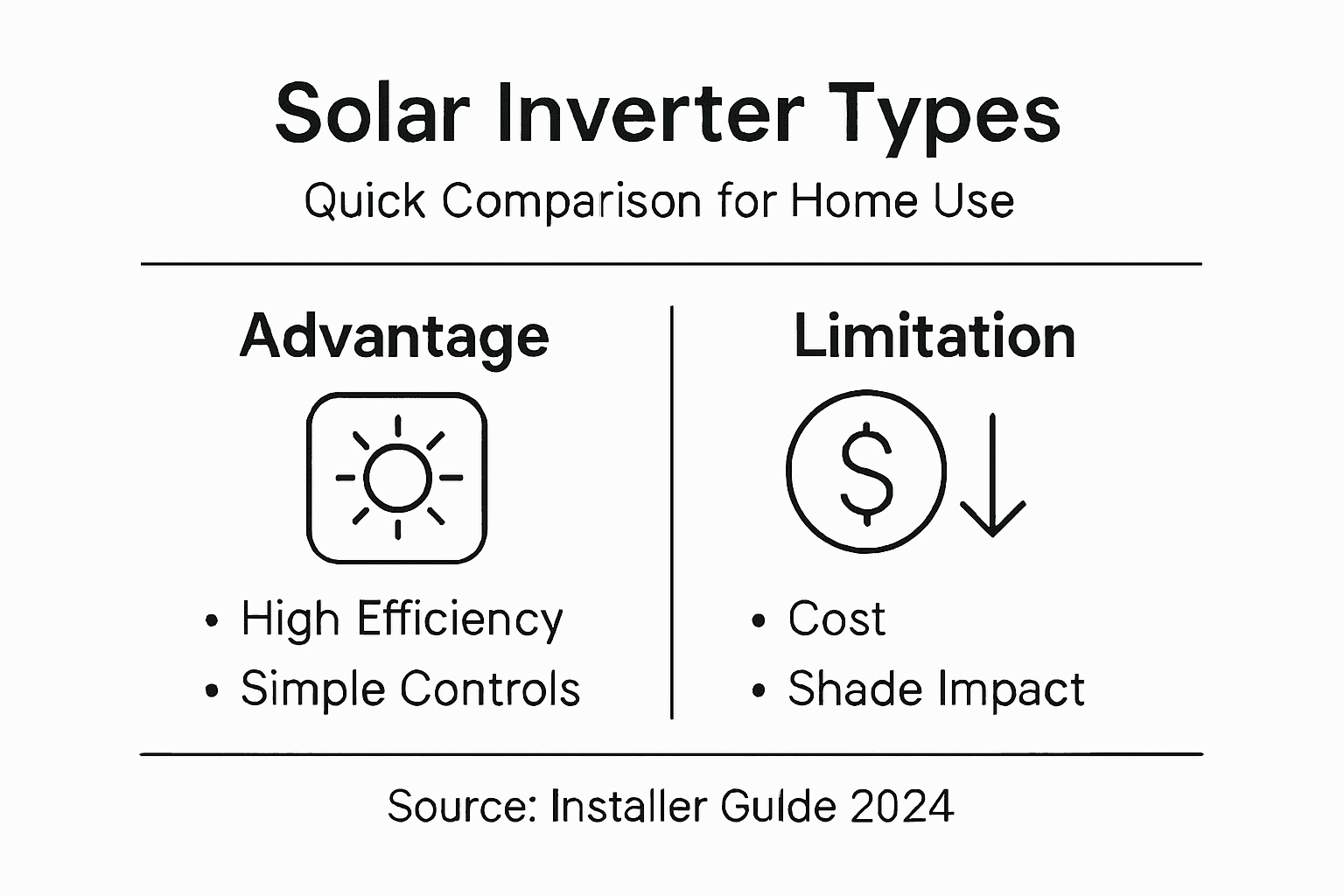
Here’s a quick comparison of major solar inverter types by their typical use cases and advantages:
Inverter Type | Ideal Use Case | Key Technical Advantage | Main Limitation |
String Inverter | Uniform residential rooftops | Lower installation cost | Limited shading tolerance |
Microinverter | Complex or shaded roof setups | Optimized per-panel performance | Higher upfront price |
Central Inverter | Commercial or utility installations | Handles high power loads | Not suited to home systems |
Hybrid Inverter | Homes with battery storage | Integrates solar and battery control | More complex design |
Pro tip: Consult a professional solar installer to perform a comprehensive site assessment and recommend the optimal inverter configuration for your specific residential energy setup.
How DC-to-AC Conversion Happens
The transformation of direct current (DC) electricity from solar panels into alternating current (AC) power is a sophisticated technological process that lies at the heart of solar energy systems. Inverter conversion mechanisms enable solar energy to become immediately usable for household appliances and grid integration.
The conversion process involves several critical technical stages:
Switching Mechanism: Rapidly transitions DC electrical flow
Uses semiconductor devices
Creates pulsed electrical signals
Mimics AC wave characteristics
Pulse Width Modulation (PWM)
Controls electrical switching frequency
Generates precise electrical waveforms
Minimizes energy loss during transformation
Filtering Process
Smooths electrical output
Removes unwanted harmonic distortions
Ensures clean, consistent power delivery
Voltage Transformation
Adjusts electrical potential
Matches grid and household voltage requirements
Stabilizes electrical current
Semiconductor technology enables the seamless translation of solar panel DC electricity into standard AC power.
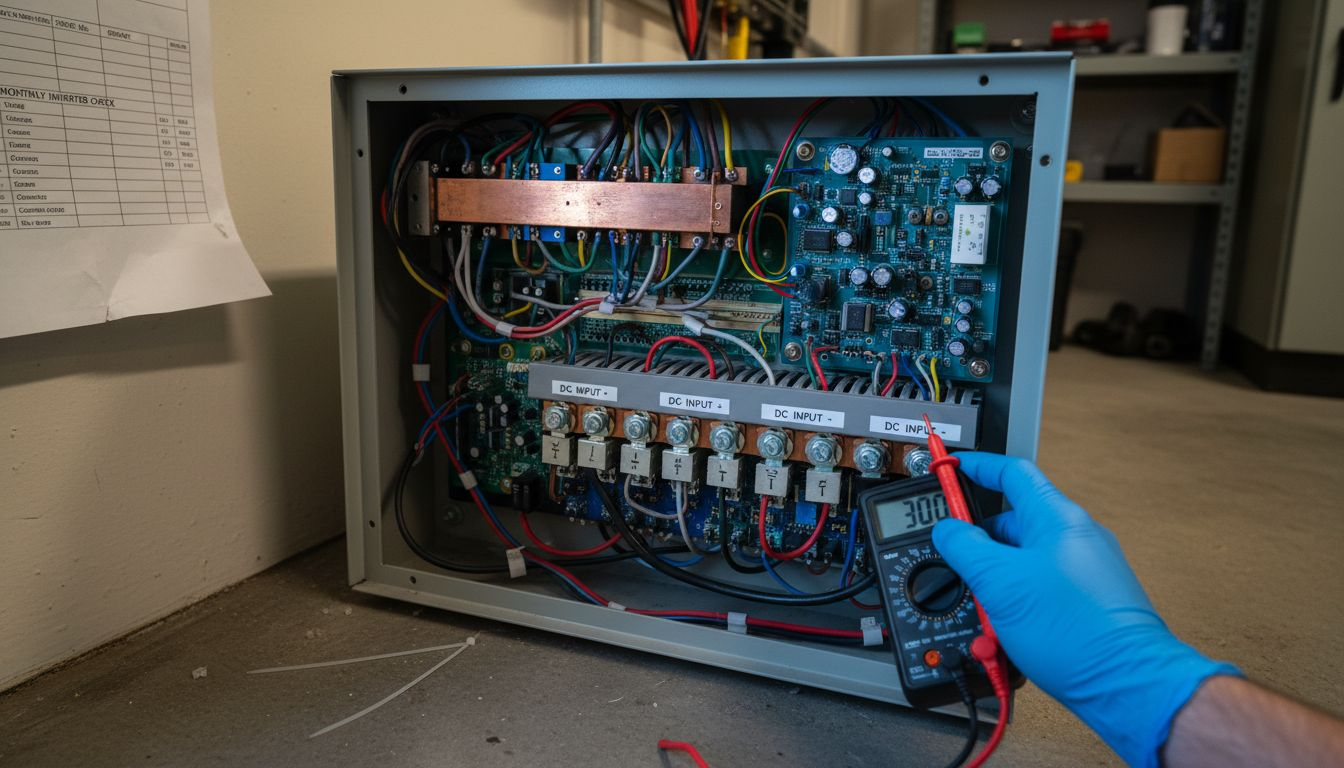
The entire conversion happens within milliseconds, with advanced inverters using sophisticated H-bridge circuits to create smooth, sine-wave-like electrical outputs. These intricate electronic processes ensure that solar-generated electricity matches the precise technical specifications required by household electrical systems.
Pro tip: Invest in high-quality inverters with advanced pulse width modulation technology to maximize your solar energy system’s overall efficiency and power conversion performance.
Key Features Like MPPT and Monitoring
Solar inverter technologies have sophisticated built-in features that dramatically enhance energy production and system performance. Maximum power point tracking algorithms represent one of the most critical technological innovations in solar energy management.
The core features of advanced solar inverters include:
Maximum Power Point Tracking (MPPT)
Continuously optimizes solar panel performance
Adjusts voltage and current dynamically
Compensates for environmental variations like temperature and shading
Real-Time Performance Monitoring
Tracks energy production in real-time
Provides detailed system diagnostics
Enables immediate identification of potential issues
Adaptive Efficiency Algorithms
Uses multiple tracking methods
Switches between classical and hybrid MPPT techniques
Maximizes energy harvest under changing conditions
Smart Grid Integration
Synchronizes with electrical grid requirements
Enables two-way power communication
Supports grid stability and energy management
Advanced MPPT technologies can increase solar system efficiency by up to 30% compared to traditional fixed-point systems.
Modern inverters employ sophisticated perturb and observe and incremental conductance methods to continuously fine-tune solar panel performance. These intelligent algorithms make minute adjustments millisecond by millisecond, ensuring that every possible watt of energy is captured and converted.
Pro tip: Invest in inverters with advanced MPPT capabilities and comprehensive monitoring features to maximize your solar energy system’s long-term performance and return on investment.
Performance Factors and Common Risks
Solar inverter performance depends on a complex interplay of environmental and technological factors that can significantly impact energy production. Performance factors affecting solar systems reveal critical challenges homeowners must understand to maintain optimal solar energy generation.
Key performance and risk factors include:
Environmental Challenges
Temperature variations affecting electrical efficiency
Humidity impact on electrical components
Dust and debris accumulation reducing panel performance
System Design Risks
Improper installation leading to energy losses
Inadequate ventilation causing component overheating
Suboptimal wiring reducing overall system efficiency
Electrical Performance Limitations
Harmonic distortion reducing power quality
Power factor variations
Partial shading impacts on energy generation
Maintenance-Related Risks
Lack of regular cleaning and inspection
Component degradation over time
Potential electrical connection failures
Environmental conditions can reduce solar inverter efficiency by up to 25% if not properly managed.
Technological monitoring and proactive maintenance are crucial for mitigating these performance risks. Modern inverters incorporate sophisticated diagnostic tools that continuously track system health, enabling early detection of potential issues before they escalate into significant energy production problems.
Pro tip: Schedule professional solar system inspections annually and implement a consistent cleaning routine to minimize environmental performance degradation.
Costs, Lifespan, and Alternatives
Solar inverter investments require careful consideration of long-term performance and financial implications. Inverter reliability and lifespan are critical factors that directly impact the overall economic value of solar energy systems.
Key considerations for solar inverter economics include:
Lifespan Factors
Typical residential inverter lifetime: 10-15 years
Indoor vs. outdoor installation impacts durability
Manufacturer quality significantly influences longevity
Cost Components
Initial purchase price
Installation expenses
Maintenance and potential replacement costs
Energy efficiency savings
Alternative Technologies
Microinverters
String inverters
Central inverters
Hybrid inverter systems
Financial Considerations
Return on investment calculations
Performance warranty terms
Energy production potential
Technological obsolescence risks
Proper maintenance can extend inverter lifespan by up to 25% and optimize financial returns.
Modern solar inverters represent a sophisticated balance between technological innovation and economic practicality. Homeowners must consider not just the upfront costs, but the long-term performance potential, maintenance requirements, and potential energy savings when selecting an inverter system.
To help homeowners evaluate inverter investments, compare these cost and lifespan factors:
Factor | Typical Value or Consideration | Impact on ROI |
Average Lifespan | 10–15 years (residential) | Influences replacement timing |
Maintenance Needs | Annual inspection recommended | Reduces risk of failure |
Initial Installation | Varies by type and power rating | Affects total system cost |
Performance Warranty | 5–12 years (manufacturer) | Offers financial protection |
Pro tip: Calculate the total cost of ownership, including potential replacement costs, when comparing different solar inverter technologies.
Unlock the Full Potential of Your Home Solar Energy with Belinus
Understanding how solar inverters work is essential to maximizing your home energy efficiency. If you have experienced challenges like fluctuating power output, shading losses, or limited monitoring and control, Belinus offers advanced solutions tailored to overcome these exact hurdles. With features such as high-efficiency Solis inverters combined with an intelligent Energy Management System, you gain precise DC-to-AC conversion, real-time performance tracking, and smooth grid integration for your residential solar setup.
Transform your home solar experience by choosing technologies designed to optimize every watt generated. Discover how our residential solutions and integrated inverter options can help you capture maximum power with enhanced safety and longevity. Take the next step toward smarter, more reliable energy management today by exploring more at Belinus and see the difference advanced solar inverter technology can make.
Frequently Asked Questions
What is the function of a solar inverter?
Solar inverters convert direct current (DC) electricity generated by solar panels into alternating current (AC) electricity that is usable by household appliances. They also optimize power output and monitor system performance.
What are the different types of solar inverters?
The main types of solar inverters are string inverters, microinverters, central inverters, and hybrid inverters. Each type has unique advantages depending on the solar system configuration and energy requirements.
How does maximum power point tracking (MPPT) work?
MPPT is a technology used by solar inverters to continuously optimize the output of solar panels. It adjusts voltage and current dynamically to ensure maximum energy production despite environmental changes like temperature and shading.
How long do solar inverters last and what factors affect their lifespan?
Most residential solar inverters have a lifespan of 10-15 years. Factors that influence longevity include installation quality, environmental conditions, and routine maintenance practices.
Recommended
Comments