IoT in Energy Management: 2026 Enterprise Guide
- Jun 6
- 9 min read

TL;DR:
IoT in energy management uses connected sensors and EMS to monitor and control energy in real time, enabling data-driven optimization. The EMS acts as the operational brain, transforming telemetry into control strategies that significantly reduce peak demand and costs. Securing these systems with standards like IEC 62443 ensures operational resilience across single or multiple facility portfolios.
IoT in energy management is the strategic use of connected sensors, smart meters, and intelligent Energy Management Systems (EMS) to monitor, analyze, and control energy consumption across business operations in real time. For energy managers and sustainability officers, this means moving from reactive monthly billing reviews to continuous, data-driven control of every kilowatt your facility consumes. The global shift toward dynamic tariffs, carbon reporting mandates, and rising electricity costs makes energy consumption monitoring through IoT not a future investment but a present operational necessity.
What is IoT in energy management and why it matters now

The industry term for this discipline is demand-side energy management, and it sits at the intersection of operational technology (OT) and information technology (IT). IoT in energy management connects physical assets — motors, HVAC units, lighting systems, EV chargers, battery storage — to a centralized EMS that processes telemetry and issues control commands. The EMS acts as the decision brain, coordinating heterogeneous resources and data streams across the entire energy value chain. Without that orchestration layer, you have data collection. With it, you have control.
Three forces are accelerating adoption in 2026. First, dynamic electricity tariffs now change every 15 minutes in many European markets, making manual optimization impossible. Second, corporate sustainability reporting under frameworks like the EU CSRD requires granular, auditable consumption data that spreadsheets cannot provide. Third, the cost of IoT hardware has dropped sharply, making sensor deployment across large facilities economically viable for mid-market businesses, not just utilities.
The business case is concrete. An IoT-based demand-side framework demonstrated that automated load shedding reduced real power demand by 23.46% during peak periods. That figure translates directly to lower demand charges on your electricity bill, which for industrial facilities often represent 30 to 50 percent of total energy costs.
How does an IoT energy management system architecture work?
Every effective IoT energy system operates across three functional layers. Understanding them helps you ask the right questions when evaluating vendors.
Perception layer. Smart meters and sensors collect raw data: voltage, current, power factor, temperature, occupancy, and equipment runtime. The accuracy and sampling frequency of these devices determine the quality of every decision made upstream. Sensors that report every 15 minutes cannot support real-time load control. Devices reporting every second can.
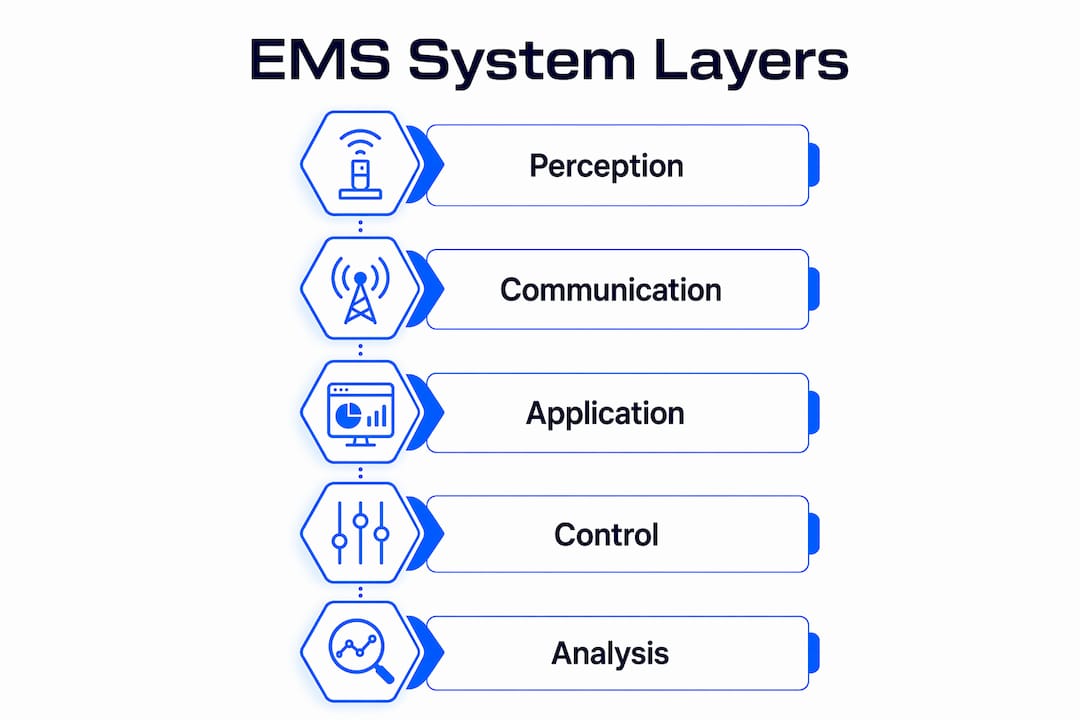
Communication layer. Data travels from field devices to the EMS via protocols including BACnet, Modbus, MQTT, and Zigbee. Each protocol has strengths: BACnet dominates building automation, Modbus is standard in industrial equipment, and MQTT suits low-bandwidth wireless sensors. Most enterprise facilities run a mix, which is why protocol gateways are not optional extras but core infrastructure.
Application layer. The EMS aggregates all incoming data, applies analytics and machine learning, and generates control commands. Machine learning algorithms including Logistic Regression and Random Forest detect anomalies and prioritize loads adaptively, adjusting control responses based on operational context rather than fixed thresholds.
System layer | Primary function | Key technologies |
Perception | Data collection from physical assets | Smart meters, current transformers, IoT sensors |
Communication | Data transport and protocol translation | BACnet, Modbus, MQTT, protocol gateways |
Application | Analytics, control, and reporting | EMS platform, ML algorithms, dashboards |
Pro Tip: Deploy sensors that measure both active power (kW) and reactive power (kVAR) from day one. Reactive power data is what enables power factor correction and reduces utility penalties. Systems that only track active power leave a significant optimization lever untouched.
How to select top IoT energy management tools for your facility
Choosing the right connected devices and platform is where most enterprise deployments either succeed or stall. The market offers hundreds of options, and the wrong selection creates integration debt that compounds over years.
Start with these non-negotiable criteria:
Interoperability. The device must support at least one open protocol (BACnet, Modbus, or MQTT). Proprietary-only devices create vendor lock-in and block future integration.
Measurement accuracy. For billing-grade monitoring, look for meters certified to IEC 62053 Class 0.5S or better. For operational monitoring, Class 1 is typically sufficient.
Scalability. Confirm the platform supports the number of data points you need today and at least five times that number for future expansion.
Cybersecurity posture. Request the vendor’s security documentation before procurement, not after. This point is covered in depth in the security section below.
For platform selection, multi-protocol integration using BACnet and Modbus through gateways is the standard approach for interoperating diverse IoT devices in energy environments. Gateways normalize data and prevent the data silos that make cross-facility benchmarking impossible.
Platforms like DATOMS provide real-time visibility and automated workflows across multiple locations, including scheduled actions and threshold-based alert routing. For facilities teams managing CMMS integration, solutions like MPulse offer IIoT real-time monitoring that connects asset health data with energy consumption tracking.
Pro Tip: Before signing any platform contract, run a 30-day pilot on a single building or production line. Measure data completeness, alert accuracy, and API response times under real operating conditions. Vendors who resist pilots are signaling something about their product’s reliability.
Implementing demand-side load control with IoT
Demand-side energy management through IoT is not simply turning equipment off during peak hours. It requires precise estimation of how much load to shed, in what order, and with what compensation for power quality effects. Anomaly detection alone is insufficient for grid stability. The system must know the magnitude of the intervention, not just that an intervention is needed.
Here is a practical implementation sequence for an IoT demand-side management cycle:
Establish baseline telemetry. Deploy meters on all major load circuits and collect at least four weeks of data before activating any control logic. You need a baseline to define what “normal” looks like.
Classify loads by priority. Segment equipment into critical (cannot be interrupted), deferrable (can shift by 15 to 60 minutes), and non-critical (can shed during peak windows). HVAC pre-cooling and EV charging are typical deferrable loads.
Configure reactive power compensation. Install capacitor banks or use inverter-based reactive power control to maintain a power factor above 0.95. This reduces apparent power demand and eliminates utility power factor penalties.
Set automated control rules. Program the EMS to shed non-critical loads when demand approaches a defined threshold, typically 85 to 90 percent of your contracted capacity.
Validate and iterate. Review control events weekly for the first three months. Adjust thresholds based on actual operational impact and comfort feedback from facility users.
“Effective IoT energy management requires translating device telemetry into EMS control signals that differentiate active vs reactive power and prioritize loads correctly. Without this granularity, demand response may not engage the right operational controls.” — IoT-based demand-side energy management
The 23.46% peak demand reduction cited earlier came from exactly this approach: automated shedding of non-critical loads combined with reactive power compensation, not from broad power cuts that disrupt operations.
What cybersecurity standards apply to IoT energy deployments?
IoT energy systems are operational technology connected to corporate networks, which makes them attractive targets for both financial and infrastructure attacks. The cybersecurity risks are not theoretical. Compromised EMS platforms have caused facility shutdowns and manipulated energy billing data in documented incidents across the industrial sector.
NIST recommends foundational cybersecurity activities by IoT product manufacturers to reduce risks and improve product securability. The practical implication for you as a buyer: manufacturers should provide cybersecurity functionality and documentation that reduces the security burden on your team after deployment. If a vendor cannot produce a software bill of materials (SBOM) or a vulnerability disclosure policy, treat that as a disqualifying factor.
The IEC 62443 standards family defines security requirements and lifecycle processes for industrial automation and control systems. It is increasingly applied beyond traditional OT environments to IIoT and building automation. Your procurement checklist should verify that any EMS platform or connected device aligns with IEC 62443 security levels appropriate to your operational risk profile.
Practical steps for your team:
Require network segmentation between IoT devices and corporate IT systems during commissioning.
Mandate firmware update capability and a defined patch cadence from all IoT vendors.
Assign joint accountability between your energy team and IT/OT security team for every new device deployment.
Conduct a tabletop exercise annually that simulates an EMS compromise scenario.
Pro Tip: Ask vendors for their IEC 62443 conformance documentation and their process for notifying customers of discovered vulnerabilities. Vendors with mature security programs answer this question immediately. Vendors without one will deflect.
Single-site vs. multi-site IoT energy management
Enterprise energy managers rarely operate a single facility. Managing IoT energy systems across multiple locations introduces challenges that single-site deployments never encounter: heterogeneous device inventories, inconsistent naming conventions, and the organizational complexity of coordinating energy data from facilities in different countries or time zones.
The core technical challenge is semantic consistency. When a Modbus register labeled “P_Total” at one site means something different from the same label at another site, your cross-facility benchmarking becomes unreliable. Semantic data mapping across BACnet, Modbus, and wireless protocols is not a configuration detail. It is the foundation of accurate enterprise reporting.
Feature | Single-site management | Multi-site management |
Data normalization | Device-level configuration | Centralized semantic mapping layer |
Benchmarking | Internal baseline only | Cross-facility performance comparison |
Alert routing | Local team notification | Role-based routing by site and severity |
Automation scope | Single building control logic | Portfolio-wide demand response programs |
Workflow automation becomes significantly more valuable at enterprise scale. Threshold-based alerts that route to the correct regional facility manager, combined with automated demand response programs that execute across all sites simultaneously, are capabilities that justify the investment in a multi-site platform. The smart energy solutions that deliver the most measurable ROI at enterprise scale are those that combine centralized visibility with site-level autonomous control.
Why the EMS is the decision you cannot afford to get wrong
I have worked with energy managers who spent their entire IoT budget on sensors and meters, then connected everything to a basic SCADA system and called it done. The data was there. The control was not. The EMS is not a reporting tool. It is the operational brain that determines whether your IoT investment pays back in months or sits as an expensive monitoring dashboard for years.
The most common mistake I see is treating anomaly detection as the primary control trigger. An alert that tells you consumption spiked is useful. A system that automatically calculates how much load to shed, which circuits to target first, and how to compensate for the reactive power shift is what actually moves the needle on your energy bill. These are not the same thing, and most entry-level platforms only offer the former.
Cybersecurity is the other area where I see organizations consistently underinvest until something goes wrong. The conversation about IEC 62443 compliance and vendor security documentation needs to happen in the procurement meeting, not during the post-incident review. Energy managers who treat security as an IT problem to solve after deployment are transferring significant operational risk to their organization.
The practical advice I give every enterprise energy team: start with one facility, instrument it properly with active and reactive power measurement, connect it to an EMS with real control capability, and prove the ROI before scaling. The technology works. The failure mode is almost always organizational, not technical.
— Marc
How Belinus supports enterprise IoT energy management
Belinus builds energy management systems designed for exactly the complexity described in this guide. The Belinus EMS delivers 15-minute dynamic tariff optimization, battery arbitrage, and real-time load control across solar PV, battery storage, and EV charging assets. Its RESTful API supports third-party integrations, and the native mobile app and web dashboard give your team visibility across every connected asset.

For commercial and utility-scale operations, Belinus offers scalable storage from 400 kWh modules to MW-capacity installations, with grid-integrated services including energy trading and demand response. Whether you are managing a single industrial facility or a multi-site portfolio, Belinus provides the energy management system architecture to turn IoT data into measurable cost reductions. Contact Belinus to discuss a tailored solution for your operational requirements.
FAQ
What is IoT in energy management?
IoT in energy management is the use of connected sensors, smart meters, and an Energy Management System to monitor and control energy consumption in real time. The EMS acts as the orchestration brain, coordinating control commands across all connected energy assets.
How much can IoT reduce peak energy demand?
Automated IoT demand-side management has demonstrated a 23.46% reduction in real power demand during peak periods through non-critical load shedding and reactive power compensation. Results vary by facility type and baseline load profile.
What cybersecurity standards apply to IoT energy systems?
IEC 62443 is the primary international standard for cybersecurity in industrial automation and control systems, including IIoT and building energy management. NIST also publishes foundational cybersecurity guidance specifically for IoT product manufacturers.
What protocols do IoT energy management devices use?
BACnet and Modbus are the dominant protocols in building and industrial energy environments, with MQTT increasingly used for wireless IoT sensors. Protocol gateways normalize data across these standards to prevent data silos in multi-device deployments.
What is the difference between single-site and multi-site IoT energy management?
Single-site management focuses on local device control and internal benchmarking. Multi-site management adds centralized semantic data mapping, cross-facility performance comparison, and portfolio-wide demand response automation, all of which require a platform purpose-built for enterprise scale.
Key takeaways
IoT in energy management delivers measurable results only when the EMS provides real control capability, not just data collection, across properly instrumented and secured connected devices.
Point | Details |
EMS is the control core | The EMS orchestrates all IoT devices and issues control commands; monitoring alone does not reduce costs. |
Measure active and reactive power | Tracking both power types enables power factor correction and unlocks demand charge reductions. |
Prioritize loads before automating | Define critical, deferrable, and non-critical loads before activating any automated shedding logic. |
Cybersecurity starts at procurement | Require IEC 62443 alignment and vendor security documentation before signing any IoT contract. |
Multi-site needs semantic consistency | Standardize data point naming across all sites to make cross-facility benchmarking reliable and actionable. |
Recommended