Top 4 Battery Energy Storage Alternatives for Top Grid Storage Solutions 2026
- Jul 17
- 10 min read
Finding a battery energy storage system for grid-scale projects that meets strict safety, sustainability, and long-cycle demands remains a complex challenge. Most traditional options still depend on lithium, provide limited material recyclability, or restrict design flexibility for project scaling. This article compares price, chemistry, and operational fit so energy professionals can match the right system to their grid storage needs in 2026.
Table of Contents
belinus
At a Glance
According to the company, the Energy Wall G1 is a 16 kWh graphene supercapacitor priced at €7,000 per unit and slated for Q1 2026. The vendor advertises lithium-free, recyclable storage options alongside long warranty terms. Belinus also highlights an AI energy management layer that targets tariff optimization and export control.
Core Features
Belinus pairs Belgian-designed high-efficiency solar panels with lithium-free energy storage hardware and an AI-powered energy management system. The portfolio spans residential systems, modular industrial cabinets, and utility storage modules, and the firm lists affiliates for PV wholesale and installations. According to Belinus, the centralized EMS supports 15-minute dynamic tariff optimization and exposes a RESTful API for third-party integration.
Key Differentiator
Belinus centers on lithium-free, recyclable storage combined with Belgian-designed bifacial and black-glass panels and AI control. That technical mix shifts lifecycle risk away from lithium supply and promises easier end-of-life recycling. For buyers focused on material circularity and reduced chemical risk, this is the defining capability.
Pros
High-tech Belgian panel design and the use of bifacial and glass-glass options improve energy yield in many European climates. The product range covers rooftop inverters, home storage, and large industrial cabinets, so system designers can scale from single houses to utility projects. The vendor emphasizes long warranties and an AI EMS to manage tariffs, exports, and fleet charging while offering RESTful API and native mobile and web dashboards.
Cons
Availability is primarily European, which limits deployment options outside Europe.
Who It’s For
Energy professionals and facility managers in Europe who prioritize material sustainability will find this offering relevant. Choose Belinus if you manage sites where recyclability, broad temperature range, and lithium avoidance matter more than lowest upfront cost. The product suits projects that plan for lifecycle handling and long warranty coverage.
Unique Value Proposition
That €7,000 price point for the Energy Wall G1 positions Belinus as a premium, lithium-free option for clients who accept higher initial costs for reduced material risk and easier recycling. The combination of Belgian PV design and a software-first EMS changes how you plan operations and maintenance budgets. For capital projects targeting social responsibility metrics, the economic case weighs long warranty coverage against the premium.
Real World Use Case
The vendor states utility storage uses 400+ kWh modules scalable to MW capacity. A European facility manager can pair those modules with Belinus inverters and the EMS to perform battery arbitrage and participate in energy trading. The setup reduces peak grid draw and gives a clear pathway for end-of-life component handling.
Pricing
Prices vary by product and sit at the premium end of the market to reflect advanced materials and extended warranties. Specific list prices and installation support details are not listed, and financing or bulk discount terms are not specified. Expect higher upfront capital expenditure compared with commodity lithium systems.
Website: https://belinus.com
Rongke Power (RKP)
At a Glance
RKP reports more than 3.5 GWh of deployed utility scale battery capacity worldwide. That scale is paired with water based vanadium electrolyte that the company says delivers very long cycle life and high safety. The combination targets grid stabilization, renewable smoothing, and long duty applications.
Core Features
RKP sells modular vanadium flow batteries that separate power and energy so sites scale from kilowatts to multi megawatts. According to the company, the chemistry supports over 25,000 cycles, which underpins claims of multi decade operation. Systems use a water based electrolyte and offer project design, installation, and ongoing maintenance support.
Key Differentiator
RKP focuses on long life and safety through recyclable vanadium chemistry and a broad installed base backed by patents. That emphasis makes the product attractive where cycle endurance and minimal capacity fade matter more than compact footprint. The vendor positions these systems for grid grade tasks that require sustained daily cycling over many years.
Pros
The vanadium chemistry lowers thermal runaway risk because it uses a water based electrolyte rather than flammable solvents. The company reports that installed systems support very long service life, which translates into fewer replacement events and simpler asset planning. RKP also offers flexible, independently scalable power and energy blocks, and the installed capacity figure suggests maturity in large project delivery.
Cons
Limited independent third party reviews specifically focused on storage products, which reduces outside performance transparency.
Naming overlap with unrelated services can cause brand confusion in some procurement searches.
Higher upfront capital outlay compared with many lithium options, reflecting the technology and system scale.
When It May Not Fit
This technology suits large grid or industrial projects. It is less relevant for small residential users or lightweight off grid appliances. Projects with tight capital budgets may prefer lower initial cost chemistries.
Who It’s For
Utilities, grid operators, and large project developers who prioritize long operational life and high safety will find RKP relevant. Industrial energy managers and microgrid operators that need predictable daily cycles and easy capacity scaling will also benefit. The product aligns with teams planning multi year asset timelines.
Real World Use Case
The vendor describes a municipal utility deployment using a 50 MW 200 MWh vanadium flow battery to store surplus renewable output and support peak capacity. The project included system design, site works, and a maintenance contract to manage long service life. That example shows how RKP targets utility scale renewables integration and grid services.
Pricing
Pricing is customized by project scale with typical enterprise solutions starting from several hundred thousand USD and rising for utility class systems. No public standard unit pricing is listed. Volume and project based discounts may apply after consultation.
Website: https://rkpstorage.com
ESS Tech, Inc.
At a Glance
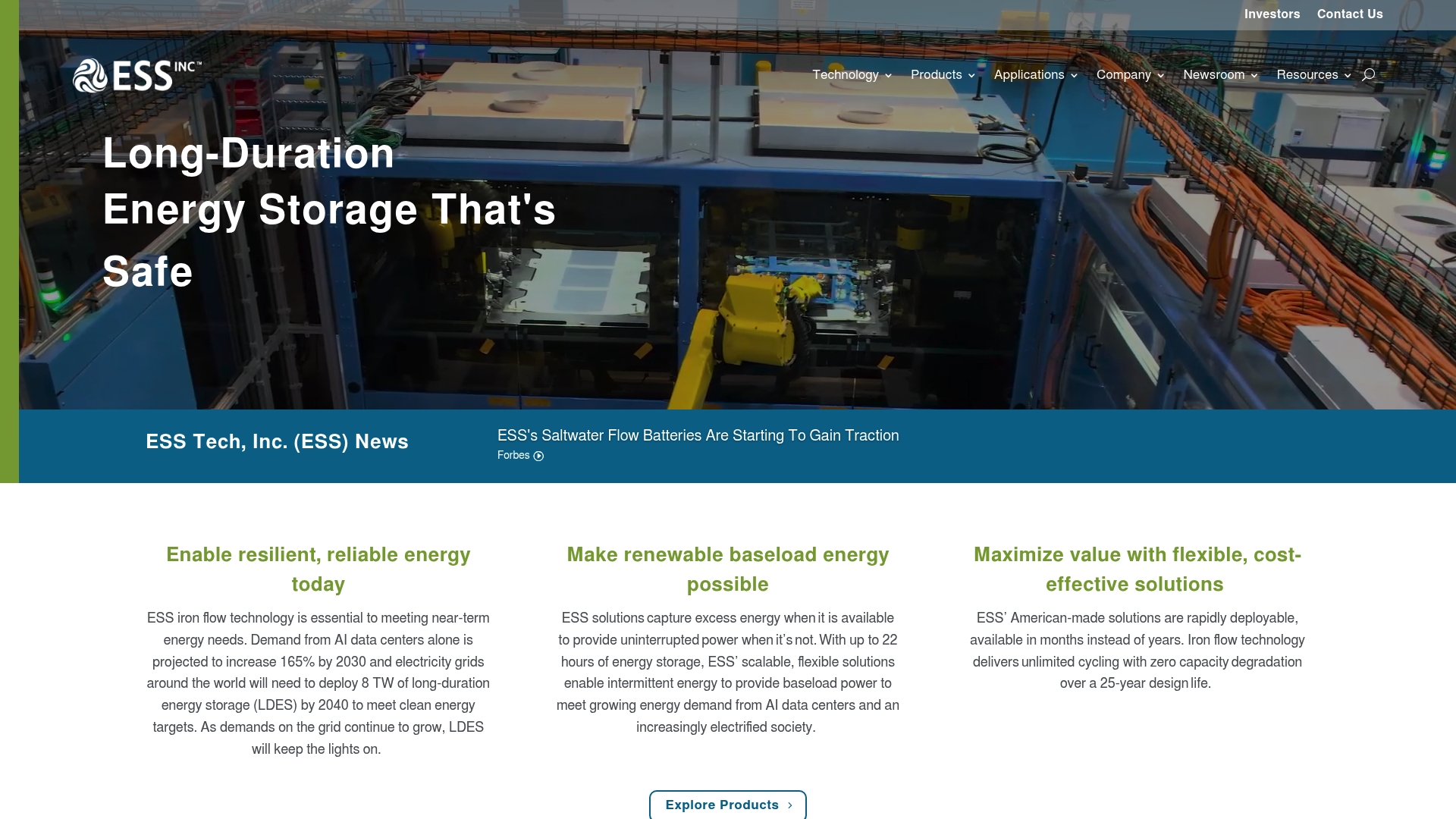
ESS Tech, Inc. reports systems that deliver up to 22 hours of energy storage and claim zero capacity degradation over decades. The vendor advertises proprietary iron flow chemistry that allows unlimited cycling without capacity loss. These attributes target long duration projects where predictable, long lived performance matters.
Core Features
ESS builds modular physical storage systems that scale to provide long duration capacity. The chemistry uses iron, salt, and water as active materials, and the architecture separates power and energy so capacity expands without replacing converters. The company also highlights rapid deployment measured in months and a 25 year design life tied to stable capacity.
Key Differentiator
The primary differentiator is the proprietary iron flow chemistry that the company promotes for safety, material sustainability, and long term durability. That chemistry is what ESS positions as enabling unlimited cycling and near zero capacity loss, which changes how projects size storage for multihour and overnight applications.
Pros
ESS presents a clear technical angle for long duration needs. The system uses abundant materials and a nonflammable chemistry, which reduces hazardous handling risks and aligns with low carbon procurement goals. Its modular tanks and separate power stacks let you scale energy hours independently from inverter capacity, simplifying upgrades on sites with evolving load profiles. The manufacturing focus in the United States supports domestic supply chains and can shorten logistics for European developers working with transatlantic partners.
Cons
Limited public pricing: Pricing details are not publicly disclosed, so budget estimates require direct vendor engagement.
Sparse independent review data: No third party performance verification is cited publicly, which raises due diligence work for procurement teams.
Not ideal for short duration use: The product is oriented toward multihour and overnight storage rather than brief grid services or frequency response.
When It May Not Fit
If your project needs subhour or two hour storage for frequency response or fast arbitrage, this product may not match that operational profile. Smaller sites with minimal technical support on site may find integration and maintenance demands higher than with simpler electrochemical batteries. Projects with fixed, tight capital budgets that require transparent list pricing will face longer procurement cycles.
Who It’s For
Energy utilities, renewable developers, microgrid operators, large industrial facilities, and data centers that require long duration backup or renewable firming will find the product relevant. Choose ESS when you prioritize long runtime, material sustainability, and domestic manufacturing for critical infrastructure projects.
Real World Use Case
A renewable developer pairs a large solar farm with an ESS installation that captures daytime surplus and supplies the grid through the evening and night. That deployment aims to extend renewable deliveries for up to 22 hours and to shift dispatchable energy into peak price windows while preserving capacity across years.
Pricing
Pricing is customized and not listed publicly. The vendor states solutions are tailored by project size and technical scope, so expect an engineered proposal rather than a fixed catalog price. Budget planning requires an RFP or direct quotation from the vendor.
Website: https://essinc.com
GSL ENERGY
At a Glance
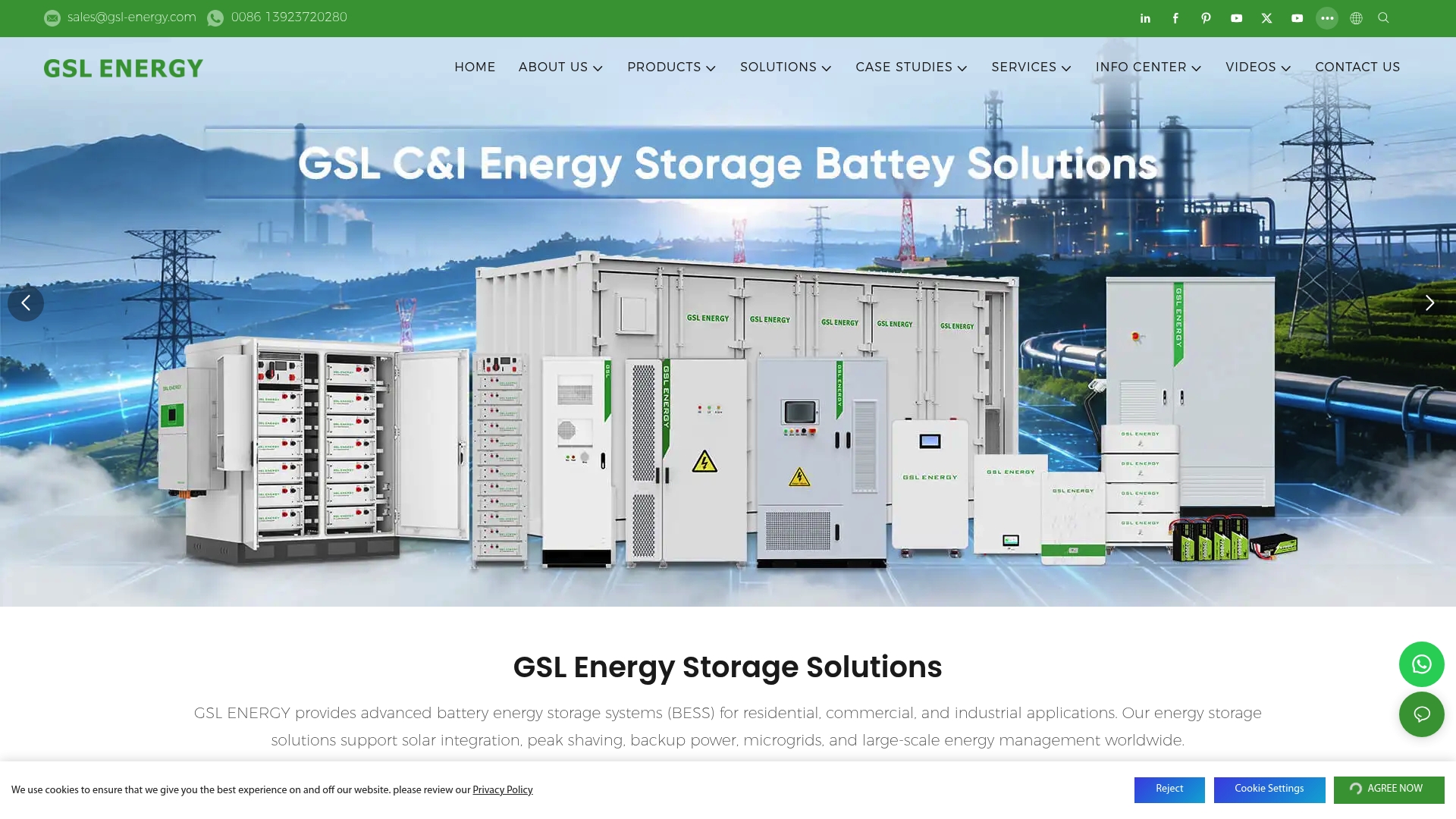
GSL ENERGY reports serving clients in over 150 countries, a scale that supports large international rollouts. The vendor advertises international certifications such as UL 9540, UL 1973, and IEC standards. Their product line emphasizes modular LiFePO4 packs and configurable systems for grid, commercial, and residential sites.
Core Features
GSL ENERGY offers configurable industrial, commercial, and residential battery systems that combine modular racks, a battery management system, and safety features. The company supports microgrid integration, peak shaving, and renewable energy storage with OEM and ODM manufacturing options. Global project support and certification workflows are part of their delivery model.
Key Differentiator
GSL ENERGY combines certified hardware with modular designs that scale from single-site commercial systems to utility-scale arrays. Their strength lies in vertical integration across R&D, automated manufacturing, and project support, which shortens delivery for large technical projects. This focus suits buyers who prefer a manufacturer-led solution rather than an EMS-first integrator.
Pros
The vendor reports a lifespan of up to 10+ years and over 6,500 cycles, which aligns with long-duration commercial deployments. That longevity claim pairs with advanced safety features, including robust BMS and fire protection, which reduce operational risk on critical sites. Vertical integration and an active R&D team support customization for complex microgrids and OEM projects.
Cons
Limited independent user feedback is available, making field performance harder to verify.
Pricing tends to suit larger projects, so small residential buyers may find the cost structure less competitive.
Product complexity often requires professional consultation and system engineering for correct sizing and integration.
When It May Not Fit
You should avoid GSL ENERGY when you need a plug-and-play residential wall system with published retail pricing. If your project is a single small home or a simple retrofit without engineering support, this offering may add unnecessary complexity. Also, buyers seeking a purely EMS-led vendor with native residential apps may prefer a different supplier.
Who It’s For
Energy project developers, EPC contractors, utilities, and industrial facility managers in Europe will find this product most relevant. OEM partners that need certified, scalable battery packs also match the profile. If you manage grid services, microgrids, or large commercial sites, GSL ENERGY aligns with those technical requirements.
Real World Use Case
A European renewable developer contracted GSL ENERGY for a microgrid. The vendor supplied modular LiFePO4 batteries with liquid cooling and integrated them with solar PV and a smart EMS. GSL ENERGY handled system design, manufacturing, and certification, and provided ongoing project support for trading and outage resilience.
Pricing
Pricing varies by product line and project scale, with tailored quotes provided on inquiry. No fixed price range is published. The company commonly offers flexible OEM and ODM pricing models adjusted to specifications and volume.
Website: https://gsl-energy.com
Comparison of Top Grid Storage Solutions
This comparison focuses on systems offering advancements in energy storage materials and technology for diverse applications ranging from residential to utility-scale projects.
Product Name | Core Feature | Key Differentiator | Best For | Pricing | Notable Limitation |
Belinus | Graphene supercapacitors with AI Energy Management | Lithium-free recyclable storage | European energy professionals prioritizing sustainability | €7,000 per unit | Limited deployment options outside Europe |
Rongke Power (RKP) | Modular vanadium flow batteries | Long cycle life with safety-focused electrolyte | Utilities and grid operators | Price not published | Limited independent third-party reviews |
ESS Tech, Inc. | Iron flow chemistry systems for unlimited cycling | Proprietary iron flow chemistry enabling zero capacity degradation | Long-duration renewable backup projects | Price not published | Oriented toward multihour applications |
GSL ENERGY | Modular LiFePO4 systems with global certifications | Certified scalable hardware and OEM customization | EPC contractors and grid service managers | Price not published | Suitability for small-scale residential projects is limited |
What Challenges Do You Face with Top Grid Storage Solutions?
Belinus offers a unique approach to energy storage that addresses common concerns in grid storage today. If you prioritize material sustainability, lifecycle management, and tariff optimization, Belinus delivers a 16 kWh graphene supercapacitor alongside an AI-powered energy management system. This solution targets long warranty coverage and recyclable materials, moving away from lithium dependency.
Key benefits include:
AI-driven 15-minute dynamic tariff optimization
Scalable utility storage modules for grid and industrial uses
Integrated fleet EV charging and RESTful APIs for third-party system control
Explore how Belinus supports energy professionals and facility managers in Europe with advanced, adaptable solar and storage systems. Learn more about tailored sustainable energy solutions at the Belinus homepage.
FAQ
What is the price of the Energy Wall G1 from Belinus?
The Energy Wall G1 is priced at €7,000 per unit. This model features a 16 kWh graphene supercapacitor and is expected to be available in Q1 2026. For projects where substantial energy storage is needed, this pricing reflects Belinus’s focus on advanced material use and performance.
How does Belinus compare to RKP in terms of cycle life?
RKP supports over 25,000 cycles with its vanadium flow batteries, emphasizing long life and high safety. In contrast, Belinus’s offerings focus on lithium-free recyclability and material sustainability, targeting users prioritizing environmental impact alongside performance. Choose Belinus for projects emphasizing lifecycle handling and reduced chemical risks.
What unique feature does Belinus provide for tariff optimization?
Belinus includes an AI-powered energy management system that supports 15-minute dynamic tariff optimization. This capability ensures that users can effectively manage energy consumption and maximize savings, making Belinus a strong choice for energy professionals focused on financial efficiency.
Can I use Belinus products for small residential projects?
Belinus is best suited for energy professionals and facility managers looking for scalable solutions, particularly in larger or more complex installations. For those considering smaller residential systems, evaluating alternative brands like GSL ENERGY, which caters to such needs, might be beneficial.
What warranties does Belinus offer on its products?
Belinus emphasizes long warranties on its products, reflecting its confidence in the durability and reliability of its systems. This assurance provides an added layer of security for users prioritizing product performance and longevity in their energy storage solutions.
Recommended
Comments