What Are Smart Grids? Benefits, Technology, and Future
- Jun 7
- 9 min read

TL;DR:
A smart grid actively manages electricity supply and demand using digital sensors and two-way communication technology. It enables bi-directional energy flow, quick fault responses, and better integration of renewable sources, transforming energy management at utility scale. Challenges include cybersecurity risks, interoperability issues, and large-scale data handling that require ongoing coordination and innovation.
A smart grid is an electricity network that uses digital sensors, automated controls, and two-way communication to actively balance supply and demand in real time. Unlike the passive infrastructure most of us grew up with, a smart grid sees, thinks, and responds. It knows when a solar panel in your neighborhood pushes excess power back onto the line. It reroutes electricity around a fault before you even notice the lights flicker. For anyone managing energy costs, planning renewable installations, or working in utility operations, understanding smart grid technology is no longer optional. It is the foundation of every serious energy decision made in 2026.
What are smart grids and how do they work?
A smart grid is defined as an electricity distribution system that integrates digital communication technology into every layer of the power network, from generation to the end consumer. The U.S. Department of Energy describes it as the application of digital processing and communications to the power grid. The result is a network that can monitor itself, detect problems, and respond automatically.
Traditional grids were designed for one-way power flow: electricity moved from a central power plant to homes and businesses, with no feedback loop. Bi-directional energy flow is the defining structural difference in a smart grid. Power can now travel from rooftop solar panels back to the grid, from battery storage systems into the network during peak demand, and from EV chargers that modulate their draw based on grid conditions.
The communication layer is what makes this possible. Data exchange between utilities and connected devices happens continuously, often multiple times per minute. That constant feedback allows grid operators to see exactly where demand is spiking, where a fault is developing, and where stored energy can be dispatched. The grid stops being a static machine and becomes a responsive system.
Key technologies that power smart grid infrastructure
Several specific technologies combine to give a smart grid its intelligence. Each one solves a distinct problem that traditional infrastructure could not address.
Smart meters and sensors replace analog meters with devices that report consumption data in near real time. Instead of a monthly reading, utilities receive granular data that reveals usage patterns, identifies inefficiencies, and enables dynamic pricing signals to consumers.
Phasor Measurement Units (PMUs) monitor voltage, current, and frequency across the grid at high speed, providing operators with a precise picture of grid stability. PMUs detect instability events that would be invisible to conventional monitoring equipment, allowing operators to intervene before a cascade failure develops.
Fault Location, Isolation, and Service Restoration (FLISR) is the technology that converts a smart grid into a self-healing system. FLISR automatically reroutes power around faults in seconds, reducing outage durations from hours to near-instantaneous restoration. For industrial facilities and hospitals, that difference is measured in production losses and patient safety.
Communication infrastructure ties all of these components together. Fiber optic networks, cellular connections, and power line communication protocols create the backbone that carries data between substations, smart meters, distributed energy resources, and control centers.
Pro Tip: If you are evaluating energy storage or solar installations for a commercial site, ask your provider whether their system communicates with the grid using open protocols like IEC 61968 or IEEE 2030. Proprietary-only systems limit your future flexibility.
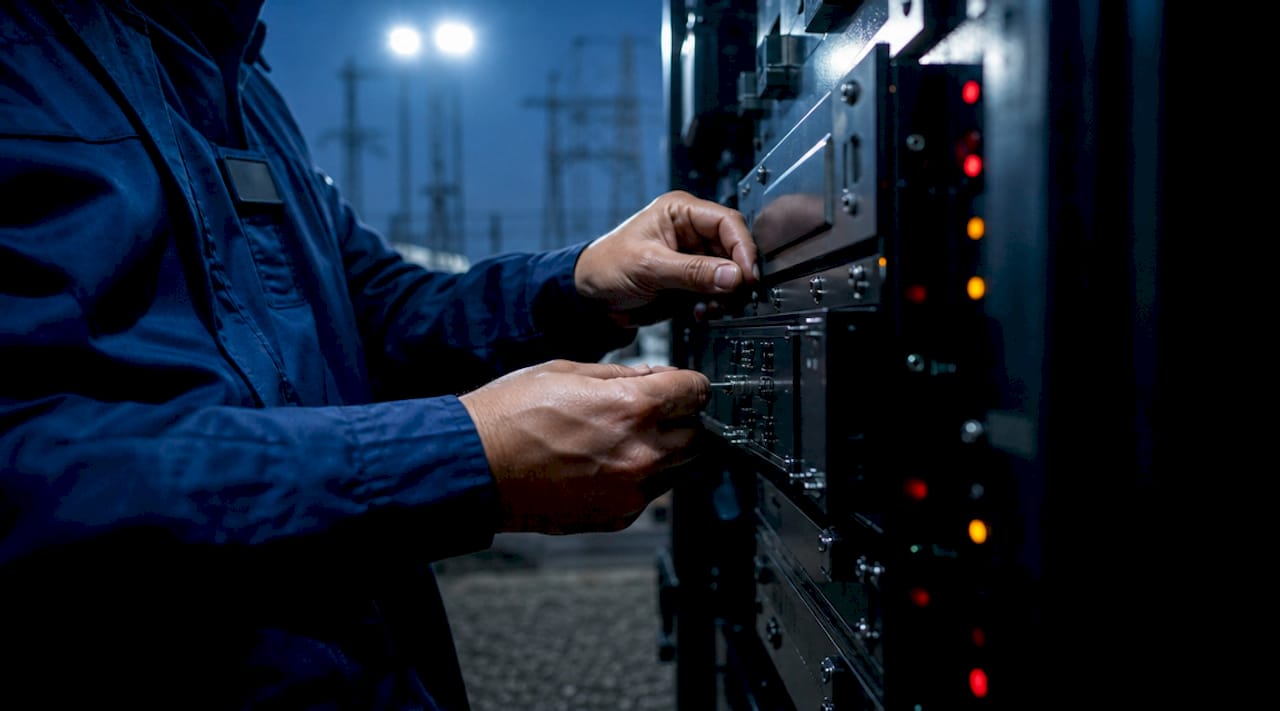
The interaction between these technologies is what produces smart grid behavior. A PMU detects a voltage anomaly. The communication network relays that data to the control center in milliseconds. FLISR isolates the fault and reroutes supply. The smart meter at your facility never registers an interruption. That sequence, which once took utility crews hours to complete manually, now happens automatically.
How smart grids compare to traditional grids and smart homes
These two comparisons come up constantly, and conflating them leads to poor decisions about technology investment.
Feature | Traditional grid | Smart grid | Smart home |
Power flow direction | One-way only | Bi-directional | N/A (consumer device) |
Scale | Utility-wide | Utility-wide | Individual property |
Communication | None or one-way | Continuous two-way | Local network |
Renewable integration | Limited | Native support | Depends on grid signals |
Fault response | Manual crew dispatch | Automated via FLISR | Not applicable |
Consumer participation | Passive | Active via pricing signals | Active via automation |
Smart homes, powered by platforms like Google Home or Amazon Alexa, operate at the consumer level. They automate thermostats, lighting, and appliances within a single property. A smart grid operates at utility scale, managing megawatts across entire regions. Smart grid infrastructure functions independently of whether any individual home is “smart,” though a smart home can respond to grid signals, such as shifting dishwasher cycles to off-peak hours when the grid sends a price signal.
Solar panels, wind turbines, and battery storage contribute dynamically to a smart grid in ways that a traditional grid simply cannot accommodate. When a cloud passes over a solar farm and output drops by 30% in 90 seconds, the smart grid compensates by dispatching stored energy or adjusting demand response programs. A traditional grid would either over-generate as a buffer or risk a frequency deviation.
Benefits of smart grids for energy management and sustainability
The advantages of smart grid technology are concrete and measurable, not theoretical.
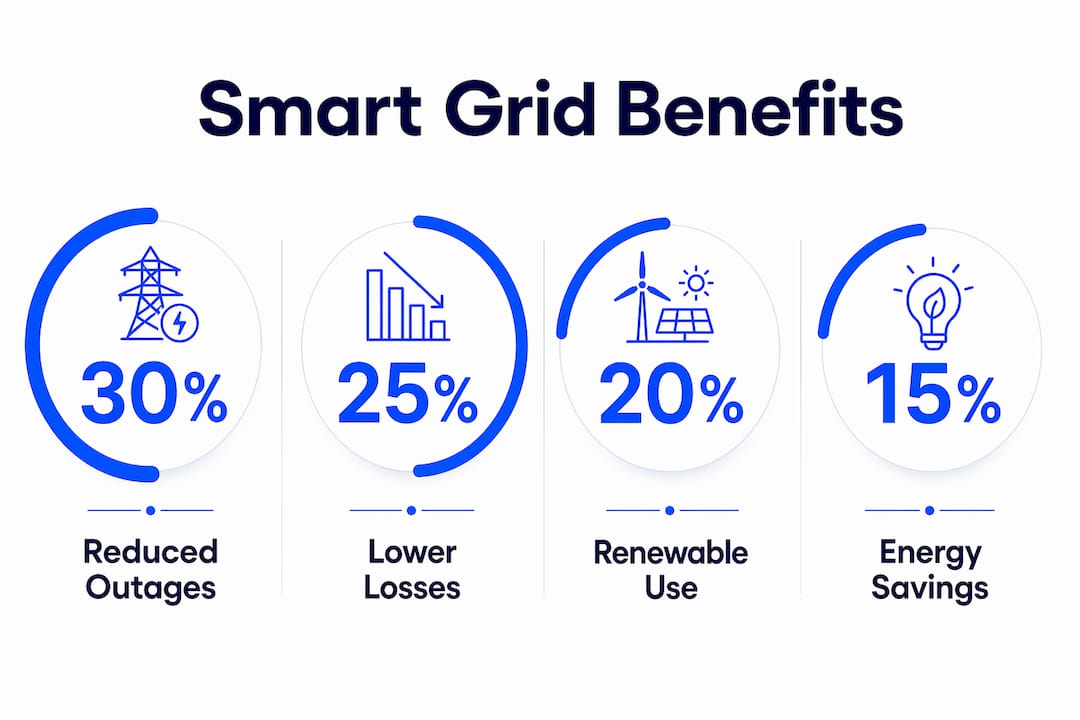
Reduced outage duration. FLISR technology cuts restoration times from hours to seconds. For commercial and industrial operators, this directly reduces production downtime and equipment damage from power interruptions.
Lower transmission losses. Smart grids optimize energy flows across the network, reducing the waste that occurs when electricity travels long distances at suboptimal loads. Demand response and load shifting flatten peak demand curves, which means utilities run fewer inefficient peaker plants.
Renewable energy integration. Variable generation from solar and wind becomes manageable when the grid can see output in real time and dispatch storage or adjust demand accordingly. This is the enabling infrastructure for any serious decarbonization target.
Consumer participation. Dynamic pricing signals allow businesses and households to shift consumption to lower-cost periods. A commercial facility with a battery storage system and an energy management system can arbitrage tariff differences, buying cheap overnight power and avoiding expensive peak rates.
Grid resilience as a strategic asset. Smart grids transform brittle infrastructure into a resilient ecosystem that absorbs shocks rather than propagating them. In a geopolitical environment where energy security is a national priority, that resilience has strategic value beyond simple cost savings.
The combination of these benefits explains why smart grids are now treated as a strategic energy security imperative, not merely an efficiency upgrade. Countries and utilities that delay modernization are not just leaving money on the table. They are accumulating systemic risk.
Challenges smart grids face in deployment
The benefits are real, but so are the obstacles. Three challenges consistently slow smart grid deployment.
Cybersecurity vulnerabilities. Every digital device added to the grid is a potential attack surface. Utilities implement encryption, authentication, and network segmentation to protect smart grid systems, but the attack surface grows with every new smart meter and IoT sensor deployed. Securing decentralized IoT-driven monitoring remains an active research challenge, and the consequences of a successful attack on grid control systems are severe.
Interoperability gaps. Smart grids combine modern IoT devices with legacy electrical infrastructure that was built decades ago. Middleware and standardized protocols are necessary to unify these systems, but incompatible IT and Operational Technology (OT) standards create fragmented deployments where components cannot communicate effectively.
Data management at scale. A fully instrumented grid generates enormous volumes of data every minute. Processing, storing, and acting on that data in real time requires significant investment in computing infrastructure and analytical capability.
Pro Tip: For organizations deploying distributed energy resources like battery storage or EV chargers, choose systems with open API architecture. Closed systems that cannot exchange data with utility-grade communication protocols will become liabilities as smart grid requirements tighten.
Addressing these challenges requires coordination between equipment manufacturers, utilities, regulators, and cybersecurity specialists. For more on the specific risks that IoT connectivity introduces to energy infrastructure, the analysis on IoT cyberattack defenses is worth reviewing.
Emerging trends shaping the future of smart grids
The next phase of smart grid evolution moves from reactive management to predictive intelligence.
Trend | Technology | Impact |
Digital Twin modeling | Virtual real-time grid simulation | Predict failures before they occur |
AI and machine learning | Automated forecasting and dispatch | Reduce human intervention in grid management |
Decentralized energy networks | Distributed generation and storage | Reduce dependence on centralized plants |
Vehicle-to-grid (V2G) | EV batteries as grid storage | Millions of mobile storage units available to the grid |
Digital Twin technology creates virtual models of the physical grid that update in real time, allowing operators to simulate scenarios and predict equipment failures before they happen. This represents a shift from reactive maintenance to proactive grid management. A utility using Digital Twins can model the impact of a new solar farm on local voltage stability before the panels are even installed.
AI and machine learning add forecasting capability that no human operator can match at scale. Algorithms trained on years of consumption data, weather patterns, and generation profiles can predict demand spikes hours in advance and pre-position stored energy accordingly. The grid becomes less a machine to be operated and more a system that largely operates itself.
Key takeaways
Smart grids are the foundational infrastructure that makes renewable energy integration, grid resilience, and consumer energy participation technically possible at utility scale.
Point | Details |
Smart grid definition | An electricity network using digital sensors and two-way communication to balance supply and demand in real time. |
Core technologies | PMUs, FLISR, smart meters, and communication protocols work together to enable automated grid intelligence. |
Key advantage over traditional grids | Bi-directional power flow and automated fault restoration reduce outages from hours to seconds. |
Main deployment challenges | Cybersecurity vulnerabilities and IT/OT interoperability gaps are the primary barriers to full deployment. |
Future direction | Digital Twin modeling and AI forecasting move smart grids from reactive to predictive management. |
Why smart grids matter more than most people realize
The conversation around smart grids tends to focus on technology specs, and that misses the bigger picture. What I find most significant after working closely with energy storage and management systems is how fundamentally smart grids change the relationship between energy producers and consumers. The old model was passive: power flowed one way, consumers paid their bills, and the utility managed everything invisibly. Smart grids make that relationship active and mutual.
The FLISR point deserves more attention than it gets. Most people have experienced a power outage and waited hours for a crew to restore service. The idea that a software-driven system can detect, isolate, and reroute around a fault in seconds is not incremental improvement. It is a categorical change in what the grid can do. For hospitals, data centers, and manufacturing facilities, that capability has direct financial and safety implications.
On cybersecurity, I think the industry sometimes understates the risk to avoid alarming consumers. Every smart meter, every grid-connected battery, every EV charger is a node that a sophisticated attacker could target. The utilities doing this well treat security as an ongoing operational discipline, not a one-time installation checklist. That mindset needs to become universal.
The integration of systems like Belinus’s Energy Management System with smart grid signals is exactly where the practical value gets realized. When a battery storage system can read dynamic tariff data from the grid and make autonomous charge/discharge decisions, the smart grid stops being abstract infrastructure and becomes a direct financial tool. That is the future worth building toward.
— Marc
Optimize your energy strategy with Belinus

Smart grid compatibility is not a future consideration for energy storage and solar installations. It is a current specification requirement. Belinus designs battery storage, solar PV, and EV charging systems with grid integration built in from the start. The Belinus Energy Management System uses 15-minute dynamic tariff optimization to maximize the financial return from smart grid pricing signals, whether you are a homeowner with rooftop solar or a commercial operator managing a multi-site portfolio. Explore how grid-connected battery storage reduces energy costs in practice, or learn how grid flexibility translates into measurable savings and sustainability gains.
FAQ
What is the smart grid definition?
A smart grid is an electricity network that integrates digital communication, sensors, and automated controls to enable real-time, two-way management of power supply and demand. It differs from a traditional grid by supporting bi-directional energy flow and automated fault response.
How do smart grids work in practice?
Smart grids use sensors, smart meters, PMUs, and communication networks to collect and exchange data continuously between utilities and connected devices. Automated systems like FLISR use that data to reroute power around faults, optimize energy flows, and respond to changes in generation or demand within seconds.
What are the main benefits of smart grids?
The primary benefits include reduced outage durations through automated fault restoration, lower transmission losses, native integration of renewable energy sources, and consumer participation through dynamic pricing. Smart grids also improve overall grid resilience against both physical and cyber threats.
What is the difference between a smart grid and a smart home?
A smart grid operates at utility scale, managing power distribution across entire regions. A smart home uses consumer-level automation to control appliances within a single property. Smart homes can respond to smart grid pricing signals, but the two systems operate independently at different scales.
What challenges do smart grids face?
The three main challenges are cybersecurity vulnerabilities from increased digital connectivity, interoperability gaps between modern IoT devices and legacy electrical infrastructure, and the data management demands of processing real-time information across millions of connected devices.
Recommended
Comments