What Is a Mobile Energy App? Your 2026 Guide
- 18 hours ago
- 9 min read

TL;DR:
Mobile energy apps enable users to monitor and control electricity consumption by connecting to hardware such as inverters, batteries, and EV chargers through protocols like Modbus. They distinguish between monitoring dashboards and bidirectional control systems, with advanced apps offering scheduling and automation based on real-time grid data and guidance principles like reduce and shift. The most effective solutions integrate hardware compatibility, clear control frameworks, and grid-aware features to maximize cost savings and sustainability benefits.
A mobile energy app is software that lets you monitor, control, and optimize your electricity use through a smartphone or tablet, connecting directly to energy hardware like inverters, batteries, EV chargers, and smart thermostats. The term “mobile energy app” is the common search phrase for what the industry calls an energy management application or energy monitoring application, and the distinction matters because the best tools do far more than display a chart. They execute commands, shift loads, and respond to live grid data. The Duke Energy App, Apple’s EnergyKit framework, and the Enyo-Energy SDK each represent a different layer of this technology, from consumer billing dashboards to developer-level device control. Understanding where each fits helps you choose the right tool for your situation.
What is a mobile energy app and how does it work?
A mobile energy app functions on two integration layers: a consumer-facing dashboard for monitoring, and a backend control layer that sends commands directly to devices. This architecture is the foundation of real-time energy management, and collapsing the two into one category is the most common mistake buyers make.
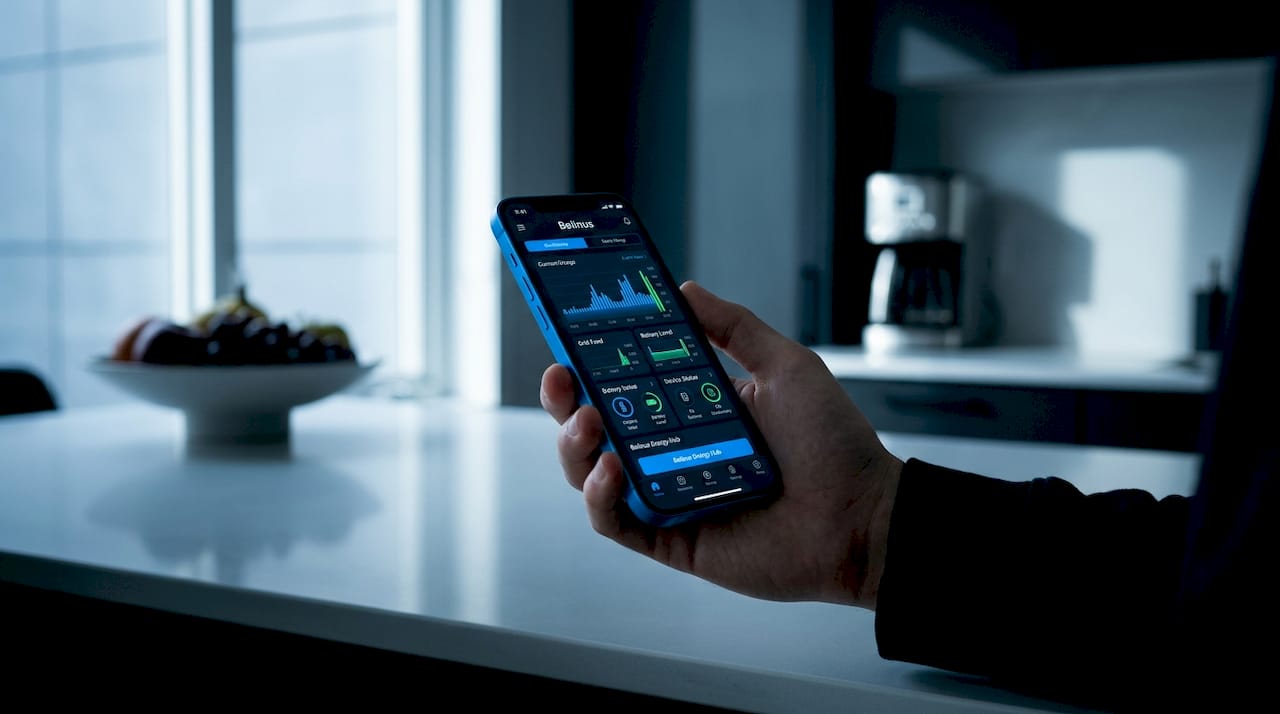
On the monitoring side, the app reads data from smart meters, inverters, and battery systems, then presents it as consumption graphs, cost breakdowns, and grid cleanliness scores. On the control side, the app sends commands back to those same devices, telling a heat pump to pause, an EV charger to start, or a battery to discharge. The Enyo-Energy SDK formalizes this split by defining two distinct app roles: Integration apps that execute commands on physical devices, and Forecast apps that produce energy load predictions. Keeping these roles separate improves reliability because a forecasting error does not accidentally trigger a device command.
Device communication relies on structured protocols. Modbus communication is one of the most common, allowing apps to read registers from meters and inverters and write control values back. The SDK abstracts this complexity so developers do not need to handle raw byte sequences for every device type. For homeowners and business operators, this means the app “just works” across a range of hardware brands without custom configuration.
Apple’s EnergyKit, introduced in iOS 26, adds a grid-aware layer on top of device control. The framework pulls utility and grid data to generate two types of guidance: Reduce, which tells devices to lower consumption immediately, and Shift, which schedules usage for cleaner or cheaper windows such as overnight EV charging. This is the direction the entire category is moving: apps that do not just report what happened, but actively shape what happens next.
Pro Tip: When evaluating any energy monitoring application, ask the vendor whether it supports bidirectional communication. An app that only reads data cannot automate savings. You need one that also writes commands and receives status confirmations from your devices.
What features do consumer mobile energy apps typically offer?
Consumer-facing energy apps have converged on a core feature set, though the depth of each feature varies significantly between utility apps and hardware-integrated apps.
Real-time consumption and production monitoring. The app displays live data from your meter, solar panels, or battery, showing how much energy you are generating, consuming, and exporting at any given moment. The Duke Energy App, for example, tracks usage and costs in near real time and sends alerts when consumption spikes above your set threshold.
Bill tracking and payment management. Utility apps connect directly to your account, showing current charges, payment history, and projected bills based on current usage patterns. This feature alone drives behavioral change because most people have no idea how daily habits translate into monthly costs until they see the number update in real time.
Energy usage insights by cost and grid cleanliness. Apps using frameworks like EnergyKit categorize load events by both cost and carbon intensity, so you know not just how much you spent but whether that energy came from renewables or fossil fuels. This is particularly useful for businesses with sustainability reporting requirements.
Program enrollment and demand-response incentives. Utilities reward users who reduce consumption during peak demand periods. The Duke Energy App surfaces these programs directly in the interface, letting you enroll and receive notifications when an event is triggered. For commercial users, these incentives can offset a meaningful portion of energy costs.
Device scheduling and automation. Integrated apps let you set rules: charge the EV when grid carbon is below a threshold, discharge the battery when spot prices peak, or pause the heat pump during a demand event. This is where energy tracking apps cross into genuine energy management applications.
Feature | Monitoring-only app | Integrated control app |
Real-time data dashboard | Yes | Yes |
Bill tracking and alerts | Yes | Yes |
Grid cleanliness scoring | Sometimes | Yes |
Device scheduling | No | Yes |
Automated demand response | No | Yes |
Bidirectional device commands | No | Yes |
What are the advantages of mobile energy apps for individuals and businesses?
The practical benefits of mobile energy management split cleanly across two dimensions: financial and behavioral.
On the financial side, time-of-use optimization is the primary driver. Apps that integrate with dynamic tariff data can shift flexible loads, EV charging, battery cycling, dishwashers, to off-peak windows where electricity costs a fraction of peak rates. Belinus’s centralized EMS, for instance, runs 15-minute dynamic tariff optimization, a cycle fast enough to capture intraday price swings that a manual schedule would miss entirely.
Cost reduction through load shifting. Moving consumption to cheaper windows directly reduces bills without changing comfort or output.
Waste elimination through real-time alerts. Knowing that a device left on standby is costing you money every hour is the fastest way to change that behavior permanently.
Environmental impact reduction. Apps that surface grid cleanliness data let users prioritize cleaner energy by timing high-consumption tasks for periods of high renewable generation.
Operational visibility for businesses. Fleet operators using apps like Belinus’s ETAP Pro integration can track charging sessions, costs per vehicle, and energy allocation across an entire company car fleet from a single dashboard.
Utility incentive capture. Businesses enrolled in demand-response programs through their utility’s app can generate revenue or credits during grid stress events, turning energy flexibility into a financial asset.
“Utility apps that provide historical and real-time data empower users to make informed choices leading to energy and cost savings.” — Duke Energy Mobile App
The behavioral dimension is equally significant. Studies in energy psychology consistently show that visibility drives reduction. When people see their consumption in real time, they reduce it. The role of energy monitoring systems for homeowners confirms this pattern: awareness precedes action, and action compounds over time into measurable savings.
Monitoring-only vs. integrated control apps: what’s the difference?
The most important distinction in the mobile energy app category is not brand or price. It is whether the app can control devices or only observe them.
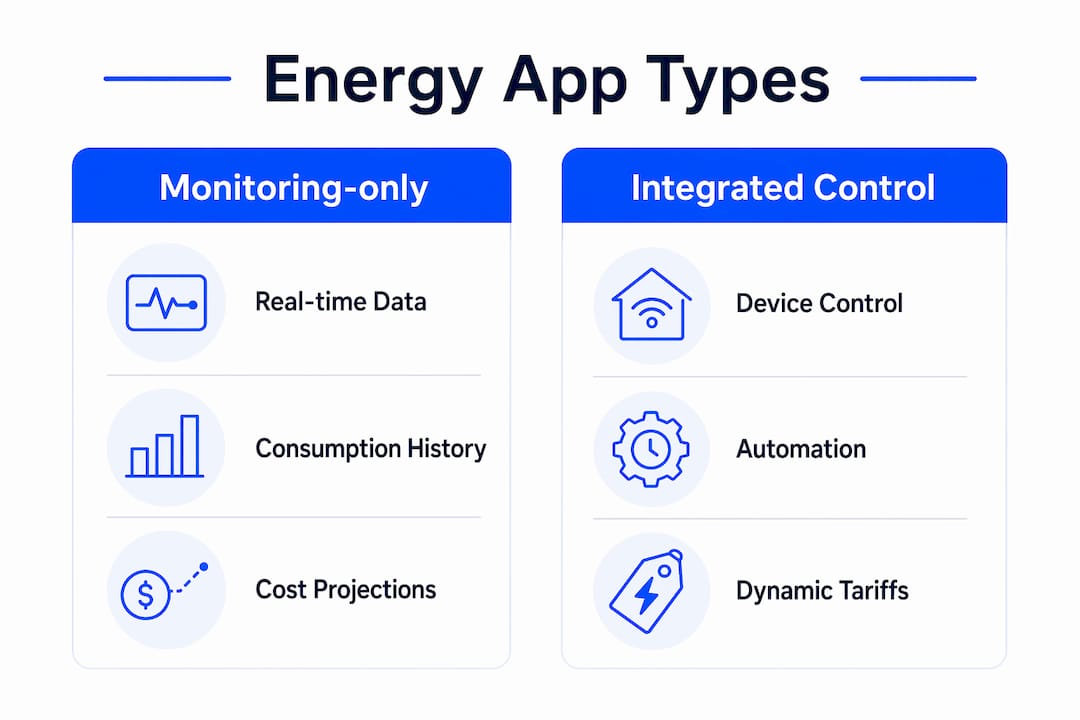
Monitoring-only apps deliver dashboards, consumption history, and cost projections. They are genuinely useful for understanding your energy profile, identifying waste, and tracking bills. What they cannot do is act on that information. If your app tells you that electricity is cheap right now but cannot tell your EV charger to start, the insight has no economic value beyond informing your next manual decision.
Integrated control apps close that gap. The Enyo-Energy SDK architecture illustrates the technical requirement: Integration apps must handle bidirectional communication, sending commands to devices and receiving acknowledgment and status updates in return. This feedback loop is what makes automation reliable. An app that sends a “start charging” command without confirming the charger responded cannot guarantee the action completed.
App type | Data access | Device control | Automation | Best for |
Monitoring only | Full | None | None | Awareness and billing |
Integrated control | Full | Full | Yes | Cost optimization and automation |
Hybrid (forecast + control) | Full | Full | Predictive | Advanced EMS and commercial use |
The hybrid category, combining Forecast and Integration roles, represents the current frontier. Apple’s reduce vs. shift design principle maps specific guidance types to specific device capabilities rather than applying a generic “save energy” instruction. A heat pump responds to a Reduce signal by lowering output. An EV charger responds to a Shift signal by moving its session to a cleaner window. This device-aware approach produces better outcomes than blanket scheduling.
Pro Tip: Before committing to any energy consumption app, verify that it supports your specific hardware protocols. An app built for Modbus-compatible inverters will not automatically work with a proprietary battery system. Ask for a compatibility list before you buy.
Key takeaways
Mobile energy apps deliver maximum value when they combine real-time monitoring with direct device control, grid-aware scheduling, and utility program integration.
Point | Details |
Two-layer architecture | Every effective energy app separates the monitoring dashboard from the device control backend. |
Protocol compatibility matters | Apps using Modbus or open SDKs integrate across more hardware brands than proprietary systems. |
Reduce vs. shift logic | Mapping guidance to device capability, as EnergyKit does, produces better savings than generic scheduling. |
Monitoring alone has limits | An app that cannot send commands cannot automate savings, only inform manual decisions. |
Incentive programs add value | Utility demand-response enrollment through mobile apps turns energy flexibility into direct financial returns. |
Why the “best energy app” question misses the point
The conversation I have most often with people evaluating mobile energy solutions goes like this: they want to know which app is best, and I have to redirect them to a prior question. Best for what hardware? Best for which utility tariff structure? Best for a homeowner with a single battery, or a fleet operator managing 40 EV chargers?
The apps that impress me most in 2026 are not the ones with the cleanest interface. They are the ones with the clearest integration boundaries. The Enyo-Energy SDK’s decision to formally separate Integration and Forecast roles is a design philosophy I wish more vendors would adopt. When a forecasting error cannot accidentally trigger a device command, the whole system becomes more trustworthy, and trust is what drives adoption.
I am also watching Apple’s EnergyKit rollout closely. The reduce versus shift distinction sounds simple, but it encodes a sophisticated understanding of device physics. A battery can do both. An EV charger mostly shifts. A heat pump mostly reduces. An app that treats all three identically will optimize poorly for all three. The frameworks that map guidance to device capability will outperform the ones that do not, and that gap will widen as dynamic tariffs become standard.
My advice for anyone choosing between energy monitoring applications right now: start with your hardware list, not your feature wishlist. The app that works with your inverter, your battery, and your utility’s API is worth more than the one with the best dashboard that cannot talk to your system.
— Marc
Explore mobile energy management with Belinus
Belinus builds energy management systems designed around exactly the integration principles this article describes: real-time monitoring, bidirectional device control, and 15-minute dynamic tariff optimization through a native mobile app and web dashboard. The Belinus EMS connects Solis inverters, the Energy Wall G1 battery, and the ETAP Pro EV charger into a single platform, giving residential and commercial users the kind of home energy savings that monitoring-only apps cannot deliver. For fleet operators, the ETAP Pro integration with EV charging infrastructure adds session-level cost tracking across every vehicle. If you are ready to move from energy awareness to energy control, explore Belinus solutions and see how the full system fits your setup.
FAQ
What is a mobile energy app?
A mobile energy app is a software application that lets users monitor and manage electricity consumption through a smartphone or tablet, connecting to hardware like inverters, batteries, EV chargers, and smart thermostats. The industry standard term is an energy management application or energy monitoring application.
How do energy apps connect to home devices?
Energy apps communicate with devices through protocols like Modbus, which allow the app to read data registers from meters and inverters and send control commands back to those devices. SDKs like the Enyo-Energy framework abstract this communication so apps work across multiple hardware brands.
What is the difference between a monitoring app and a control app?
A monitoring app provides dashboards and consumption data but cannot operate devices. A control app sends commands to hardware like EV chargers and batteries, enabling automated scheduling and real-time optimization that monitoring alone cannot achieve.
Can a mobile energy app reduce my electricity bill?
Yes. Apps that integrate with dynamic tariff data shift flexible loads like EV charging and battery cycling to off-peak windows where electricity costs less, directly reducing monthly bills without changing comfort or output levels.
What is Apple’s EnergyKit and how does it relate to energy apps?
EnergyKit is an iOS 26 framework that gives apps access to grid and utility data to generate two types of guidance: Reduce, for devices that should lower consumption immediately, and Shift, for devices that can move usage to cleaner or cheaper time windows like overnight EV charging.
Recommended
Comments