What Is Energy as a Service? A 2026 European Guide
- Jul 4
- 8 min read

TL;DR:
Energy as a Service (EaaS) offers organizations access to energy infrastructure without upfront investments. It shifts costs to operational expenses and improves efficiency through smart energy management systems. Proper contract management and portfolio scaling are crucial for maximizing benefits.
Energy as a Service (EaaS) is a subscription-based business model that gives organizations access to energy infrastructure, management, and optimization without any upfront capital investment. The industry term you will encounter most often is EaaS, though “energy-as-a-service” and “energy subscription services” describe the same concept. EaaS shifts energy costs from CapEx to OpEx, freeing up capital for core operations while a third-party provider owns, operates, and maintains the physical assets. For European companies facing rising electricity prices and tightening EU decarbonization targets, this model offers a direct path to lower bills, predictable budgets, and measurable sustainability gains.
What is energy as a service and how does it work?

EaaS works on a simple principle: a provider installs and owns the energy infrastructure on your site, and you pay a recurring fee for the energy output or performance delivered. You never buy the solar panels, battery storage units, or energy management hardware. The provider handles procurement, installation, maintenance, and ongoing optimization. Your obligation is the subscription payment, which is typically structured as a fixed monthly fee, a pay-per-kilowatt-hour rate, or a performance-based contract tied to verified savings.
The operational core of any EaaS arrangement is an intelligent Energy Management System (EMS). Intelligent EMS platforms optimize revenue streams every 15 minutes, dynamically adjusting battery dispatch, grid imports, and renewable generation to minimize costs. Without that continuous optimization layer, the theoretical savings in a contract rarely materialize in real conditions. This is why the quality of the EMS is the single most important technical factor when evaluating an EaaS provider.
Common services bundled into EaaS contracts include:
Solar PV generation and grid export management
Battery storage for peak shaving and arbitrage
EV charging infrastructure for fleets and employees
Demand response participation and grid balancing services
Energy efficiency upgrades such as LED lighting and HVAC controls
Backup power and resilience systems
Real-time monitoring and reporting through a web or mobile dashboard
Pro Tip: Before signing any EaaS contract, ask the provider to define the performance baseline in writing. The baseline is the reference point used to calculate your savings. A vague or poorly audited baseline means you could pay for savings that never actually occurred.
What are the economic and operational benefits of Energy as a Service?
The financial case for EaaS is straightforward. Integrated management systems can reduce utility costs by up to 30%, and large-scale partnerships have produced even more dramatic results. One hospital network partnership projected savings of over $350 million across 30 years, with first-year savings reaching $6.9 million. Those figures reflect what happens when professional energy operators run infrastructure full-time rather than leaving it to facilities teams with competing priorities.
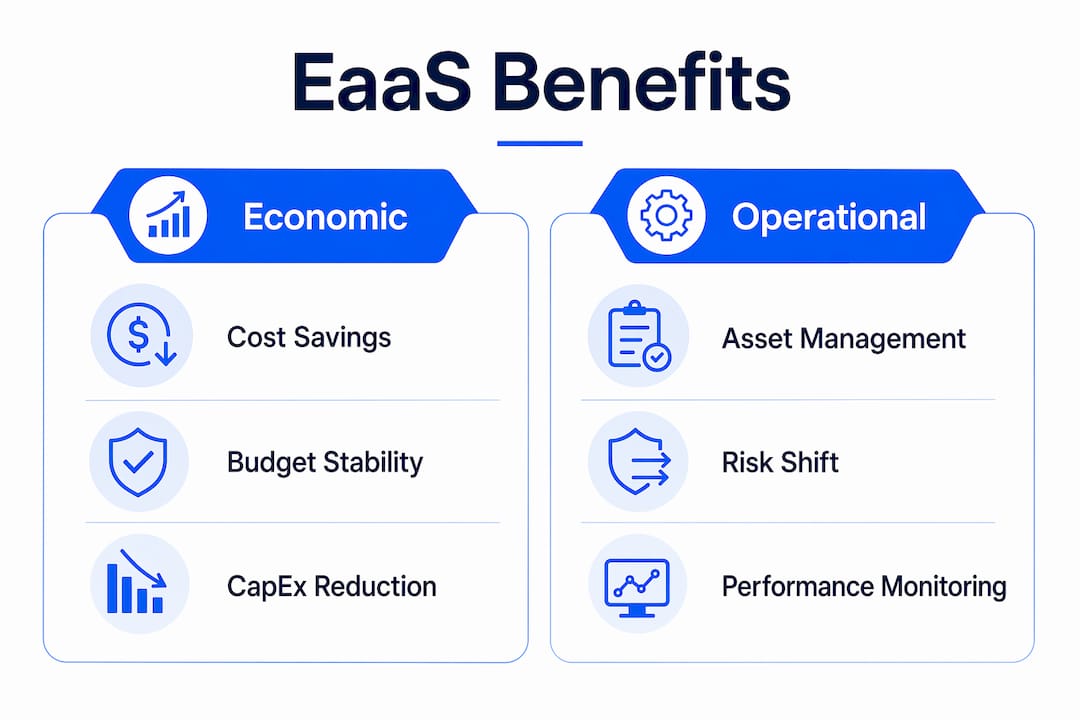
Subscription pricing models stabilize budgets and shift market risk to providers. That predictability matters enormously for European finance teams dealing with volatile wholesale electricity prices. You lock in a known cost per unit of energy or a fixed monthly payment, and the provider absorbs the exposure to price spikes.
The table below compares EaaS against traditional energy ownership across the dimensions that matter most to European organizations.
Dimension | Traditional ownership | Energy as a Service |
Upfront cost | High CapEx required | Zero upfront investment |
Maintenance responsibility | Internal team | Provider-managed |
Technology risk | Owner bears obsolescence risk | Provider bears upgrade risk |
Budget predictability | Variable utility bills | Fixed subscription or pay-per-use |
Access to renewable energy | Requires separate procurement | Bundled into contract |
Decarbonization reporting | Self-managed data collection | Provider delivers verified data |
Operationally, EaaS removes the burden of asset management from your team. EaaS providers take ownership of energy infrastructure, including procurement, maintenance, and performance optimization. Your facilities team stops spending time on inverter firmware updates and battery health checks. That time goes back to your core business.
Pro Tip: Pair your EaaS contract with an internal energy champion who reviews monthly performance reports. Providers deliver better results when clients actively track KPIs and flag anomalies early.
What contractual and strategic considerations should organizations know?
The greatest barrier to EaaS adoption is not the technology. It is managing long-term, multi-site contractual and regulatory risks. EaaS contracts typically run 10–25 years. A lot changes in that window: energy regulations, grid tariff structures, building use patterns, and organizational priorities. Getting the contract terms right at the start is far more valuable than negotiating the lowest subscription rate.
Portfolio-level aggregation of multiple sites enhances leverage against energy market volatility and maximizes value from local renewable assets. A company with 20 sites across Europe has far more negotiating power than one running a single-site pilot. Providers offer better pricing, stronger performance guarantees, and more flexible terms when they can commit capital across a portfolio. This is the same logic that drives enterprise energy strategies for large European organizations.
Follow these steps to negotiate and manage EaaS contracts effectively:
Define the performance baseline. Audit 12–24 months of historical energy data before any contract is signed. This baseline determines whether the provider’s savings claims are real.
Specify audit rights. Include a contractual right to commission independent measurement and verification at any point during the contract term.
Clarify risk allocation. Confirm in writing which party bears the cost of regulatory changes, grid tariff restructuring, and equipment failure.
Align internal stakeholders. Internal stakeholder alignment across finance, facilities, and sustainability teams is essential before signing. Misaligned departments create contract disputes later.
Plan for portfolio scaling. Structure the contract to allow additional sites to join under the same terms. This preserves your negotiating position as you expand.
Build in exit provisions. Long contracts need clear termination clauses that protect both parties if operational circumstances change significantly.
The servitization trend driving EaaS growth means providers are increasingly sophisticated at managing technical complexity. Your job is to match that sophistication on the contractual side.
What practical applications and examples show EaaS in action?
EaaS is not a niche concept. It operates across sectors where energy costs are high, capital is constrained, or decarbonization targets are legally binding.
Healthcare systems are among the most active adopters. Hospitals run 24 hours a day, carry enormous energy loads, and face strict resilience requirements. An EaaS provider can install combined heat and power systems, solar arrays, and battery backup under a single contract, delivering guaranteed uptime alongside verified carbon reductions. The financial model works because the provider monetizes grid services and demand response revenue alongside the base energy contract.
Commercial real estate is another strong use case. Building owners use EaaS to upgrade aging HVAC systems, add EV charging for tenants, and meet EU Energy Performance of Buildings Directive requirements without drawing on development capital. The subscription structure also makes the upgrade attractive to tenants who share in the utility savings.
Industrial facilities benefit from EaaS through peak demand management and energy efficiency as a service programs. A manufacturing plant with predictable production cycles can use battery storage and demand response to cut peak demand charges significantly. Modern platforms monitor and control energy use in real time across multi-site portfolios, giving operations managers a single view of consumption, cost, and carbon.
Sectors and benefits achieved with EaaS implementations include:
Healthcare: Resilience, carbon reduction, and long-term cost certainty
Commercial real estate: Regulatory compliance, tenant attraction, and capital preservation
Industrial manufacturing: Peak demand reduction and grid service revenue
Retail chains: Standardized energy upgrades across hundreds of sites under one contract
Public sector buildings: Decarbonization without public capital expenditure
Logistics and warehousing: EV fleet charging integrated with solar and storage
The digital service economy offers a useful parallel. Just as subscription-based service models have restructured industries from software to mobility, EaaS applies the same logic to physical energy infrastructure. You pay for outcomes, not assets.
Key Takeaways
EaaS is the most direct path for European organizations to access modern energy infrastructure without capital expenditure, provided the contract baseline and stakeholder alignment are handled correctly from day one.
Point | Details |
CapEx to OpEx shift | EaaS eliminates upfront investment by replacing it with a predictable subscription or performance-based payment. |
EMS is the core engine | Intelligent energy management systems optimize costs every 15 minutes; without one, theoretical savings rarely materialize. |
Baseline accuracy is critical | Poorly defined performance baselines allow providers to claim savings from reduced activity, not real efficiency gains. |
Portfolio scale wins | Organizations with multiple sites gain stronger contract terms, better pricing, and greater resilience against market volatility. |
Sector applicability is broad | Healthcare, commercial real estate, industrial, retail, and public sector organizations all have proven EaaS use cases. |
Why the contract matters more than the technology
I have watched organizations get excited about zero-upfront-cost energy upgrades and then spend years arguing with providers over whether the savings are real. The technology in EaaS is genuinely good. Intelligent EMS platforms, LFP battery storage, and grid-integrated solar are proven at scale. The failure points are almost always contractual.
The performance baseline is where deals go wrong. If you sign a contract without auditing your historical consumption data, you have no reliable reference point. A provider can show you a 20% savings figure that reflects a quieter production year rather than genuine efficiency. Zero upfront cost marketing often obscures this risk entirely.
My strongest advice for European companies entering EaaS in 2026 is to treat this as a long-term operating partnership, not a procurement transaction. The best outcomes come from organizations that stay engaged, review monthly performance data, and push providers when numbers drift. EaaS is not set-and-forget. It rewards active management.
Scaling to portfolio level is the other move that separates good EaaS outcomes from great ones. A single-site pilot teaches you the model. A portfolio-wide EaaS strategy gives you the leverage to negotiate terms that genuinely align with your 10-year decarbonization roadmap. Start the pilot, but plan the portfolio from day one.
— Marc
Belinus and your energy service strategy
Belinus builds the kind of integrated energy infrastructure that sits at the heart of any serious EaaS deployment. The Belinus platform combines solar PV, battery storage, EV charging through Evonity, and a centralized EMS that runs 15-minute dynamic tariff optimization across every connected asset.
For European companies evaluating energy service models in 2026, Belinus offers both the hardware and the intelligence layer to make performance guarantees credible. Whether you are structuring a single-site pilot or a multi-site portfolio, the Belinus energy solutions team can help you define baselines, model 25-year financials with automated quotation software, and build a contract framework that protects your interests. Explore what an integrated approach looks like for your organization.
FAQ
What is the difference between EaaS and a traditional energy contract?
A traditional energy contract buys electricity from a utility at a variable rate. EaaS is a service agreement where a third-party provider owns and operates energy infrastructure on your site, delivering guaranteed performance for a subscription fee.
How does an EMS improve EaaS outcomes?
An intelligent Energy Management System continuously adjusts battery dispatch, solar generation, and grid imports to minimize costs. Without real-time optimization, the savings projected in an EaaS contract rarely appear on the actual utility bill.
What sectors benefit most from energy as a service?
Healthcare, commercial real estate, industrial manufacturing, retail chains, and public sector buildings all have strong EaaS use cases. Each sector benefits from capital preservation, resilience, and verified carbon reduction.
How long do EaaS contracts typically run?
EaaS contracts commonly run 10–25 years, reflecting the capital commitment providers make to install and maintain infrastructure. Contract length makes baseline accuracy and exit provisions especially important to negotiate upfront.
Is EaaS available for smaller European companies?
Yes. Single-site EaaS contracts are available for smaller organizations, though companies with multiple sites gain significantly better pricing and contract terms through portfolio-level aggregation.
Recommended
Comments